

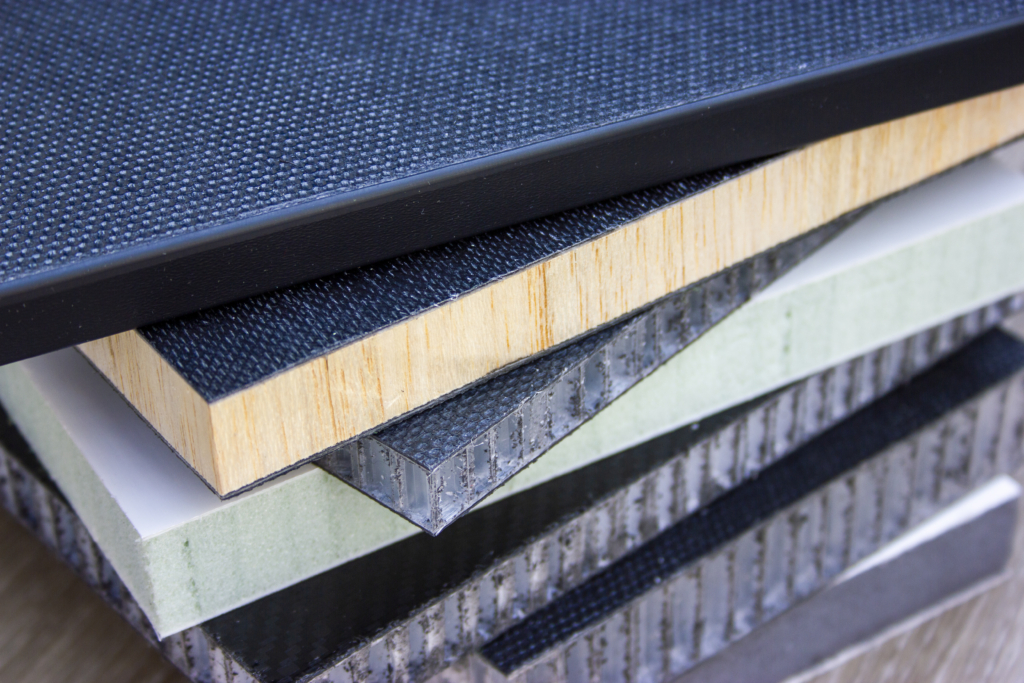
PP foam sandwich panels resist compression through the combined action of the foam core and the fiber-reinforced skins bonded to each face. The core carries the compressive load perpendicular to the panel surface, while the skins prevent buckling and distribute point loads across a wider area. The sections below work through the specific questions engineers and procurement teams ask when evaluating these panels for structural applications.
How is compression strength measured in sandwich panels?
Compression strength in sandwich panels is measured by applying a controlled load perpendicular to the panel face and recording the stress at which the core crushes or the skins buckle. The relevant European standard is EN ISO 844 for rigid cellular plastics, which defines specimen preparation, loading rate, and the calculation of compressive stress at 10% deformation or at yield, whichever comes first.
Testing distinguishes between two failure modes. Core crushing occurs when the foam cell walls collapse under the applied load. Skin wrinkling occurs when the face sheets lose lateral support and buckle inward. A well-designed panel fails by core crushing at a predictable, gradual load rather than by sudden skin delamination, which gives engineers a reliable safety margin to design around.
For sandwich panels used in transport flooring or structural decking, compression testing is often supplemented by flatwise compression tests that simulate point loads from fork tines, pallet feet, or concentrated cargo. These tests use smaller sample areas to replicate real-world load concentrations rather than uniformly distributed pressure.
What compression strength values do PP foam cores typically achieve?
PP foam cores used in structural sandwich panels typically achieve compressive strengths in the range of 0.3 to 1.5 MPa, depending on core density. Higher-density foams deliver higher compressive resistance but add weight. The relationship between density and compressive strength is roughly proportional, so specifying the right density for the application is the primary design lever.
PP honeycomb cores, which differ structurally from closed-cell foam but are often grouped in the same category, can achieve significantly higher compressive strength values because the cell wall geometry concentrates load along the cell edges rather than distributing it through a continuous foam matrix. A 140 kg/m³ PP honeycomb core, for example, delivers compressive performance that supports heavy flooring applications in trailers and truck bodies without requiring a supporting subframe beneath the panel.
It is worth noting that compressive strength alone does not determine whether a panel is suitable for a given application. The ratio of compressive strength to panel weight, the stiffness of the skins, and the bond quality between skin and core all contribute to how the panel performs under real load conditions. Specifications vary by customer and application, so always confirm the requirements of your specific project before selecting a core density.
How do the skins affect the overall compression resistance of a PP foam panel?
The skins in a PP foam sandwich panel do not carry compressive load directly in the through-thickness direction, but they have a significant effect on how the panel resists compression in practice. Stiff, well-bonded skins prevent the core from buckling laterally under load, which raises the effective compressive capacity of the panel system above what the core alone would achieve.
Glass-fiber-reinforced PP skins are particularly effective here. Their high in-plane stiffness constrains the core and distributes concentrated surface loads over a larger core area before the stress reaches the foam or honeycomb cells. This is why a panel with a 66% glass content skin performs better under point loading than a panel with a thinner or lower-fiber-content face sheet, even when the core specification is identical.
Skin thickness and ply count also matter. A 4-ply glass-fiber-PP skin provides more lateral restraint than a 2-ply skin, which raises the load at which the core begins to deform. For flooring applications in trailers or truck bodies, where fork tines and pallet feet create concentrated point loads, the skin specification is often the deciding variable in whether the panel meets the load requirement.
What factors reduce compression strength in PP foam sandwich panels?
Several factors reduce the compressive performance of PP foam sandwich panels in service. Understanding them helps you avoid specifying a panel that meets the datasheet value but underperforms in the field.
- Elevated temperature: PP is a thermoplastic, and its stiffness decreases as temperature rises. Core compressive strength drops at sustained temperatures above 80°C. For applications near heat sources or in direct sun exposure in warm climates, this thermal softening effect needs to be factored into the design.
- Moisture ingress at cut edges: If panel edges are not sealed, moisture can enter the core over time. In PP foam, this degrades the cell wall integrity and reduces compressive resistance, particularly after repeated wet-dry cycles. Proper edge sealing is not optional in transport or outdoor applications.
- Skin delamination: A skin that has partially separated from the core no longer provides lateral restraint. Even partial delamination in a localized area can reduce the effective compressive capacity of that zone significantly. Bond quality during manufacturing is therefore a direct determinant of long-term compressive performance.
- Impact damage: A sharp impact that dents the skin without visibly cracking it can crush the underlying core cells. The panel may look intact but carry less compressive load in the damaged zone. This is particularly relevant for floor panels in cargo environments.
- Incorrect core density selection: Specifying a lower-density core to save weight without checking the compressive load requirement is the most common design error. The weight saving is real, but so is the reduction in compressive capacity.
How does PP foam compression strength compare to metal or wood alternatives?
Steel and aluminum outperform PP foam cores in raw compressive strength per unit area, but this comparison is misleading for most panel applications. The relevant comparison is compressive strength per unit weight, and on that basis, PP foam sandwich panels are competitive with aluminum and significantly better than plywood.
Plywood, which remains common in trailer floors and truck body walls, is heavier than a composite sandwich panel of equivalent compressive capacity and degrades faster in wet conditions. Industry experience with transport flooring consistently shows that composite panels outlast plywood by a factor of three to four in heavy-use environments. Over a 15-year vehicle life, a composite floor eliminates two to three plywood replacement cycles. Once you account for panel cost, installation labor, and vehicle downtime during replacement, the composite option is cheaper per year of service even at a higher unit price.
Steel is rarely used as a direct panel alternative because its weight penalty is severe. A steel floor panel that meets the same load requirement as a PP sandwich panel will add hundreds of kilograms to the vehicle structure. In 2026, that weight penalty has a dual cost: it reduces legally permitted payload capacity and, for electric trucks and vans, it reduces battery range per charge. Every kilogram of structural dead weight reduces range per charge, which is now a standard procurement question from EV fleet buyers. Lighter body structures extend battery range directly, making weight reduction a range argument as much as a payload argument.
When is compression strength the deciding factor in panel selection?
Compression strength becomes the deciding factor when the panel must carry concentrated vertical loads without a supporting subframe beneath it. Floor panels in trailers, truck bodies, and cargo boxes are the clearest examples. When a forklift drives onto a trailer floor, the load is concentrated on two small contact patches. The panel must resist that point load without the core crushing or the skin wrinkling.
For wall panels and roof panels, bending stiffness and tensile strength typically govern the design rather than compressive strength. Compression becomes relevant again in wall panels only when they carry significant vertical loads from stacked cargo or structural connections at the top and bottom edges.
In scaffolding applications, compressive strength is directly tied to load class certification. A 10.5 mm Compoform panel has achieved EN 12811 load class 4 with no support underneath, which is a specific, tested result rather than a general claim. This load class defines the distributed load the board must carry in service, and compressive resistance of the core is one of the properties that determines whether the panel passes.
When evaluating panels for any of these applications, ask for test data specific to the panel construction you are specifying. A compression value from a different skin weight, core density, or panel thickness does not transfer directly to your configuration.
How Compoform Supports Your Compression Strength Requirements
We work with you to match panel construction to your specific load requirements rather than offering a standard range and leaving the selection to you. For compression-critical applications, this means reviewing your load case, identifying the governing failure mode, and recommending the core density and skin specification that meet the requirement at the lowest possible weight.
- Application review: We assess your load case, including point loads, distributed loads, and any dynamic or impact loading relevant to your structural panel application area.
- Panel configuration: We specify core density, skin ply count, and glass content to match the compressive requirement without over-engineering the panel and adding unnecessary weight.
- Self-supporting floor panels: A 30 mm PP sandwich floor panel is self-supporting with no aluminum subframe required. This removes a production step and reduces cost for truck body builders working at volume.
- Edge protection: Edge sealing and edge bending are available to protect the core from moisture ingress, which is relevant for truck floors washed down regularly and for scaffolding boards used outdoors.
- Custom dimensions: Panels are available in custom dimensions cut to your exact specification, including large-format panels up to 13,500 mm × 2,950 mm for applications where standard sheet sizes create unnecessary joints.
For truck body flooring and trailer floor applications, see how these properties translate in practice on our truck body panel application page. If your project involves scaffolding boards or structural decking, contact us to discuss your load requirements and confirm the panel configuration before production begins.
Related Articles
- How much weight can you save by switching from plywood to sandwich panels?
- How do sandwich panels hold up in outdoor and off-road RV use?
- How do sandwich panels reduce the tare weight of a motorhome?
- What is the difference between sandwich panels and conventional composite sheets?
- What is a sandwich panel?