

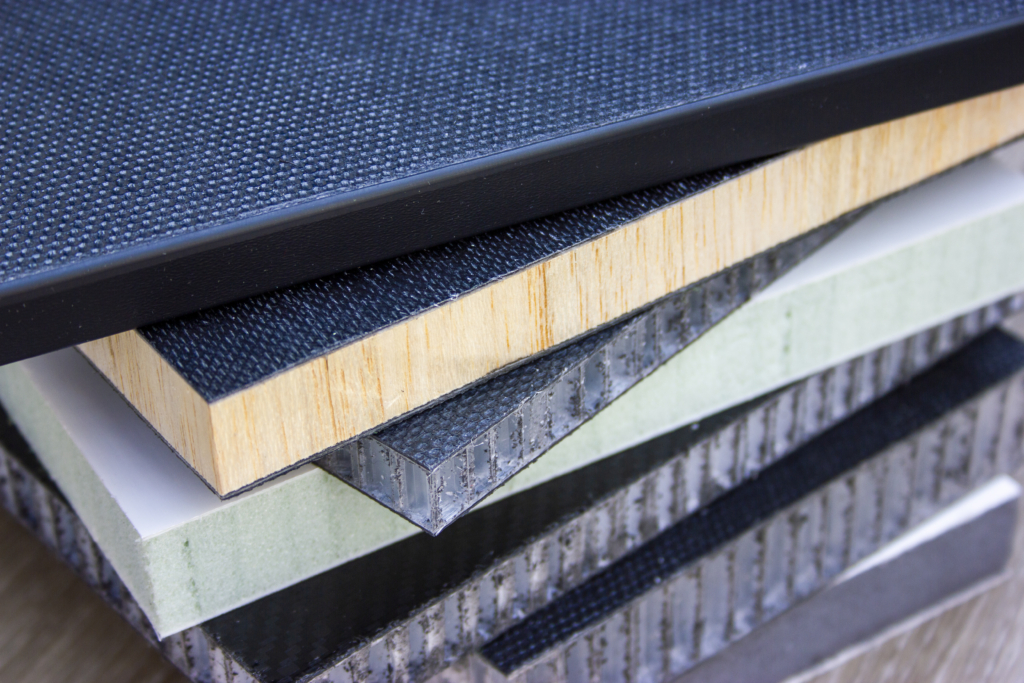
In structural sandwich panels, PP (polypropylene) honeycomb cores are typically used rather than PP foam. The standard density for structural applications is 140 kg/m³, which delivers the stiffness and load-bearing performance that vehicle floors, trailer decks, and scaffolding boards require. The sections below unpack how density affects weight, strength, and material choice across common transport and industrial applications.
What density range does PP foam typically come in?
Polypropylene core materials for sandwich panels span a broad density range, roughly from 30 kg/m³ at the lightweight end up to 200 kg/m³ or higher for heavy-duty structural grades. The right point within that range depends entirely on the mechanical demands of the application — there is no single universal density that suits every use case.
It is worth noting an important distinction here: PP honeycomb and PP foam are two different core architectures, and they behave differently even at the same nominal density. PP honeycomb achieves its stiffness through a geometric tube structure, while PP foam distributes material continuously throughout the core volume. In practice, PP honeycomb at 140 kg/m³ outperforms many foam cores at equivalent density because the honeycomb geometry concentrates material where it contributes most to bending resistance.
For most structural transport applications, cores in the 100 to 200 kg/m³ range are the relevant territory. Below 80 kg/m³, panels typically lack the compressive strength to handle point loads from forklifts, cargo straps, or foot traffic without localized deformation.
Which PP foam density is best for structural sandwich panels?
For structural sandwich panels in transport and industrial applications, a core density of around 140 kg/m³ is the established benchmark. At this density, a PP honeycomb core provides sufficient compressive strength to resist point loads, adequate shear stiffness to prevent core failure under bending, and an areal weight that keeps the finished panel significantly lighter than steel or hardwood alternatives.
This 140 kg/m³ figure is not arbitrary. It reflects the load requirements of real applications: trailer floors that must support loaded pallets, scaffolding boards that carry workers and equipment, and truck body panels that face repeated wash-down cycles and mechanical stress. A lower-density core may save weight on paper but can fail under concentrated loads. A higher-density core adds mass without proportional gains in the properties that matter most for these applications.
The skin specification matters just as much as core density. A 140 kg/m³ PP honeycomb core bonded to a 4-ply glass-fiber-reinforced thermoplastic skin produces a panel with substantially higher bending performance than the same core paired with a thinner or unreinforced skin. Structural performance is always a system result, not a core-only figure.
How does PP foam density affect panel weight and payload?
Higher core density increases panel weight directly, which reduces the payload capacity available to the vehicle or structure. In transport applications, every kilogram of structural dead weight is a kilogram that cannot carry revenue-generating cargo. Choosing the lowest density that still meets the structural specification is therefore a commercial decision, not just an engineering one.
To make this concrete: a truck body floor built from steel or hardwood plywood can easily weigh two to three times as much as an equivalent composite sandwich panel. Over a full vehicle load cycle, that difference in structural weight translates directly into additional payload capacity. For a fleet operator running daily routes at or near the legal gross vehicle weight, that payload gain compounds across thousands of trips.
In 2026, weight reduction carries an additional argument that procurement teams at electric truck and van fleets now raise routinely. Lighter body structures extend battery range in electric trucks and vans. Every kilogram of structural dead weight reduces range per charge, making weight reduction a range argument, not just a payload argument. EV fleet buyers increasingly specify composite panels precisely because the weight saving improves operational range between charges, which directly affects route planning and charging infrastructure costs.
The practical implication is that core density should be selected at the minimum level that satisfies the structural requirement, not defaulted to the highest available grade. Oversizing density adds cost and weight without adding usable performance.
What’s the difference between PP foam and other sandwich panel core materials?
PP honeycomb and PET foam are the two core materials used in thermoplastic structural sandwich panels for commercial vehicles and scaffolding. They differ in geometry, mechanical behaviour, and the applications they suit best.
PP honeycomb uses a tubular cell structure — individual tubes bonded together to form a rigid, lightweight grid. This geometry is highly efficient in bending and compression because material is concentrated at the cell walls rather than distributed uniformly. The result is excellent stiffness-to-weight performance and good resistance to point loads. PP honeycomb at 140 kg/m³ is the standard choice for floor panels in trailers, truck bodies, and scaffolding boards where load-bearing performance is the primary requirement.
PET foam uses a closed-cell structure with continuous material throughout the core volume. This gives it different characteristics: more uniform compressive behaviour, good fatigue resistance, and a surface that bonds well to a range of skin materials. PET foam tends to suit applications where the load is distributed rather than concentrated, or where the panel needs to be formed or shaped during manufacturing.
Both materials are thermoplastic, which means they are recyclable at end of life. This is increasingly relevant for European OEMs subject to the EU End-of-Life Vehicles (ELV) Directive and CSRD sustainability reporting obligations. Thermoset cores — which cannot be remelted and reprocessed — do not offer this compliance advantage.
Does higher PP foam density always mean a stronger panel?
No. Higher core density improves compressive strength and shear stiffness, but overall panel strength depends on the complete sandwich construction — skin material, skin thickness, core thickness, and the bond between them. Increasing core density alone does not guarantee a stronger panel if the skins are undersized for the application.
The sandwich panel principle works because the skins carry bending loads in tension and compression, while the core carries shear and keeps the skins separated. A thicker panel with a lower-density core can outperform a thinner panel with a higher-density core in bending, because the increased separation between skins raises the panel’s second moment of area. This is why a 30 mm panel produces substantially higher maximum loads in absolute terms than a 15 mm panel of the same construction, even though the bending strength in MPa terms is lower due to the geometry of the test span.
The practical takeaway is that density is one variable in a multi-variable system. Specifying a higher-density core to compensate for an undersized skin, or to achieve a thinner panel, often adds unnecessary weight and cost. The correct approach is to define the load requirement first, then optimise the combination of core density, core thickness, and skin specification together.
What PP foam density is used in vehicle and trailer panels?
In commercial vehicle and trailer floor panels, a PP honeycomb core at 140 kg/m³ is the standard density used in production-grade structural panels. This density level supports the compressive and shear loads generated by loaded pallets, forklift entry, and dynamic road loads without adding unnecessary mass to the vehicle structure.
A 30 mm floor panel built on a 140 kg/m³ PP honeycomb core with 4-ply glass-fiber-reinforced thermoplastic skins on both faces achieves an areal weight of approximately 7,600 g/m² — based on Compoform’s own tested panel data. That is a significant weight saving compared to hardwood or steel floor alternatives, and the panel is self-supporting: no aluminium subframe is required beneath it. Removing the subframe eliminates a production step and reduces both material cost and assembly time for truck body builders.
For scaffolding boards, the same 140 kg/m³ core architecture supports EN 12811 load class 4 performance in a 10.5 mm panel with no support underneath — a result verified through Compoform’s own testing. This demonstrates that the density and construction used in vehicle panels translates directly to demanding industrial applications.
Thermoplastic composite floors also outlast plywood alternatives by a significant margin. In heavy transport use, composite panels typically last 12 or more years compared to 3 to 5 years for plywood. Over a 15-year vehicle life, that eliminates two to three replacement cycles. Once you account for panel cost, installation labour, and vehicle downtime during each replacement, the composite floor is cheaper per year of service even at a higher unit price.
How Compoform Helps with Structural Sandwich Panel Specification
We manufacture thermoplastic sandwich panels with PP honeycomb and PET foam cores, produced at our facilities in Beek and Ospel, the Netherlands. Every panel is 100% European-made, and our production line handles panels up to 13,500 mm × 2,950 mm — custom dimensions that most European suppliers cannot match off the shelf.
When you bring us a vehicle floor, trailer deck, or scaffolding board requirement, we do not simply ship panels to a generic specification. We review your design, assess the load case, and recommend the core density, core thickness, and skin configuration that meets your structural requirement at the lowest possible weight. Specifically, we help you:
- Select the right core density for your load case — avoiding both under-specification and unnecessary overweight
- Eliminate subframe components where a self-supporting panel construction makes them redundant
- Confirm compliance with relevant European standards, including EN 12811 for scaffolding and EN 13501-1 for fire classification
- Optimise panel dimensions to your assembly process, reducing cutting waste and fitment time on your production line
- Support integration through the production ramp-up, not just the initial order
For truck body builders and trailer manufacturers evaluating composite floors, the starting point is a review of your current floor specification and load requirements. Bring us your drawings and we will identify where a PP honeycomb sandwich panel can replace your current material, what the weight saving looks like, and how the TCO calculation compares over your vehicle’s service life. Speak to our engineering team to start that conversation.
Related Articles
- What is the difference between a woven and non-woven sandwich panel skin?
- How does the choice of face sheet affect sandwich panel stiffness and weight?
- What are the thermal properties of a PP honeycomb core?
- How do lead times for custom sandwich panels compare to standard sheet materials?
- How thick can a sandwich panel be?