

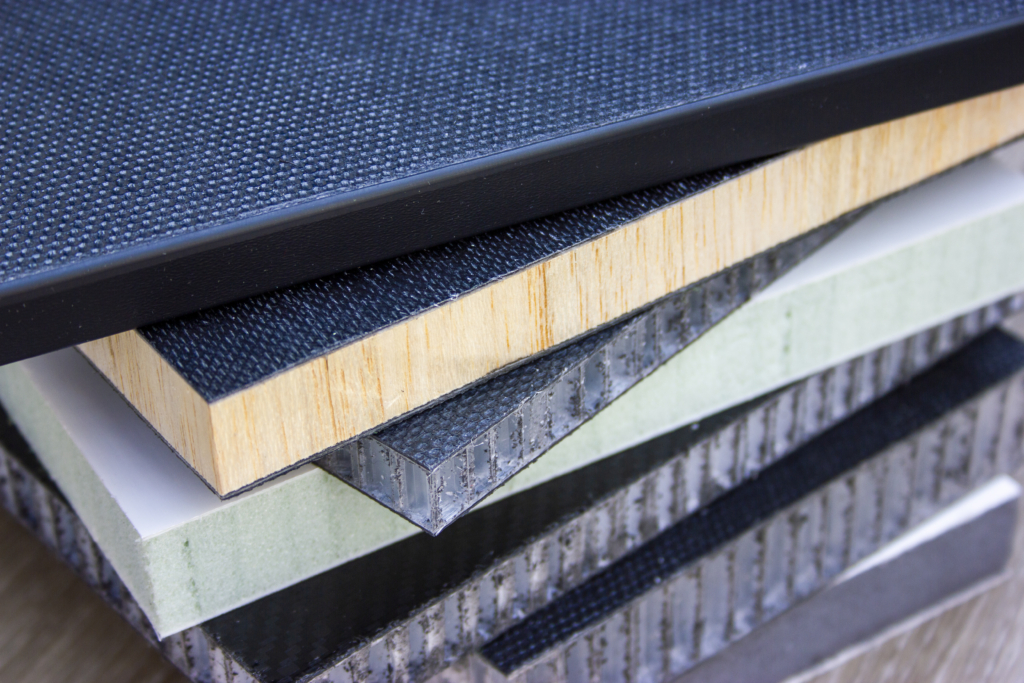
PP foam core and PP honeycomb core are both polypropylene-based sandwich panel materials, but they differ significantly in structure, weight, and mechanical performance. PP honeycomb delivers higher stiffness-to-weight ratios and is the stronger choice for structural floor panels in truck bodies and trailers. PP foam offers more uniform compression resistance and is better suited to applications where insulation or surface consistency matters more than peak structural performance.
For most commercial vehicle and scaffolding applications in 2026, the choice between these two core types comes down to the specific load case, panel thickness, and whether the panel needs to be self-supporting. The sections below work through the most common questions engineers and procurement teams ask when comparing these two materials.
This article covers the broader sandwich panel market. Compoform’s range is limited to PP honeycomb and PET foam cores for commercial vehicles and scaffolding.
What are the structural differences between PP foam and PP honeycomb cores?
PP foam core is a closed-cell expanded polypropylene material with a continuous, isotropic structure throughout its cross-section. PP honeycomb core is a tubular or hexagonal cell structure extruded from polypropylene sheet, creating a highly directional geometry that concentrates material where it resists bending loads most efficiently. The honeycomb’s geometry gives it a much higher stiffness-to-mass ratio than foam at equivalent thickness.
In practical terms, this structural difference shapes how each core behaves under load. A foam core distributes compressive stress evenly across its full cross-section, which makes it predictable and forgiving under point loads. A honeycomb core resists bending more efficiently because its cell walls act like vertical columns between the two face skins, keeping the skins separated and working in tension and compression rather than shear.
For floor panels in truck bodies and trailers, this distinction matters directly. A honeycomb-cored floor panel at 30 mm thickness can achieve average maximum loads exceeding 5,600 N in three-point bending tests conducted to ISO 14125, based on Compoform’s own testing data. That level of structural performance is difficult to match with a foam core at the same panel weight.
Foam cores also tend to have lower flexural modulus values than honeycomb at the same density, meaning they deflect more under equivalent loads. For applications where deflection under dynamic load is a failure mode, such as a trailer floor under forklift traffic, honeycomb is structurally the more appropriate choice.
Which core material is lighter – PP foam or PP honeycomb?
At equivalent densities, PP honeycomb and PP foam are broadly comparable in mass per unit volume. However, PP honeycomb achieves its structural performance at lower densities than foam, meaning a honeycomb-cored panel can be lighter than a foam-cored panel of equivalent stiffness. In practice, PP honeycomb cores used in commercial vehicle floor panels typically run at densities around 140 kg/m³, while delivering structural performance that a foam core would need higher density to match.
The more useful comparison is not density alone but areal weight – the mass of the complete panel per square metre. A 15 mm floor panel with a 140 kg/m³ PP honeycomb core and 4-ply glass-fibre-reinforced thermoplastic skins on both faces has an areal weight of approximately 5,550 g/m², based on Compoform’s own panel testing. That is a meaningful figure for truck body builders calculating gross vehicle weight and payload capacity.
For EV fleet operators and the truck body builders supplying them, this distinction has become a procurement-level question in 2026. Lighter body structures extend battery range in electric trucks and vans. Every kilogram of structural dead weight reduces range per charge, which means weight reduction is a range argument as much as a payload argument. Procurement teams specifying panels for electric truck bodies increasingly ask for areal weight data alongside structural performance data, not as a secondary consideration but as a primary one.
How does impact resistance compare between PP foam and PP honeycomb?
PP honeycomb generally delivers higher impact resistance than PP foam at equivalent panel weight, particularly when the face skins are continuous-fibre-reinforced thermoplastic. The cell wall geometry of honeycomb absorbs and distributes impact energy through the cell structure before it reaches the opposite skin, while foam cores absorb impact through compression of the closed-cell matrix, which can result in permanent deformation at lower energy levels.
The face skin specification plays a significant role here. In a well-engineered sandwich panel, the skin carries most of the impact load before the core is engaged. Continuous-fibre-reinforced thermoplastic skins bonded to a PP honeycomb core produce a panel that resists both puncture and delamination under repeated impact, which is relevant for trailer floors subject to pallet drops and forklift tine contact.
Foam cores are not without impact resistance, and in some configurations they perform well under distributed loads. But under concentrated point impacts, the isotropic structure of foam means there is no geometric mechanism to redirect load laterally the way honeycomb cell walls do. For scaffolding boards and truck body floors where dropped tools, equipment, and concentrated foot traffic are routine, honeycomb-cored panels tend to show less surface damage over time.
When should you choose PP foam over PP honeycomb in a sandwich panel?
PP foam core is the better choice when the application requires uniform compression resistance across the panel surface, consistent machinability, or thermal insulation performance. Foam cores machine cleanly in all directions without the cell-wall voids that honeycomb creates at cut edges, making them easier to work with when panels require extensive routing, drilling, or edge detailing.
Foam also performs more consistently under distributed compressive loads where the load footprint is small relative to the cell size of a honeycomb. In some thin-panel applications, the cell geometry of honeycomb can create local stress concentrations at cell walls under point loads, while foam distributes the same load more evenly.
From a thermal performance standpoint, closed-cell PP foam provides measurable insulation value that honeycomb does not. Honeycomb cores are largely air-filled, which gives them low thermal mass but not meaningful insulation resistance. If a panel needs to contribute to temperature management inside a cargo body, foam core is the more appropriate starting point.
For scaffolding boards and access equipment where surface consistency and predictable load distribution matter more than peak bending stiffness, foam-cored panels can be a practical choice. That said, the specific load class required by EN 12811 should always drive the core selection decision, not material preference alone.
What are the cost differences between PP foam and PP honeycomb cores?
PP honeycomb core is generally more expensive to produce than PP foam core at equivalent panel dimensions, because the extrusion and cell-forming process for honeycomb is more complex than foam expansion. However, the cost comparison that matters for truck body builders and trailer manufacturers is not core material cost in isolation but total cost of ownership across the panel’s service life.
A honeycomb-cored floor panel that is self-supporting eliminates the need for an aluminium subframe beneath it. That removes a production step, reduces assembly labour, and cuts the weight of the substructure. Over a 15-year vehicle life, a composite floor panel also eliminates two to three plywood replacement cycles. When you add panel cost, installation labour, and vehicle downtime for each replacement, the composite panel is cheaper per year of service even at a higher unit price.
Foam-cored panels may carry a lower initial cost per square metre, but if the application requires additional structural support to compensate for lower stiffness, the system cost can quickly exceed that of a honeycomb panel that performs the same function without supplementary structure. The right cost comparison is always system cost, not panel cost.
Can PP foam and PP honeycomb cores be used in the same sandwich panel construction?
Yes, hybrid core constructions that combine PP foam and PP honeycomb within a single panel are technically feasible. In practice, this approach is used when different zones of a panel face different load conditions. A floor panel might use honeycomb in the central span where bending loads are highest and foam at the edges where machinability and edge sealing are priorities.
Hybrid constructions add complexity to the manufacturing process and require careful attention to the bond interface between the two core materials and the face skins. The skin must bond consistently to both core types, and any difference in thermal expansion between foam and honeycomb zones needs to be accounted for in the panel design, particularly for panels exposed to wide temperature ranges in outdoor transport applications.
For most commercial vehicle and scaffolding applications, a single core type selected to match the dominant load case is simpler, more consistent, and easier to quality-control in production. Hybrid cores are worth considering when a specific design requirement cannot be met by either material alone, but they should be treated as an engineered solution to a defined problem rather than a default configuration.
How Compoform Helps You Choose the Right Core
We manufacture sandwich panels with PP honeycomb and PET foam cores for commercial vehicle and scaffolding applications. When you bring us a panel specification, we review the load case, the assembly process, and the service environment before recommending a core type and construction. That means you get a panel configuration matched to your actual application, not a standard product pushed into a role it was not designed for.
- Structural review: We assess your floor load requirements, span conditions, and whether the panel needs to be self-supporting, then select the core density and skin specification accordingly.
- Weight optimisation: For truck body and trailer applications, we calculate areal weight against your payload and range targets, including EV range implications where relevant.
- Custom dimensions: Panels are available in custom dimensions cut to your exact specification, including large-format panels up to 13,500 mm × 2,950 mm produced on our semi-automatic line in the Netherlands.
- Edge protection: Edge sealing and edge bending are available to protect the core from moisture and UV exposure, which is relevant for both scaffolding boards and truck floors washed down regularly.
- Testing data: We provide panel test data referenced to European standards, including ISO 14125 for flexural performance and EN 12811 for scaffolding load classes, so your engineering team has the documentation needed for compliance sign-off.
We work as an application partner through the integration process, not just at the point of sale. If you are evaluating PP honeycomb against PET foam for a specific truck body or scaffolding application, speak with our engineering team about your design requirements and we will review the configuration with you before production begins.
Related Articles
- What is the difference between a woven and non-woven sandwich panel skin?
- What makes thermoplastic sandwich panels 100% recyclable?
- How do sandwich panel bridge decks compare to steel and concrete?
- How do sandwich panels perform in high-humidity or coastal environments?
- How do sandwich panels perform under impact?