

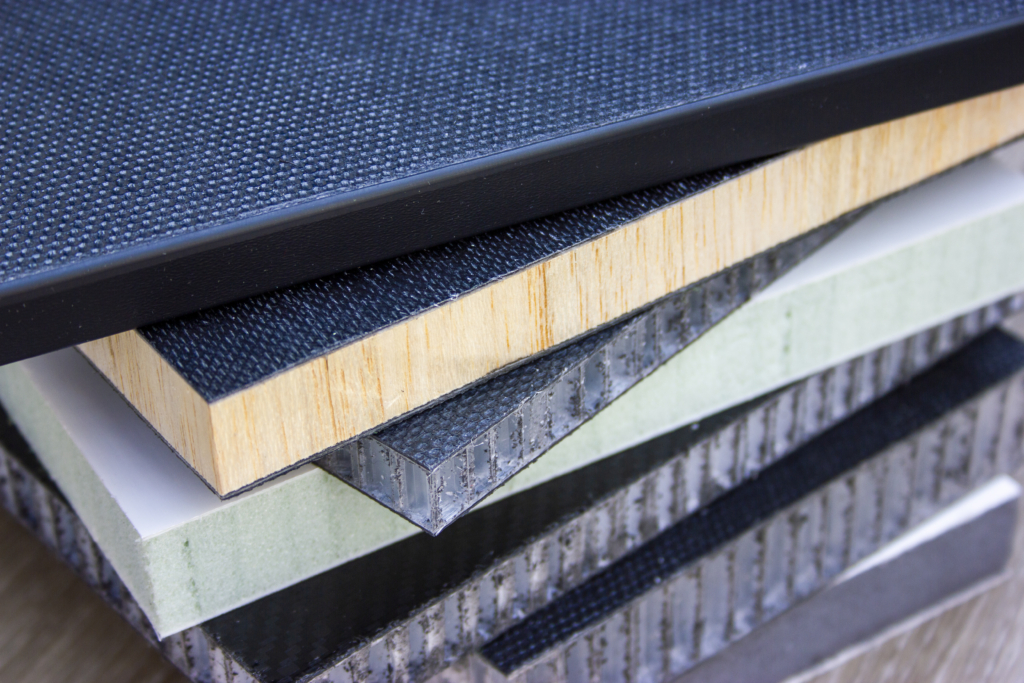
A lightweight sandwich panel reduces vehicle emissions over time by cutting the structural dead weight that engines and drivetrains must move on every journey. Less mass means less energy consumed per kilometre, and that relationship holds whether the vehicle runs on diesel or electricity. For fleet operators and truck body builders, the emission benefit compounds across hundreds of thousands of kilometres and the full operational life of the vehicle.
The questions below unpack the mechanics behind that benefit, from how much weight composite panels actually save to when the production footprint of the panel itself is offset by the emissions avoided in service.
This article covers the broader sandwich panel market. Compoform’s range is limited to PP honeycomb and PET foam cores for commercial vehicles and scaffolding.
How much weight does a sandwich panel actually save compared to steel or wood?
A thermoplastic sandwich panel typically weighs between 60% and 80% less than a steel panel of equivalent structural performance, and between 40% and 60% less than a comparable plywood panel, depending on the core material, skin architecture, and thickness specified. For a full truck body or trailer, that difference can translate to several hundred kilograms of structural weight removed from the vehicle.
To make this concrete: a glass-fibre-reinforced thermoplastic wall panel with a PP foam core can deliver the stiffness and impact resistance needed for a truck body sidewall at a fraction of the mass of a steel equivalent. The sandwich construction achieves this through structural geometry rather than material density. Stiff face skins carry tensile and compressive loads, while a lightweight core holds them apart and resists shear, producing a panel that is disproportionately stiff relative to its weight.
For floor panels, where load demands are higher, PP honeycomb cores deliver substantially greater bending and compressive performance than foam cores at similar thicknesses. The weight saving over steel is smaller in absolute terms for floor panels, but it remains significant across the full floor area of a trailer or truck body.
The practical implication for vehicle manufacturers is straightforward: every panel that replaces steel or plywood removes dead weight that was never generating revenue or range. That weight can be reallocated to payload, or it can reduce the energy the vehicle consumes on every trip.
How does reducing vehicle weight lead to lower fuel consumption?
Reducing vehicle weight lowers fuel consumption because the engine must do less work to accelerate, maintain speed, and overcome rolling resistance on every journey. The relationship between mass and energy demand is direct: a lighter vehicle requires less force to move, and that reduction in force demand translates into lower fuel burn per kilometre across the vehicle’s operational life.
In practical terms, industry experience in commercial transport consistently shows that reducing a truck’s gross vehicle weight produces measurable fuel savings over time. The exact figure depends on vehicle type, duty cycle, and route profile, but the directional relationship is well established in transport engineering. Stop-start urban routes amplify the benefit because acceleration events are frequent, and each one demands energy proportional to the mass being moved.
The diesel case
For diesel-powered trucks and trailers, weight reduction directly reduces the volume of fuel burned per kilometre. Over a vehicle life of ten to fifteen years and hundreds of thousands of kilometres, even a modest reduction in fuel consumption per trip accumulates into a substantial total. Lower fuel burn means lower CO2, NOx, and particulate emissions across the fleet.
The electric vehicle case
For electric trucks and vans, the argument shifts from fuel consumption to battery range. Lighter body structures extend the distance a vehicle can travel on a single charge. Every kilogram of structural dead weight reduces range per charge, and in 2026 this is a standard procurement question from EV fleet buyers evaluating truck body panel applications for commercial vehicles. Weight reduction is no longer just a payload argument for electric fleets. It is a range argument, and range directly determines operational viability on longer routes without intermediate charging. Truck body builders who can demonstrate a lighter body structure are answering a question that EV fleet operators are actively asking.
What is the cumulative CO2 impact of switching to composite panels over a vehicle’s lifetime?
The cumulative CO2 impact of switching to composite sandwich panels over a vehicle’s lifetime is significant because the emission reduction on each journey compounds across the entire operational period. A vehicle that burns less fuel or consumes less battery energy on every trip accumulates that saving across hundreds of thousands of kilometres before it is retired or replaced.
The total impact depends on three variables: the weight saved by switching from steel or wood to composite panels, the vehicle’s annual mileage, and the energy source. A heavier duty cycle with higher annual mileage amplifies the benefit. An electric powertrain converts the weight saving into extended range rather than reduced fuel burn, but the underlying physics is the same.
What makes the lifetime calculation particularly relevant for commercial vehicle operators is that trucks and trailers are long-lived assets. A trailer body may remain in service for fifteen years or more. The emission benefit of a lighter body structure is not a one-time gain at the point of manufacture. It recurs on every loaded and unloaded trip for the full operational life of the vehicle. Fleet operators with sustainability reporting obligations under the EU’s Corporate Sustainability Reporting Directive (CSRD) have a direct interest in quantifying and documenting this kind of operational emission reduction.
Do sandwich panels maintain structural integrity without adding weight back?
Yes. Thermoplastic sandwich panels maintain full structural integrity without requiring additional reinforcement that would add weight back into the structure. The sandwich construction itself provides the structural performance: stiff glass-fibre-reinforced skins carry the primary loads, and the core holds the skins apart to maximise the panel’s second moment of area, producing high bending stiffness at low mass.
A 30mm PP sandwich panel floor, for example, is self-supporting across typical truck body floor spans with no aluminium subframe required. Removing the subframe eliminates a production step for the truck body builder and removes additional weight from the vehicle. The panel achieves this because the combination of skin stiffness and core geometry distributes loads efficiently without needing a secondary structural frame beneath it.
For wall panels, the cross-ply skin architecture equalises mechanical properties in both directions, meaning the panel performs consistently regardless of installation orientation. This matters for body builders who need predictable structural behaviour across different panel positions in the same build.
Thermoplastic panels also resist moisture, UV exposure, and the repeated wash-down cycles that commercial vehicle floors and walls experience in service. Edge sealing and edge bending protect the core from ingress, which is relevant for any panel exposed to water regularly. This durability means the structural performance is maintained over the vehicle’s life, not just at the point of installation.
How do composite panels compare to aluminium for emission reduction in vehicles?
Thermoplastic composite sandwich panels and aluminium panels both reduce vehicle weight compared to steel, but they do so through different mechanisms and with different trade-offs. Composite sandwich panels typically achieve greater weight reduction per unit of structural performance than aluminium sheet, particularly in bending-dominated applications like truck body walls and floors, because the sandwich geometry amplifies stiffness without adding mass.
Aluminium is denser than the thermoplastic materials used in composite sandwich panels. A glass-fibre-reinforced thermoplastic skin bonded to a PP honeycomb or PP foam core produces a panel that is lighter than an aluminium panel of equivalent stiffness in most commercial vehicle applications. The weight advantage of composite over aluminium translates into a greater reduction in fuel consumption or battery energy demand per kilometre, and therefore a greater cumulative emission reduction over the vehicle’s life.
There is also a recyclability dimension relevant to European manufacturers. Thermoplastic composite panels are recyclable and align with the requirements of the EU End-of-Life Vehicles (ELV) Directive, which is a compliance requirement for many European OEMs, not simply a preference. Aluminium is also recyclable, but the energy intensity of aluminium production and reprocessing is substantially higher than for thermoplastic materials, which affects the full lifecycle emission picture.
The practical comparison for a truck body builder is that composite sandwich panels offer a lighter structure, comparable or superior durability in transport environments, and a recyclability profile that supports ELV compliance, alongside the emission reduction benefits that come from the lower operational weight.
When does the emission benefit of lightweight panels outweigh the production footprint?
The emission benefit of lightweight composite panels outweighs the production footprint relatively early in the vehicle’s operational life, typically within the first years of service, because the energy saved on every trip accumulates quickly against the one-time manufacturing impact. The exact crossover point depends on the vehicle’s duty cycle, annual mileage, and energy source, but the directional answer is consistent: high-mileage commercial vehicles recover the production footprint faster than low-mileage ones.
Thermoplastic sandwich panels have an additional advantage in this calculation compared to thermoset composites: they are recyclable at end of life. Thermoset materials cannot be remelted and reprocessed, which means their production energy is effectively a sunk cost. Thermoplastic panels can be recovered and reprocessed, which reduces the net lifecycle footprint and improves the overall emission balance.
Durability also affects this calculation in a way that is often underestimated. Thermoplastic composite panels last substantially longer than plywood in heavy transport applications. Industry experience indicates a service life of twelve years or more for composite floors, compared to three to five years for plywood. Over a fifteen-year vehicle life, a plywood floor requires two to three replacement cycles, each of which carries its own production footprint, installation labour, and vehicle downtime. A composite panel that lasts the life of the vehicle eliminates those replacement cycles entirely, improving the lifetime emission balance further.
For fleet operators and body builders doing lifecycle assessments, the relevant comparison is not composite panel production versus nothing. It is composite panel production versus the repeated production, transport, and installation of the wood or steel panels it replaces over the vehicle’s full operational life.
How Compoform Helps You Reduce Vehicle Emissions Through Panel Specification
We work with truck body builders, trailer manufacturers, and fleet operators to specify the right panel configuration for their application, not the heaviest panel that will pass a load test. That distinction matters for emission reduction because over-specified panels carry unnecessary weight, and under-specified panels fail prematurely and require replacement. Both outcomes increase the lifetime emission footprint of the vehicle.
Here is what that looks like in practice when you work with us:
- Panel configuration review: We review your body design and load requirements to identify where weight can be reduced without compromising structural performance. For floor panels, this means selecting the right core density and skin architecture for your specific floor span and load class. For wall panels, it means confirming that a lighter foam-core panel meets your sidewall requirements before specifying a heavier honeycomb alternative.
- Self-supporting floor panels: Our 30mm PP sandwich floor panels are self-supporting across standard truck body floor spans, removing the need for an aluminium subframe. This reduces both the vehicle’s structural weight and the body builder’s production complexity in a single specification decision.
- Lifetime durability: Our thermoplastic panels are designed for twelve or more years of service in commercial transport environments, including regular wash-down, UV exposure, and heavy floor loading. Over a fifteen-year vehicle life, eliminating two to three plywood replacement cycles reduces both the total cost of ownership and the cumulative production footprint of the floor.
- EV fleet compatibility: For customers building bodies for electric trucks and vans, we can help you quantify the weight saving relative to your current steel or wood specification and translate that into a range benefit for your end customer’s fleet operators.
- Custom dimensions: Panels are available in custom dimensions cut to your exact specification, up to 13,500mm × 2,950mm, so you are not adding joints or offcuts that compromise structural performance or add unnecessary weight.
If you are specifying panels for a truck body or trailer and want to understand how a lighter panel configuration affects your vehicle’s operational emission profile, speak with our application engineers. We will review your design, confirm the right panel specification for your load requirements, and flag any integration considerations before production starts.
Related Articles
- What is the carbon footprint of producing a sandwich panel?
- How do OEM manufacturers specify sandwich panels across different vehicle types?
- How do sandwich panels increase payload capacity in trailers?
- How do sandwich panel truck floors compare to aluminium floors?
- What is the maximum size of a sandwich panel?