

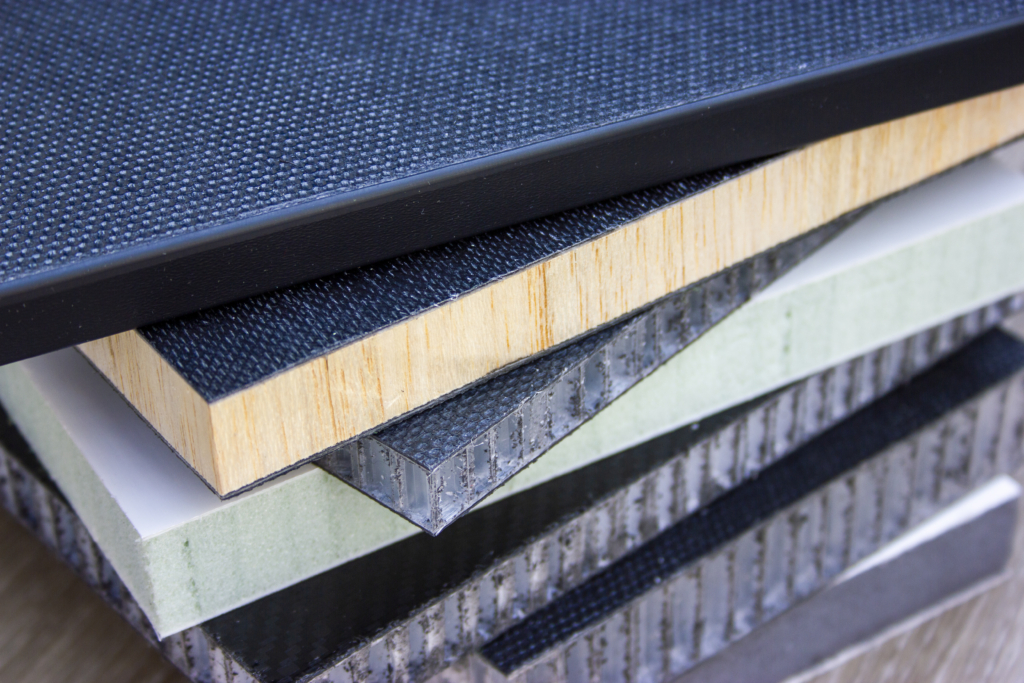
Sandwich panels reduce CO2 emissions across their full lifecycle primarily through weight reduction during operation and through the recyclability of thermoplastic materials at end of life. A lighter panel means less fuel burned every kilometer a vehicle travels, and over a service life of 12 or more years, those savings accumulate into a substantial carbon reduction compared to steel or wood alternatives. The questions below unpack each stage of that lifecycle in detail.
How much CO2 do sandwich panels save compared to steel and wood?
Thermoplastic sandwich panels are significantly lighter than steel and meaningfully lighter than plywood, and that weight difference translates directly into lower fuel consumption and lower CO2 output over a vehicle’s operating life. The exact saving depends on panel specification, vehicle type, and annual mileage, but the direction of the comparison is consistent: a lighter structure means lower emissions per kilometer driven.
Steel body panels on a truck or trailer add structural dead weight that the engine must move on every journey, loaded or empty. Replacing steel sidewalls or floor panels with glass-fibre-reinforced thermoplastic sandwich panels removes a meaningful portion of that dead weight. Plywood is lighter than steel but absorbs moisture over time, increasing its effective weight in service and requiring replacement every three to five years. Each replacement cycle carries its own embedded carbon cost in material production, transport, and installation.
Thermoplastic sandwich panels, by contrast, last 12 or more years in heavy transport applications based on Compoform’s own service experience. Over a 15-year vehicle life, that longevity eliminates two to three plywood replacement cycles. When you account for the carbon embedded in producing and installing those replacement panels, the composite alternative carries a substantially lower total lifecycle carbon burden, even if its upfront manufacturing footprint is higher than plywood.
Why does panel weight affect vehicle emissions so directly?
Every kilogram of structural weight a vehicle carries requires fuel or electrical energy to move, on every journey, for the entire service life of that vehicle. In road freight, the relationship between vehicle mass and fuel consumption is well established: reducing structural dead weight lowers the energy demand of each trip, and that reduction compounds across hundreds of thousands of kilometers over a vehicle’s life.
For diesel-powered trucks and trailers, the fuel saving from a lighter body structure translates into a proportional reduction in CO2 emissions at the tailpipe. For electric trucks and vans, the relationship is equally direct but carries an additional dimension. Lighter body structures extend battery range per charge, because the drivetrain is moving less mass. In 2026, this is a standard procurement question from EV fleet buyers: every kilogram of structural dead weight reduces range per charge, making weight reduction a range argument, not just a payload argument. Fleet operators specifying electric vehicles are actively seeking body builders who can demonstrate structural weight savings, because those savings directly affect the operational viability of the vehicle.
A sandwich panel achieves its strength-to-weight ratio through its structural architecture: stiff, fibre-reinforced skins bonded to a lightweight core, whether PP foam or PP honeycomb. The core resists shear forces while the skins carry bending loads, delivering the structural performance of a much heavier solid panel at a fraction of the mass. That efficiency is what makes the weight saving possible without compromising load-bearing capacity.
What happens to sandwich panels at end of life?
Thermoplastic sandwich panels have a clear end-of-life advantage over thermoset composites and over treated wood: the thermoplastic matrix can be remelted and reprocessed. This makes thermoplastic panels recyclable in principle, and under the EU End-of-Life Vehicles (ELV) Directive, recyclability is a compliance requirement for many European OEMs, not simply a preference.
The practical recyclability of a thermoplastic composite panel depends on how it is constructed. Panels built entirely from thermoplastic materials, including PP or PET skins and PP foam or PP honeycomb cores, can be mechanically recycled by shredding and remelting. The resulting material may be used in lower-grade applications, but the material does re-enter the production chain rather than going to landfill.
Plywood, particularly treated plywood used in truck floors and trailer decking, presents a more difficult end-of-life picture. Treated wood is classified as hazardous waste in many European jurisdictions, restricting disposal options and adding cost. Thermoset composites, which use resins that cure irreversibly, cannot be remelted and are difficult to recycle mechanically. Thermoplastic panels avoid both of these problems, which is why European OEM procurement teams increasingly ask for material declarations that confirm thermoplastic construction as part of their CSRD sustainability reporting obligations.
How does a lifecycle assessment (LCA) measure panel emissions?
A lifecycle assessment (LCA) measures the total CO2 and greenhouse gas emissions associated with a product across every stage of its life: raw material extraction, manufacturing, transport, use in service, and end-of-life processing. For sandwich panels, the LCA framework captures both the carbon embedded in producing the panel and the carbon saved or generated during its operational life.
Production phase emissions
The production phase covers the energy and materials used to manufacture the panel, including fibre production, resin or polymer processing, and the lamination process itself. Thermoplastic composites generally require less energy to process than thermoset alternatives because they do not require a curing oven cycle. Manufacturing location also matters: panels produced in Europe under ISO-certified quality systems, using European energy grids, carry a different carbon profile than panels shipped from distant manufacturing regions, where longer transport distances add freight emissions before the panel even reaches the customer.
Use phase emissions
The use phase is typically where the largest carbon differences emerge between panel types. A lighter panel fitted to a vehicle reduces fuel or energy consumption on every journey for the entire service life of that vehicle. Over 12 or more years of operation, those per-trip savings accumulate into a carbon reduction that dwarfs the differences in manufacturing footprint between panel types. LCA methodology captures this by modelling annual mileage, load cycles, and fuel or energy consumption against the weight saving delivered by the panel.
Do thermoplastic panels have a lower carbon footprint than thermoset composites?
Thermoplastic sandwich panels generally carry a lower full-lifecycle carbon footprint than thermoset composites, primarily because of processing energy differences during manufacture and recyclability advantages at end of life. The comparison is not straightforward at the production stage alone, but across a full lifecycle the thermoplastic option performs better on most carbon metrics.
During manufacturing, thermoset composites require a curing process that locks the resin into a permanent cross-linked structure. This typically involves elevated temperatures sustained over a curing cycle, adding energy demand. Thermoplastic composites are processed by heating, forming, and cooling, without a separate cure stage. The energy profile of thermoplastic processing is generally more efficient, particularly in continuous production lines of the kind used for large-format panels.
At end of life, the difference becomes more pronounced. Thermoset composites cannot be remelted. Recycling options are limited to mechanical grinding for use as filler material, or energy recovery through incineration. Neither route recovers the material value of the composite. Thermoplastic panels, built from PP or PET matrix systems, can be remelted and reprocessed, keeping the material in productive use and reducing the carbon cost of disposal. For European manufacturers subject to CSRD reporting and ELV Directive compliance, this recyclability distinction is increasingly relevant to procurement decisions.
Which industries benefit most from sandwich panel CO2 reductions?
Commercial vehicle manufacturing and scaffolding are the sectors where sandwich panel weight savings translate most directly into measurable CO2 reductions. These are high-utilisation applications across truck body and scaffolding industries where vehicles or structures operate intensively over long service lives, amplifying the per-kilogram carbon benefit of switching from heavier materials.
In truck body building and trailer manufacturing, a lighter body structure reduces fuel consumption on every loaded and empty trip. For a trailer operating at high annual mileage across a 15-year service life, the cumulative fuel saving from a composite body is substantial. As electric trucks enter European fleets in growing numbers, the same weight saving extends battery range per charge, making composite body panels relevant to both the carbon argument and the operational economics of EV fleet management.
In scaffolding, the carbon benefit works differently. Scaffold boards and platforms are handled, transported, and repositioned repeatedly across their service life. Lighter boards reduce the physical load on workers and lower the transport emissions associated with moving scaffolding equipment between sites. A 10.5mm Compoform panel achieves EN 12811 load class 4 with no support underneath, delivering the structural performance required for scaffolding applications at a weight that plywood boards cannot match at equivalent load capacity.
Cargo box manufacturers, horse van builders, and caravan producers also benefit from composite panel weight savings, though the carbon arithmetic is most compelling in high-mileage commercial vehicle applications where the use phase dominates the lifecycle carbon balance.
How Compoform Supports Your CO2 Reduction Goals
We work with truck body builders, trailer manufacturers, and scaffolding companies across Europe to specify and supply thermoplastic sandwich panels that reduce structural weight without compromising load performance. Our panels use PP honeycomb or PET foam cores with glass-fibre-reinforced thermoplastic skins, and every configuration is engineered for the specific demands of commercial vehicle and scaffolding applications.
Here is what that looks like in practice:
- Self-supporting floor panels: A 30mm PP sandwich panel floor is self-supporting, removing the need for an aluminium subframe and eliminating a production step for truck body builders.
- Extended service life: Our panels last 12 or more years in heavy transport based on our own service data, eliminating two to three plywood replacement cycles over a vehicle’s life and reducing both cost and lifecycle carbon.
- Edge protection: Edge sealing and edge bending protect the core from UV exposure and moisture ingress, which is relevant for truck floors washed down regularly and scaffold boards exposed to weather.
- Custom dimensions: Panels are available in custom dimensions cut to your exact specification, up to 13,500mm x 2,950mm, so you are not adapting your design to standard sheet sizes.
- Thermoplastic recyclability: Our panels are built entirely from thermoplastic materials, supporting your compliance with the EU ELV Directive and your CSRD sustainability reporting obligations.
Before we produce a single panel, we review your design, assess the load requirements for your application, and confirm the right panel configuration for your assembly process. If there are integration issues or optimisation opportunities, we flag them before production, not after delivery. See how these properties translate in truck body applications, or contact our engineering team about your project.
Related Articles
- What load ratings should a truck floor sandwich panel meet?
- How are sandwich panels used in raised access flooring systems?
- How are sandwich panels edged and finished?
- How to calculate the true lifetime cost of your panel materials?
- Why are European manufacturers switching to composite sandwich panels in 2026?