

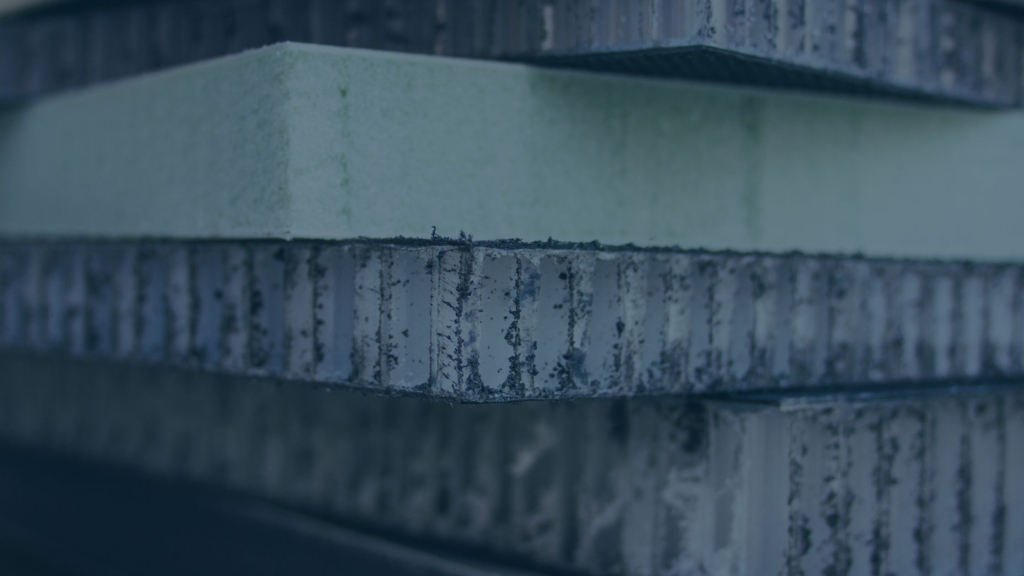
Sandwich panel edges are finished using a combination of edge sealing, edge banding, profiled trims, and protective capping; the right method depends on the panel’s core material, the application environment, and how the panel connects to surrounding structure. For thermoplastic composite panels used in commercial vehicle and scaffolding applications, edge finishing is a functional requirement, not just an aesthetic one. The sections below address the most common questions buyers and builders ask about sandwich panel edge treatment.
What types of edge finishes are used on sandwich panels?
Sandwich panel edges are finished using four main methods: sealed edges (filled or coated to close the core), edge banding (a strip of material bonded along the perimeter), profiled aluminium or thermoplastic trims (mechanical profiles that cap or frame the edge), and folded or bent skins (where the face skin wraps around the edge during manufacture). The choice depends on the core type, the exposure conditions, and the connection method used in assembly.
For open-cell or porous cores, sealing the edge is the first priority; moisture and contaminants can migrate into the core if the cut face is left exposed. For honeycomb cores, the open tube geometry at the cut edge creates a direct path for water ingress, making edge protection particularly important in wash-down environments like truck bodies or scaffolding boards used outdoors.
Edge banding uses a strip of compatible material, often the same thermoplastic as the skin, bonded along the perimeter. This creates a clean, closed surface that resists impact and moisture. Profiled trims, typically aluminium or thermoplastic extrusions, serve a dual purpose: they protect the edge and provide a mechanical connection point for joining panels to frames, floors, or adjacent panels. In high-traffic applications such as vehicle floors, corner trims also absorb impact that would otherwise delaminate the skin at the edge.
Why does edge sealing matter for composite panel performance?
Edge sealing matters because an unsealed sandwich panel edge is the most vulnerable point in the entire panel system. Moisture entering through a cut edge can degrade the bond between skin and core, reduce structural performance over time, and, in freeze-thaw environments, cause progressive internal damage. For panels used in applications that involve regular washing, outdoor exposure, or chemical contact, an unsealed edge is a direct path to premature failure.
In commercial vehicle applications, truck floors and trailer walls are routinely pressure-washed. Any unsealed edge becomes a water entry point that works against the panel from the inside. Over months of use, this weakens the skin-to-core bond along the panel perimeter, exactly where fasteners and load transfer points are concentrated.
For scaffolding boards, the situation is similar. Boards are stored outdoors, exposed to rain and frost, and handled roughly at the edges. Edge sealing and edge bending protect the core from UV and moisture, a practical requirement for any scaffolding panel that needs to maintain its structural rating across multiple seasons of use. A panel that passes EN 12811 load class requirements when new must continue to perform after repeated exposure cycles, and edge protection is part of how that durability is maintained.
How are thermoplastic sandwich panel edges finished differently from thermoset panels?
Thermoplastic sandwich panel edges can be heat-formed, welded, and re-bonded using thermal processes; thermoset panels cannot. This means thermoplastic panels support edge finishing methods that are faster, cleaner, and more reversible than the adhesive-only or mechanical approaches required for thermoset composites. The core thermoplastic material can also be re-melted locally to create a fused, sealed edge without additional sealant compounds.
With thermoset panels, such as those using glass-fibre reinforced polyester skins, edge finishing relies on adhesive bonding, mechanical capping, or applied sealants, because the cured material cannot be re-processed with heat. This limits the options and adds process steps. Adhesive bonds at edges can also be a weak point if the adhesive is not compatible with the operating environment.
Thermoplastic skins, by contrast, can be locally heated and folded or pressed to wrap around the core edge during or after manufacture. This creates a monolithic edge without a separate bonded component. For glass-fibre reinforced polypropylene panels, this approach produces an edge that is mechanically continuous with the skin, no bond line to fail, no separate material to delaminate. It is a meaningful advantage in applications where edge durability is a service life factor, not just a cosmetic concern.
What edge profiles and trims are compatible with sandwich panels?
The most common edge profiles compatible with sandwich panels are U-channel trims, L-angle corner profiles, T-section joining profiles, and flat edge banding strips. These are available in aluminium, thermoplastic extrusions, and rubber or EPDM for applications requiring flexibility or vibration damping. The profile geometry must match the panel thickness precisely; a loose-fitting trim creates movement at the edge that accelerates wear.
U-channel and L-angle profiles
U-channel profiles slide over the panel edge and are retained by adhesive, rivets, or mechanical fasteners. They are widely used on trailer walls and cargo box panels where the edge needs protection against forklift contact and loading dock impacts. L-angle profiles are used at corners where two panels meet at 90 degrees, providing both edge protection and a clean visual finish. Both profile types are available in standard thicknesses that correspond to common panel dimensions.
T-section and joining profiles
T-section profiles connect two panels edge-to-edge in a flat plane, common in floor systems and wall cladding where panels are laid side by side. The T-profile bridges the joint, seals both edges simultaneously, and distributes load across the connection. In scaffolding applications, joining profiles must be compatible with the panel’s load class rating; the profile cannot become the weak point in a system designed to meet EN 12811 requirements.
Can sandwich panel edges be cut and re-finished on-site?
Yes, sandwich panels can be cut on-site using standard woodworking or composite cutting tools; circular saws, jigsaws, and routers all work effectively on thermoplastic composite panels. After cutting, the exposed edge should be re-sealed or re-capped before installation. Leaving a freshly cut edge unprotected in a moisture-exposed application will reduce the panel’s service life at that location.
For thermoplastic panels, on-site edge finishing typically means applying a compatible edge trim or sealant to the cut face. The cut itself is clean and does not require grinding or sanding in most cases; thermoplastic skins cut without the fraying or delamination that can occur with some thermoset laminates. This makes on-site modification practical for builders who need to adjust panel dimensions to fit non-standard openings or connection details.
That said, on-site cutting introduces variability. Factory-cut panels arrive with finished, dimensionally accurate edges that are ready to install. Panels are available in custom dimensions cut to your exact specification, which removes the need for on-site cutting in most production scenarios and ensures edge quality is consistent across every panel in a build.
How does edge finishing affect the total cost of a sandwich panel system?
Edge finishing affects total cost in three ways: upfront material and labour cost for the finishing itself, installation time (panels with pre-finished edges install faster), and long-term maintenance cost (panels with inadequate edge protection fail earlier and require replacement or repair). In commercial vehicle and scaffolding applications, the maintenance and replacement cost typically outweighs the upfront finishing cost by a significant margin.
Consider a truck floor replaced every three to five years when built from plywood. Over a 15-year vehicle life, that means two to three replacement cycles, each requiring panel cost, installation labour, and vehicle downtime. A thermoplastic composite floor with properly sealed edges lasts significantly longer under the same conditions, eliminating those replacement cycles. Once you account for panel cost, installation labour, and downtime across the vehicle’s life, the composite with correct edge finishing is cheaper per year of service, even at a higher unit price.
For scaffolding boards, the calculation is similar. A board that fails at the edge after one season because the core absorbed moisture is not a cost saving; it is a liability. Proper edge finishing is the factor that allows a panel’s structural performance to be maintained across its rated service life, which is the basis on which the system’s cost per use is calculated.
In electric truck and van applications, this argument extends further. Lighter body structures extend battery range in electric trucks and vans; every kilogram of structural dead weight reduces range per charge. In 2026, this is a standard procurement question from EV fleet buyers: edge finishing that adds unnecessary weight (heavy aluminium capping across large panel areas, for example) works against the range argument that makes composite panels attractive in the first place. Choosing lightweight thermoplastic edge profiles instead of heavier metal alternatives is a range decision as much as a cost decision.
How Compoform Approaches Edge Finishing for Commercial Vehicle and Scaffolding Applications
We engineer edge finishing as part of the panel specification, not as an afterthought. For truck body floors, trailer walls, and scaffolding boards, the edge treatment is defined alongside the core density, skin architecture, and panel dimensions, because the edge is where panels connect to structure, absorb impact, and face the harshest environmental exposure.
- Custom panel dimensions: Panels are produced to your exact dimensions on our 72-metre semi-automatic line, with maximum sizes up to 13,500 mm × 2,950 mm. Fewer cuts on-site means fewer exposed edges to manage.
- Thermoplastic edge compatibility: Our glass-fibre reinforced PP skins support heat-based edge finishing methods that thermoset panels cannot accommodate, giving you more options for clean, durable edge treatment without additional adhesive bond lines.
- Application-specific edge specification: For scaffolding boards that need to maintain EN 12811 load class performance across outdoor exposure cycles, and for truck floors washed down regularly, we specify edge protection that matches the operating environment, not a generic solution applied across all products.
- Engineering review before production: We review your assembly design and flag edge finishing requirements before panels go into production, identifying connection details, trim compatibility, and potential moisture exposure points that affect long-term performance.
If you are specifying composite panels for a truck body, trailer, or scaffolding application and want to review edge finishing options alongside panel configuration, speak with our engineering team before finalising your design. We work through the full panel specification with you, dimensions, core, skin, and edge treatment, so the solution fits your assembly process from the start.