

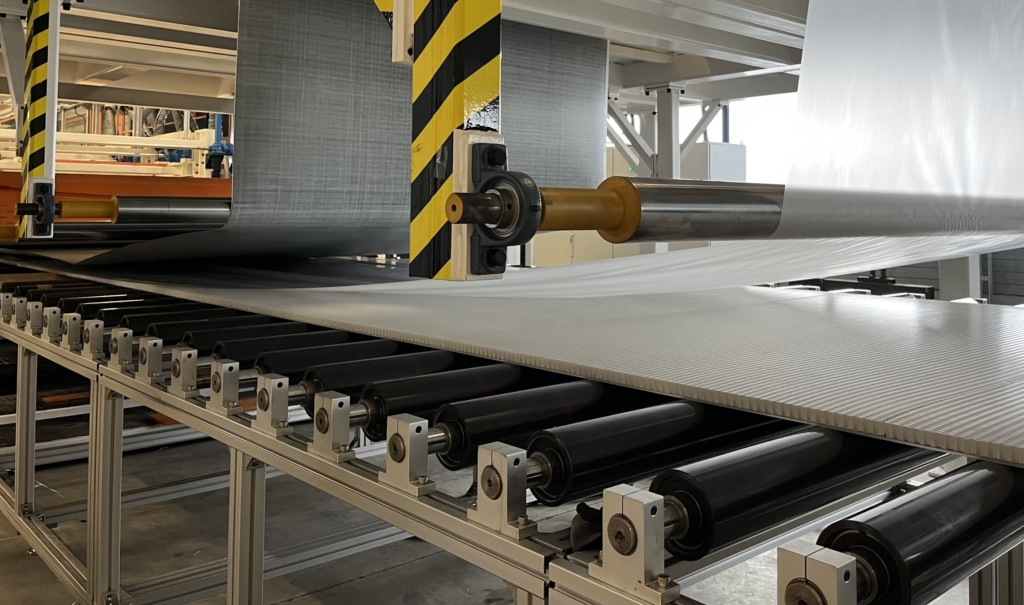
Concrete formwork is reusable when the panel retains its dimensional stability, surface quality and structural strength after repeated use, cleaning and stripping. That is only possible if the base material can withstand moisture, mechanical loads and chemical agents. The questions below take a closer look at material selection, service life and the practical advantages of composite formwork panels compared to traditional alternatives.
Which material properties determine the reusability of formwork?
The reusability of a formwork panel depends on three interrelated properties: moisture resistance, mechanical stiffness and surface resistance. A panel that absorbs moisture swells and loses its dimensional stability. A panel with too little bending stiffness deflects under concrete pressure and produces an uneven concrete surface. And a panel whose surface wears or becomes damaged quickly makes stripping more difficult and impairs concrete quality.
Beyond these three core properties, impact resistance and chemical resistance also play a role. On site, formwork panels are regularly stacked, moved and fixed in place. Edge damage and dents directly reduce the usable service life. Chemical release agents and concrete residues can attack surfaces if the material is not resistant to them. Panels that withstand all of these loads without structural deterioration are suitable for repeated use in industrial formwork systems.
How many times can a composite formwork panel be reused?
A composite formwork panel achieves considerably more use cycles than a plywood panel. Whereas plywood formwork can typically handle ten to twenty pours before the surface is too badly damaged, high-quality composite panels can withstand several dozen to hundreds of cycles, depending on the panel construction, the surface and the conditions on site.
The exact number of reuse cycles varies by application and panel configuration. The quality of the skin layers, the core construction and the edge finishing are decisive. A glass-fibre-reinforced thermoplastic panel with a closed surface absorbs no moisture and shows no delamination. That keeps it structurally stable over a longer period. In practice, this means that a single composite formwork panel bridges several plywood replacement cycles, which lowers the total material cost per pour.
What is the difference between thermoplastic and thermoset composites in formwork?
The main difference is how the material responds to heat and mechanical loading. Thermosets, such as polyester resin or epoxy, cure chemically and cannot be reshaped afterwards. They are stiff and strong, but brittle under point loads and difficult to recycle. Thermoplastic composites soften when heated and can be reshaped. They are tough, impact-resistant and fully recyclable at the end of their service life.
For formwork applications, this has practical consequences. Thermoset panels are more susceptible to edge damage and crack when struck. Thermoplastic panels absorb energy better and retain their shape even after repeated mechanical loading. In addition, the recyclability of thermoplastic composites aligns with EU regulations on material flows and sustainability reporting under the CSRD, which is an increasing procurement requirement for many European manufacturers.
Why is composite increasingly replacing plywood in formwork systems?
Composite is replacing plywood in formwork systems because it structurally resolves the weakest points of wood. Plywood absorbs moisture, swells, delaminates and loses its flatness after a limited number of pours. Composite does not. It retains its dimensions, surface quality and stiffness even after intensive use and regular cleaning.
The availability of timber also plays a role. The quality of structural plywood has become less consistent in recent years, while the requirements for concrete surfaces are becoming stricter. Composite panels offer predictable, reproducible performance from batch to batch, which is a tangible advantage for formwork system manufacturers and precast concrete producers. The higher purchase price is offset by the longer service life: one composite panel replaces several plywood replacement cycles, including the associated labour costs and downtime.
Which formwork applications benefit most from lightweight panels?
Lightweight formwork panels deliver the greatest gains in applications where panels are moved frequently, used at height or handled manually. This applies to wall formwork on large construction projects, column formwork and mobile or modular formwork systems that are repositioned daily.
Precast concrete production also benefits from lighter panels. In precast plants, moulds are repeatedly set up, filled and stripped. Every kilogram of weight reduction per panel lowers the physical strain on workers and speeds up cycle time. For formwork systems moved by crane, a lower panel weight reduces lifting and transport costs per cycle. The more often a panel is moved, the more the weight advantage counts in total operating costs.
How does panel weight affect the total cost of formwork?
Panel weight affects total formwork costs on several levels at once: labour costs, transport costs, cycle time and safety risks. A lighter panel is quicker to place and remove, requires less manpower and reduces the risk of injury from overexertion. Over a project with hundreds of pours, that difference adds up considerably.
A concrete calculation example makes this clear. If a composite panel weighs half as much as a comparable plywood panel, two workers can do the work that would otherwise require three or four people. That directly lowers the labour cost per pour. At the same time, more panels fit on each truck, which lowers the transport cost per unit. And because composite panels last longer, the costs of repeated purchasing, delivery and installation of replacement panels fall away. Over a project lifetime of fifteen years, that can save several replacement cycles, each with its associated material and labour costs.
How we help with reusable concrete formwork
We develop and produce thermoplastic sandwich panels designed specifically for applications where durability, dimensional stability and low weight are central. For formwork manufacturers and precast concrete producers, that means a panel that bridges several plywood replacement cycles, without modifications to existing formwork systems.
- Custom panel configurations: We tailor the core material, skin thickness and surface finish to the specific loads and cycle times of your application.
- Edge finishing and custom work: Panels are cut to size and supplied with edge finishing that protects the core against moisture and mechanical damage on site.
- Technical support: We review your design, optimise the panel configuration for your production process and flag points of attention before production starts.
- ISO-certified production: Every production batch goes through strict quality control in our facilities in the Netherlands, so performance is consistent and predictable.
Whether you are developing a new formwork product, looking for an alternative to plywood or want a production partner for specialised panel applications: we will work with you to determine what is technically feasible and commercially sensible. Get in touch to discuss the possibilities for your application.
Related Articles
- Which construction applications benefit most from lightweight formwork?
- Does lightweight formwork make installation faster?
- How do European sandwich panel suppliers support OEM production schedules?
- How are sandwich panels used in raised access flooring systems?
- How do sandwich panel scaffold boards reduce on-site injuries?