

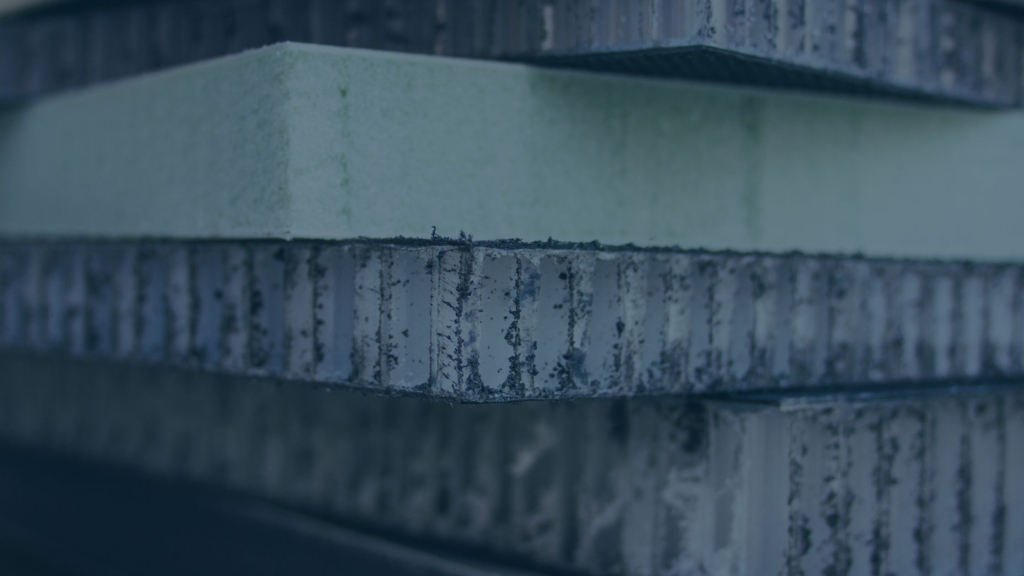
A double belt press is a continuous lamination machine that bonds multiple material layers together under controlled heat and pressure to produce flat, uniform composite panels. Two opposing steel belts move in sync, applying consistent force across the full panel width as materials pass through a heated zone and then a cooling zone. The result is a fully consolidated sandwich panel produced in a single, uninterrupted process. The sections below answer the most common questions about how this technology works and why it matters for composite panel production.
How does a double belt press actually work?
A double belt press works by feeding raw materials between two continuous steel belts that run in parallel. The belts apply uniform pressure across the entire panel surface while the assembly passes through a heated zone that activates the thermoplastic matrix, followed by a cooling zone that locks the consolidated structure in place. The process runs continuously, producing panels at a consistent rate without stopping between cycles.
The heated zone raises the temperature of the thermoplastic skins and core to the point where the polymer flows and bonds to adjacent layers. Pressure from the belts ensures intimate contact between skin and core, eliminating voids and delamination risks. As the panel exits the heated zone, the cooling section rapidly brings the temperature down, fixing the bond before the panel leaves the press.
Tension control across the belt width is what separates a well-engineered double belt press from simpler lamination equipment. Uneven pressure creates thickness variation and internal stress. A properly calibrated press maintains uniform nip pressure from edge to edge, which is why panels produced this way show consistent mechanical properties across their full surface area.
What materials can be processed in a double belt press?
A double belt press can process a wide range of thermoplastic and thermoset-compatible materials, provided they can be consolidated under heat and pressure in a continuous format. Common skin materials include glass-fiber-reinforced polypropylene (glass-fiber PP), carbon-fiber PP, plain PP films, and glass-PET laminates. Core materials include PP foam, PP honeycomb, and various other lightweight structural cores.
The press can also handle surface films and functional layers applied in-line. PET films, anti-skid coatings, and decorative finishes can be laminated directly onto the panel surface during the same pass, eliminating a secondary bonding step. This in-line capability is one reason continuous pressing is preferred over batch methods for high-volume production.
Material selection determines the temperature and pressure profile required. PP-based systems typically process at lower temperatures than PET-based systems. The press must be capable of holding the correct temperature window precisely, because too little heat leaves the bond incomplete, while too much degrades the polymer or distorts the core geometry. This is why process control, not just machine size, defines output quality.
What types of panels does a double belt press produce?
A double belt press produces flat, continuous sandwich panels with a lightweight core bonded between two reinforced skins. The specific panel type depends on the combination of core material, skin architecture, and surface finish fed into the press. Common outputs include wall cladding panels, structural floor panels, scaffolding boards, and body panels for commercial vehicles and trailers.
Core geometry drives the panel’s structural role. PP foam cores, available across a range of densities, suit wall panels and applications where thermal insulation or a smooth surface finish matters. PP honeycomb cores deliver higher bending and compressive performance for the same thickness, making them the preferred choice for floor panels and load-bearing decking in transport applications.
Skin architecture adds further differentiation. A cross-ply laminate, with fibers oriented at 0 and 90 degrees in alternating layers, produces balanced mechanical properties in both directions, which suits panels that may be installed in either orientation. A unidirectional multi-ply skin concentrates strength along a specific axis, which is useful when the dominant load direction is known, as in scaffolding planks loaded across their width.
How does a double belt press compare to batch lamination methods?
A double belt press produces panels continuously, while batch lamination methods press one panel at a time in a static mold or platen press. The continuous process delivers higher throughput, more consistent bond quality, and lower per-unit cost at scale. Batch methods offer greater flexibility for small runs, complex shapes, or materials that require very long dwell times under pressure.
Consistency is the most significant practical difference. In a batch press, each cycle introduces variables: loading position, platen temperature uniformity, and clamping pressure can all shift slightly between cycles. A continuous belt press eliminates these cycle-to-cycle variables because the process parameters remain constant as long as the line runs. For OEM manufacturers producing the same panel specification in volume, this consistency directly reduces rejection rates and rework.
Batch lamination remains relevant for prototyping, low-volume specialty panels, and configurations that require very thick cores or complex edge profiles that a continuous press cannot accommodate. For high-volume production of flat sandwich panels, however, the double belt press is the more productive and cost-effective process, particularly when panel dimensions and material combinations are standardized.
Why do composite panel manufacturers use a double belt press?
Composite panel manufacturers use a double belt press because it combines high output volume with tight process control, producing panels that meet consistent mechanical and dimensional tolerances at a cost that batch methods cannot match at scale. The continuous format also enables in-line integration of surface films, core materials, and reinforcement layers, reducing the number of separate production steps.
For manufacturers supplying truck body builders, trailer manufacturers, and other commercial vehicle OEMs, consistency is not optional. A panel that varies in thickness by even a few tenths of a millimeter creates fit problems during assembly. A panel with inconsistent skin-to-core bonding creates warranty exposure. The double belt press addresses both risks through continuous, controlled consolidation.
There is also a weight argument. Thermoplastic sandwich panels produced on a double belt press replace steel and wood in vehicle body structures at a fraction of the weight. In 2026, this matters beyond payload capacity alone. Lighter body structures extend battery range in electric trucks and vans. Every kilogram of structural dead weight reduces range per charge, making weight reduction a range argument, not just a payload argument. This is a standard procurement question from EV fleet buyers, and it makes the case for composite panels stronger than it has ever been.
What panel dimensions can a double belt press achieve?
Panel dimensions from a double belt press depend on the width of the belts and the cutting system downstream of the press. Width is fixed by the machine design, while length is theoretically unlimited in a continuous process and is determined by downstream cutting equipment. Thickness is controlled by the gap between the belts and typically ranges from a few millimeters to around 150 mm depending on the press configuration.
Large-format panels are one of the practical advantages of continuous pressing. A press wide enough to produce panels approaching three meters in width can supply truck body builders and trailer manufacturers with single-piece floor or wall panels that eliminate internal joints. Fewer joints mean fewer potential failure points and faster assembly on the production line.
Panel length is particularly relevant for vehicle body applications. A trailer floor or a truck body sidewall often requires a panel longer than what any batch press can produce in a single cycle. A continuous press, combined with a downstream saw or guillotine, can cut panels to any specified length without restarting the process, which is why long-format panels are almost exclusively produced on continuous equipment.
How Compoform Supports Your Panel Specification
We operate a 72-meter semi-automatic double belt press line at our facilities in the Netherlands, capable of producing thermoplastic sandwich panels up to 13,500 mm long and 2,950 mm wide, with thicknesses up to 150 mm. Our annual production capacity reaches 1.5 million square meters of composite sheet material, all manufactured in Europe to consistent quality standards.
What this means in practice for truck body builders, trailer manufacturers, and scaffolding producers:
- Custom dimensions cut to your specification — panels are not limited to standard sheet formats. If your assembly process requires a specific length or width, we produce to that dimension.
- PP honeycomb and PP foam cores across a range of densities, matched to your load requirements and weight targets. A 30 mm PP sandwich floor panel is self-supporting, removing the need for an aluminium subframe and eliminating a production step from your build process.
- Thermoplastic panels that outlast plywood by a significant margin in heavy transport applications, based on our own field experience. Over a 15-year vehicle life, eliminating two or three plywood replacement cycles changes the total cost calculation substantially, even when the composite panel carries a higher unit price.
- EN 12811 load class 4 performance achieved by our 10.5 mm scaffolding panel with no support underneath, based on Compoform’s own testing.
- Edge sealing and edge bending available to protect the core from moisture and UV exposure, relevant for scaffolding boards and truck floors that are washed down regularly.
We review your design before production begins. If a panel configuration creates an assembly problem, a structural risk, or an unnecessary cost, we flag it at the engineering stage, not after the first production run. For scaffolding and commercial vehicle floor applications specifically, contact our team to discuss your panel requirements and let us confirm the right configuration for your build process.
Related Articles
- What is the role of sandwich panels in dry freight trailer construction?
- Can sandwich panels be used as formwork in concrete construction?
- Why are sandwich panels replacing plywood floors in commercial vehicles?
- How do sandwich panels perform after repeated loading cycles?
- How much does aluminium really cost over its lifetime?