

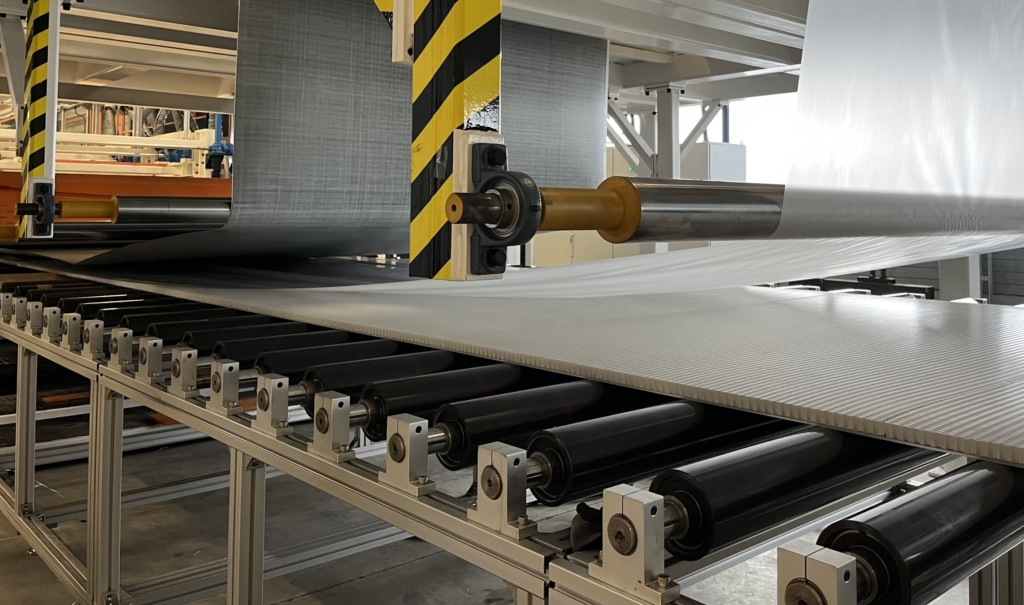
Construction projects in which large amounts of material have to be moved, assembled, and dismantled repeatedly benefit most from lightweight formwork panels. This applies in particular to high-rise construction, infrastructure projects, and precast concrete production, where the weight of formwork elements directly affects handling speed, labor load, and total project costs. The questions below look more closely at which applications are best suited, how composite compares with plywood, and when making the switch makes financial sense.
What are the benefits of lightweight formwork on large construction projects?
Lightweight formwork panels speed up handling on large construction projects because they require less manpower for placing, moving, and dismantling. Less weight per panel means workers can handle more elements per day without mechanical aids, which increases productivity and reduces the risk of physical overexertion.
On large projects, this advantage adds up quickly. When formwork elements are moved dozens or hundreds of times over the course of a project, every kilogram saved per panel makes a measurable difference in cycle time. Crews can work faster, crane hours are reduced, and site logistics are simplified.
Durability also plays a role. Lightweight composite panels are resistant to moisture, chemicals in the concrete mix, and mechanical stress from repeated use. Whereas traditional plywood needs replacing after a limited number of use cycles, composite alternatives retain their dimensional accuracy and surface quality for longer. This is relevant for projects that require a smooth concrete finish, such as exposed concrete in architectural applications.
Finally, the lower weight offers advantages for transport and storage. Less weight per pallet lowers transport costs and makes it easier to bring formwork elements to height or to hard-to-reach locations without heavy lifting equipment.
Which concrete structures benefit most from lightweight formwork panels?
Concrete structures in which formwork is reused frequently, placed at height, or processed in large volumes benefit most from lightweight formwork panels. Specifically, these include walls and columns in high-rise construction, tunnel formwork, bridge decks, and precast concrete production in factory environments.
High-rise and vertical structures
When forming walls and columns in high-rise construction, panels are repeatedly moved up to a higher floor. Every kilogram less per element reduces crane load and speeds up the cycle per floor. Lightweight panels deliver a direct productivity gain here.
Precast concrete production
In precast plants, formwork elements are assembled, filled, dismantled, and repositioned every day. The weight of the mold partly determines how fast a production cycle runs. Lightweight composite panels reduce the physical strain on workers and make it possible to change molds faster without mechanical aids.
Infrastructure and civil engineering works
On bridges, viaducts, and tunnels, formwork elements are often placed in hard-to-reach locations. The weight of the formwork partly determines which lifting equipment is required. Lightweight panels lower equipment requirements and increase flexibility on site.
How does composite formwork compare with traditional plywood?
Composite formwork panels are lighter, more durable, and resistant to moisture and chemicals, whereas traditional plywood is cheaper to buy but wears out faster and withstands fewer use cycles. The difference in service life is the central argument in the comparison.
Plywood is a familiar material with a low purchase price, but it absorbs moisture, swells, and loses dimensional accuracy after repeated contact with wet concrete. Depending on the application and maintenance, plywood formwork typically achieves a limited number of use cycles before it needs replacing. Composite panels are non-absorbent, dimensionally stable, and retain their surface quality over a considerably greater number of cycles.
Another difference is weight. Composite sandwich panels with a PP foam or PP honeycomb core are lighter than plywood at comparable thickness and stiffness. This makes them easier to handle on site and reduces the load on scaffolding and support structures.
Composite also performs better on dimensional accuracy over its service life. Plywood can shrink, expand, or warp under changing humidity conditions. Composite panels are more dimensionally stable, which is relevant when a smooth concrete finish or tight tolerances are required.
The drawback of composite is the higher initial purchase price. Whether that investment pays off depends on the number of use cycles, the labor costs for replacement, and the requirements for the concrete surface. For applications with a high reuse rate, the total cost per use cycle is generally lower with composite.
When is lightweight formwork the most cost-efficient choice?
Lightweight composite formwork is the most cost-efficient choice when panels are reused intensively, when labor costs for replacement and handling are high, or when the application places high demands on surface quality and dimensional accuracy over multiple cycles.
The calculation is easy to make. Suppose a composite panel lasts three to four times as long as plywood under comparable use. You then eliminate several replacement cycles over the life of the panel, including the associated material costs, labor time, and downtime. When you add up those costs, the composite option is in many cases cheaper per use cycle, even with a higher purchase price.
Labor costs are a second factor. On projects where formwork is moved by hand, weight savings translate directly into time savings. Less weight per panel means workers can work faster and run less risk of physical overexertion. In markets with high labor costs, this argument carries considerable weight.
Composite formwork is less attractive for one-off applications or projects with a very low reuse rate. If a panel is used only once or twice, the higher purchase price is seldom justified. In that case, plywood remains the logical choice from a cost perspective.
A third consideration is the quality requirement for the concrete surface. When exposed concrete or tight tolerances are required, the dimensional stability of composite can justify the extra investment in the longer term, even at a lower reuse rate.
What technical requirements does concrete formwork place on composite panels?
Concrete formwork places high demands on flexural strength, stiffness, dimensional stability, and resistance to alkaline conditions. Composite panels for formwork applications must be able to withstand concrete pressure without deflection, resist the alkaline environment of fresh concrete, and retain their dimensions under varying temperature and humidity.
The key technical requirements are:
- Flexural strength and stiffness: Formwork panels must absorb the hydrostatic pressure of fresh concrete without unacceptable deflection. The required stiffness depends on the pour height, the pour rate, and the support spacing.
- Chemical resistance: Fresh concrete has a high pH value. Panels must withstand alkaline conditions without surface degradation or loss of mechanical properties.
- Dimensional stability: Formwork panels must retain their dimensions under humidity changes and temperature fluctuations on site. Shrinkage or expansion leads to seams in the concrete surface or problems when closing the formwork.
- Surface quality: The panel surface determines the quality of the concrete surface. For exposed concrete, a smooth, non-absorbent surface finish and consistent release are required.
- Connection stiffness: Composite panels must be able to be fastened and connected using standard formwork hardware. The edge finish and the mechanical properties of the panel determine whether standard connection techniques can be used.
In addition to these functional requirements, practical aspects also play a role, such as workability on site, repair options in case of damage, and the availability of panels in the required dimensions. Maximum panel sizes are relevant for applications where large seamless formwork surfaces are required.
How does Compoform help with composite formwork panels?
We develop and produce thermoplastic sandwich panels suitable for formwork applications where weight, durability, and dimensional accuracy matter. Our panels are built with PP honeycomb or PP foam cores and glass-fiber-reinforced thermoplastic skins, and are available in custom dimensions up to 13,500 mm x 2,900 mm.
What we offer specifically for formwork applications:
- Technical evaluation of your application: We assess your specific load requirements, use cycles, and surface requirements before recommending a panel configuration. Specifications vary by application, and we tailor the core material, thickness, and skin build-up to your design.
- Custom panel construction: PP foam is available in six density classes, which offers flexibility in matching stiffness and strength to your formwork design.
- Production volume: Our production line has a capacity of 1.5 million square meters per year, which ensures continuity of supply for both development projects and series production.
- Partnership in product development: We work with formwork system manufacturers and precast concrete producers who want to develop an alternative to plywood. This means we review your design, optimize the panel configuration for your production process, and flag potential bottlenecks before production starts.
Are you looking for a composite alternative to your current formwork material, or would you like to explore whether lightweight sandwich panels suit your application? Get in touch to discuss your project with our engineers.
Related Articles
- What sustainability certifications should sandwich panels carry?
- How do sandwich panels meet aerospace weight and strength requirements?
- How are sandwich panels used in bridge deck construction?
- What sandwich panels are used in swap body and container construction?
- What is the difference between sandwich panels and conventional composite sheets?