

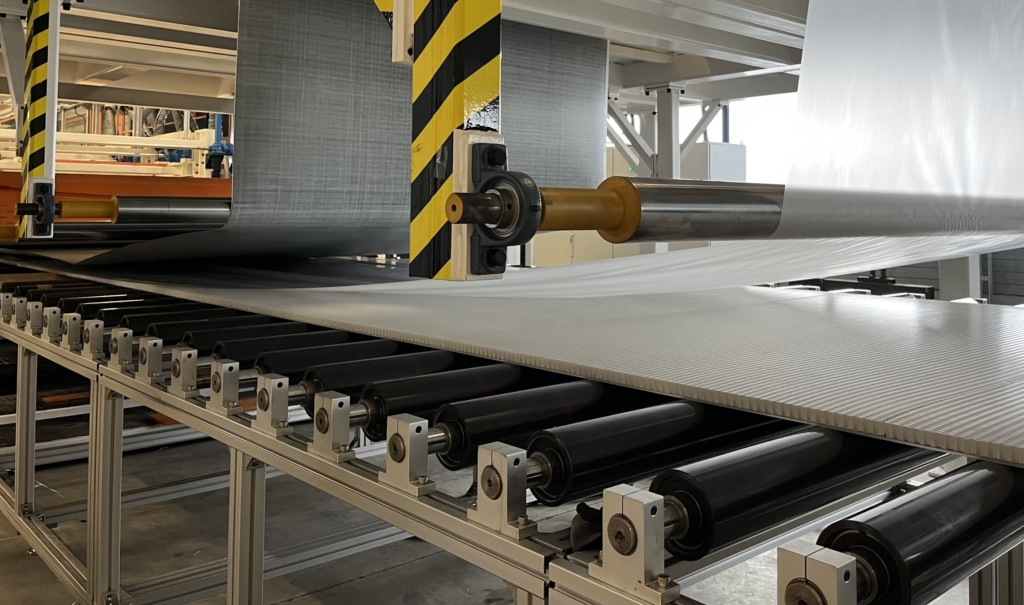
Composite formwork and plywood formwork differ in four areas: material composition, weight, service life, and total cost over time. Composite panels are built from fibre-reinforced thermoplastic layers around a lightweight core, whereas plywood consists of glued wood layers. For manufacturers of formwork systems and precast concrete producers, the difference in reuse cycles and maintenance costs is usually the deciding factor. The questions below work out each difference in concrete terms.
Which materials are used in composite and plywood formwork?
Plywood formwork consists of multiple glued wood layers, usually softwood or tropical hardwood, with a phenolic resin coating on the surfaces to slow moisture absorption. Composite formwork is built from fibre-reinforced thermoplastic skins, such as glass-PP or glass-PET, laminated onto a lightweight core of PP foam or PP honeycomb. The combination of skin and core determines the strength, weight, and durability of the panel.
With plywood formwork, the quality of the adhesive and the wood species play a major role in performance. Phenolic resin coatings slow moisture absorption, but they do not fully protect the wood against swelling, shrinking, or delamination under intensive use. In composite panels, the core is fully enclosed by the thermoplastic skins, so moisture cannot reach the structure. This makes the material inherently waterproof and rot-free, without any additional coating or treatment.
The fibre architecture in composite panels can be tailored to the load requirements of the application. A cross-oriented glass fibre structure distributes forces in multiple directions, while a unidirectional build concentrates strength along the main load axis. Plywood offers fewer possibilities for targeted optimisation, because its properties are largely determined by the wood species and the number of layers.
How do composite and plywood panels perform under construction conditions?
Composite panels perform more consistently than plywood under changing construction conditions. They are fully waterproof, UV-resistant, and chemically resistant, and they retain their dimensions through temperature fluctuations, freeze-thaw cycles, and high humidity. Plywood absorbs moisture, which leads to swelling, shrinking, and eventually delamination, causing the load-bearing capacity and the quality of the concrete surface to deteriorate.
For formwork applications, dimensional stability is particularly important. When a plywood panel swells or shrinks because of moisture changes, irregularities appear in the concrete surface. Composite panels keep their shape regardless of weather conditions, resulting in a more consistent concrete surface across multiple pouring cycles.
Composite panels require no painting, drying time, or structural repairs between use cycles. Cleaning consists of rinsing or wiping down. Plywood panels must be inspected regularly for damage after intensive use, and the coating must be restored periodically to extend their service life. In environments with chemical exposure, such as precast concrete production with release agents, the chemical resistance of composite offers a clear advantage.
How many times can composite formwork be reused compared with plywood?
Composite formwork is designed for a minimum service life of twelve years under intensive use. In practice, plywood formwork lasts three to five years under comparable loads, depending on the quality of the panel and the intensity of use. This means that one composite life cycle replaces four to five plywood replacement cycles.
This difference has a direct impact on total costs. Every replacement of plywood panels involves not only material costs but also labour costs for dismantling and assembly, logistics costs for transport and storage, and lost production during the replacement. When you add up these costs over a period of twelve years, composite formwork is in many cases cheaper per year of use, even if the initial purchase price is higher.
An additional advantage is that composite panels require no repair work between use cycles. After intensive use, plywood regularly needs repairs to the coating or the edges in order to make use of its remaining service life. These interim costs are often underestimated when comparing total cost of ownership.
What is the weight difference between composite and plywood formwork?
Composite panels are considerably lighter than comparable plywood panels. Depending on the thickness and configuration, the weight difference can be as much as 65% in favour of composite, with the relative advantage increasing as panel thickness increases. This weight difference has a direct impact on handling, logistics, and the load on the formwork structure.
In practice, a lower panel weight means that one worker can handle a panel without assistance, which increases assembly speed and reduces physical strain. For formwork systems that are assembled and dismantled several times a day, this advantage quickly adds up in labour costs and lead time. Lighter panels also increase the load density per shipment, so more panels can be carried per transport.
With composite panels, the lower weight does not come at the expense of load-bearing capacity. A fibre-reinforced composite core can absorb high loads while keeping the total weight of the panel low. This makes composite particularly suitable for applications where weight reduction and structural performance are both required.
When is composite formwork the better choice over plywood?
Composite formwork is the better choice when reuse, dimensional stability, and low maintenance costs are priorities. This applies in particular to formwork systems that are deployed frequently, to precast concrete production with high cycle frequencies, and to applications in environments with a lot of moisture, chemicals, or extreme temperature fluctuations.
Plywood remains a viable option for one-off or short-term use, where the lower purchase price per panel weighs more heavily than service life. For projects where panels are discarded after use or where the formwork shape varies greatly, plywood can be more cost-efficient in the short term.
For manufacturers of modular formwork systems and formwork rental companies, the trade-off is different. They benefit most from the longer service life of composite, because their panels are used intensively and replaced regularly. Every replacement cycle that is eliminated lowers operating costs and reduces the logistical complexity of their fleet. In that context, composite is not just a material choice but a business-economic decision.
What are the sustainability benefits of composite compared with plywood?
Composite formwork has a lower environmental impact over its full life cycle than plywood, mainly because of its longer service life and lower material consumption over time. Because one composite panel replaces four to five plywood panels, the production, transport, and processing of those additional panels are avoided. The extended period of use significantly lowers the carbon footprint per use cycle.
Plywood treated with phenolic resin or other chemical coatings falls into the category of treated wood waste when replaced, which complicates processing and increases disposal costs. Thermoplastic composite panels are in principle recyclable: the thermoplastic matrix can be melted and reprocessed, which aligns with EU regulations on circular material flows and the CSRD reporting obligations that increasingly affect European OEMs and contractors.
Lighter panels also contribute to lower transport emissions per shipment, because more panels can be carried per load. For companies that report on sustainability targets or work with tenders in which environmental criteria carry weight, composite offers a demonstrable advantage over treated plywood.
How we help with composite formwork
We develop and produce composite sandwich panels for formwork system manufacturers and precast concrete producers who are looking for an alternative to plywood or other conventional formwork materials. Our panels are produced entirely in Europe, in our ISO-certified facilities in Ospel and Beek, the Netherlands.
What we offer for formwork applications:
- Custom panel configurations tailored to the load requirements, dimensions, and assembly procedures of your formwork system
- Technical evaluation of your current design, in which we optimise the panel configuration for your production process and application
- Prototyping and testing by our in-house R&D team, so you can validate material behaviour before moving to series production
- Production capacity of 1.5 million square metres per year, with panels up to 13,500 mm × 2,950 mm × 150 mm
- Ongoing technical support during and after product development
We work as a development partner, not as a supplier who ships panels to specification. That means we review your design, flag potential bottlenecks in your assembly procedure, and tailor the panel configuration to your specific requirements before production starts. Want to know whether composite is the right choice for your formwork application? Contact us and discuss your project with our technical team.
Related Articles
- Does repeated concrete pouring affect composite panel performance?
- What are the hidden costs of using conventional panel materials?
- How do sandwich panels reduce the tare weight of a motorhome?
- What are the weight savings of switching to sandwich panels in a trailer?
- What happens to sandwich panels at end of life?