

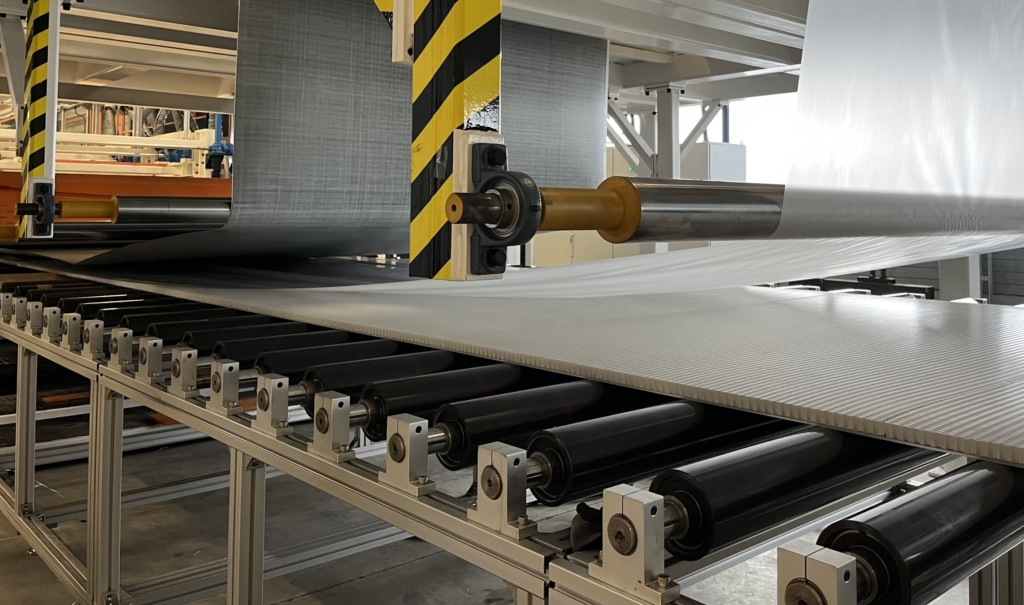
In most cases, composite formwork outperforms plywood formwork, especially with repeated use. Composite panels are lighter, water-resistant and last considerably longer without structural deterioration. For manufacturers and contractors who use formwork intensively, this results in a lower total cost per use, even if the purchase price per panel is higher. The questions below explore the comparison in more detail.
What are the biggest disadvantages of plywood formwork?
Plywood formwork absorbs moisture, swells and delaminates with repeated use. After a limited number of concrete pours, dimensional stability decreases, surface defects appear and the risk of concrete leakage rises. That makes plywood suitable for short-term projects, but costly for intensive reuse.
The main disadvantages of plywood formwork panels are:
- Moisture absorption: Plywood takes up water along the edges and through damage to the top layer. This leads to swelling, shrinkage and eventually delamination of the wood layers.
- Limited service life: Depending on the type and treatment, a plywood panel lasts an average of five to fifteen concrete pours before it becomes structurally unreliable. With intensive use, that means frequent replacement.
- Weight: Plywood is relatively heavy. This increases the physical strain on workers and the transport costs per shipment.
- Maintenance: Panels must be inspected and repaired regularly, and sometimes re-treated with release oil, to keep the concrete surface acceptable.
- Waste stream: Worn-out plywood panels are difficult to recycle because of the glue layers and chemical treatments. This creates a significant waste stream, which is becoming increasingly problematic under European sustainability regulations such as the CSRD.
For formwork manufacturers who supply panels as part of a reusable system, these disadvantages are directly visible in replacement costs and long-term customer satisfaction.
How does composite formwork perform with repeated use?
Composite formwork panels retain their dimensional stability, strength and surface quality considerably better than plywood with repeated use. The fiber-reinforced construction does not absorb moisture, does not delaminate and does not deform due to temperature changes or damp conditions on the construction site.
Whereas plywood deteriorates structurally after a limited number of use cycles, a well-designed composite panel remains dimensionally stable over a much longer period. This has a direct impact on the quality of the concrete surface: a flat, undamaged panel produces a more consistent concrete result than a warped or damaged plywood panel.
Composite panels also withstand the chemical environment on the construction site, including contact with wet concrete, release oils and cleaning agents. Cleaning requires no special treatment: rinsing or wiping is sufficient. No drying time is needed before the next use, which shortens the turnaround time on site.
From a TCO perspective, the longer service life is the strongest argument. One composite panel can span multiple plywood replacement cycles. Over a period of ten to fifteen years, that means lower purchasing costs, less installation labor and less downtime for panel replacement.
What is the weight difference between composite and plywood formwork panels?
Composite sandwich panels are generally considerably lighter than comparable plywood panels. The exact weight difference depends on the thickness, core composition and skin construction, but the advantage of composite increases as panel thickness grows.
This weight advantage has practical consequences at several levels:
- Handling on site: Lighter panels are quicker to place and remove. One worker can move a panel without assistance, which increases labor productivity and reduces physical strain.
- Transport efficiency: More panels per truck lower the transport cost per unit and reduce the number of trips.
- Structural load: For formwork systems that rest on a supporting structure, a lighter panel reduces the total load on the scaffolding or frame.
For formwork manufacturers developing systems for repeated use, weight is a relevant design parameter. A lighter panel makes the system more attractive to contractors who value fast assembly and simple logistics.
Is composite formwork more expensive than plywood?
The purchase price of composite formwork panels is higher than that of plywood. However, when you calculate the total costs over the period of use, including replacement, labor costs and disposal, composite is cheaper per use in most intensive applications.
A concrete example makes this clear. If a plywood panel lasts an average of five to ten concrete pours and a composite panel can handle dozens of cycles without structural deterioration, then one composite panel replaces several plywood panels over the same period. Add the labor costs for replacement and the disposal costs of worn-out plywood, and the TCO advantage of composite quickly becomes apparent.
The payback period depends on usage intensity. For projects where panels are used only a few times, plywood is financially more attractive. For formwork systems that are reused on a structural basis, the balance tips toward composite. Formwork manufacturers and rental companies that treat panels as a fleet investment benefit most from the lower replacement frequency.
Which composite materials are suitable for formwork panels?
For formwork panels, fiber-reinforced thermoplastic sandwich panels are the most suitable. These combine a lightweight core of PP foam or PP honeycomb with glass-fiber-reinforced skin layers, resulting in a stiff, light and water-resistant panel that can withstand the mechanical and chemical loads of concrete formwork.
The choice of core material and skin construction determines performance:
- PP foam core: Available in various densities. A higher density provides greater compressive strength, which is relevant for formwork applications with high concrete pressure.
- PP honeycomb core: Offers a favorable ratio of stiffness to weight. Suitable for applications where bending stiffness is a priority.
- Glass-fiber-reinforced skin layers: The skin construction, such as a cross-ply or multilayer laminate, determines the flexural strength and impact resistance of the panel. A higher fiber content increases mechanical performance.
The panel surface is also relevant for formwork. A smooth PET film surface produces a sleek concrete finish. A textured anti-slip surface is more suitable for flooring or scaffold plank applications. The right combination of core, skin and surface depends on the specific load requirements and the desired concrete finish.
Materials such as balsa, aluminum honeycomb or PU foam are sometimes used in the wider market, but are less suitable for the damp, mechanically loaded environment of concrete formwork.
When is composite formwork the better choice?
Composite formwork is the better choice when panels are used repeatedly, when weight matters for handling or transport, or when total cost over several years is the deciding factor. For one-off or occasional use, plywood remains financially more attractive.
Composite formwork performs best in the following situations:
- Reusable formwork systems: Manufacturers and rental companies that manage panels as a fleet benefit from the longer service life and lower replacement frequency.
- Industrial and chemical environments: At locations where formwork is exposed to aggressive cleaning agents or extreme weather conditions, composite offers more reliable performance than plywood.
- Projects with high handling frequency: When panels are moved daily, the lower weight reduces labor strain and increases assembly speed.
- Applications with high dimensional stability requirements: In precast concrete production or specialized formwork systems where the concrete surface must meet strict quality requirements, a dimensionally stable composite panel delivers more consistent results.
- Sustainability goals: Companies reporting under the CSRD or other European sustainability regulations can use composite panels to reduce the waste stream from worn-out plywood and lower their life-cycle impact.
Ultimately, the decision depends on usage intensity, the technical requirements of the formwork system and the time horizon over which costs are assessed. The more intensive the use, the stronger the case for composite.
How we help you choose composite formwork panels
We develop and produce thermoplastic sandwich panels for companies looking for an alternative to plywood in formwork applications. We do not do this as a supplier that cuts panels to size and ships them, but as a technical partner that thinks along with you on configuration, dimensions and integration into your existing system or production process.
What we can do for you in practice:
- Assess your formwork application and determine the most suitable core and skin combination based on your load requirements and frequency of use
- Produce panels in custom dimensions, up to a maximum of 13,500 mm × 2,900 mm, including edge finishing and private labeling for OEM programs
- Supply prototypes and test panels so you can validate performance before moving to series production
- Provide technical support for integrating composite panels into your formwork system, including advice on fastening methods and surface finishing
Our production line in the Netherlands has a capacity of 1.5 million square meters per year and operates according to ISO-certified quality processes. Every project begins with a technical discussion about your application, your requirements and your goals for weight, service life and cost.
Want to know whether composite panels suit your formwork application? Get in touch and discuss your project with our technical team.