

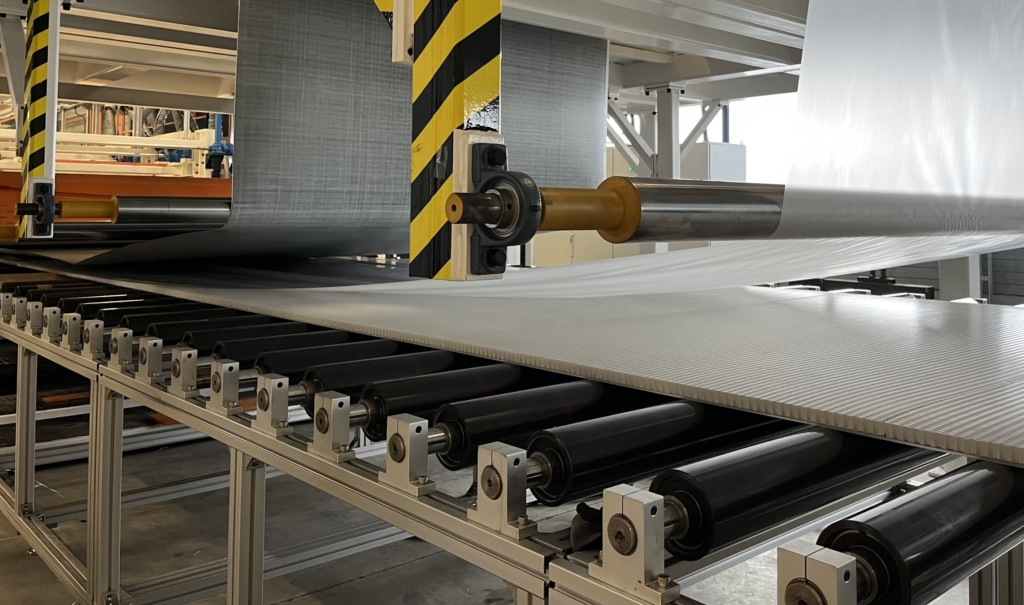
Composite formwork has a few concrete limitations that you should know about before choosing a material. The main drawbacks are the higher initial purchase price compared with plywood, limited availability from specialised suppliers, and specific technical limits under extreme loads or chemical conditions. For most industrial applications, the long-term benefits outweigh these drawbacks, but the context always determines whether composite is the right choice. The questions below address each of these limitations separately.
Which materials are suitable for composite formwork?
For composite formwork, glass-fibre-reinforced thermoplastic sandwich panels are the most widely used material form. These panels combine a PP foam or PP honeycomb core with glass-fibre-reinforced skin layers, resulting in a lightweight construction with high bending and compressive strength. However, not every composite material is suitable for the specific demands of concrete formwork.
The choice of material depends on the load class, the number of reuse cycles and the chemical environment. Formwork panels come into contact with fresh concrete, alkaline cleaning agents and fluctuating temperatures. The material must withstand these conditions without delaminating or deforming dimensionally.
Glass-fibre-reinforced thermoplastic panels with a PP honeycomb core perform well under high point loads and repeated use. Higher-density PP foam cores, such as 100 to 140 kg/m³, offer more stiffness for applications where deflection is critical. Both core types are fully waterproof and rot-free, which is a direct advantage over plywood, which swells and delaminates in damp conditions.
What makes composite formwork less suitable is the limited choice of standard dimensions from generic suppliers. Custom sizes are possible, but they require working with a manufacturer that can produce panels to specification.
What are the technical limitations of composite formwork panels?
Composite formwork panels have technical limitations in terms of local point loads, workability and behaviour at extreme temperatures. Under very high concentrated forces, such as when driving in anchors or using heavy clamps, the core can fail locally if the panel configuration has not been specifically designed for that load.
A second technical limitation concerns workability on site. Composite panels can be sawn and drilled, but cut edges must be sealed to prevent moisture from penetrating the core. With plywood this is less critical because the material is more homogeneous. With composite panels that lack edge finishing, there is a risk that the core is exposed to water or fresh concrete at the cut edge, which shortens service life.
Thermoplastic composites also behave differently from steel or aluminium when temperatures change. At low temperatures, impact strength decreases, although glass-fibre-reinforced PP panels generally perform better than thermosets in frost. At high ambient temperatures, such as when formwork stands in direct sunlight for long periods, the stiffness of thermoplastic cores may decrease slightly. In most European building conditions this is not a practical problem, but it is a factor to consider for applications in extreme climates.
Finally, the anisotropy of fibre-reinforced panels deserves attention. Panels with unidirectional fibres have higher strength in the fibre direction than across it. A cross-ply architecture, in which fibres alternate at 0° and 90°, compensates for this and makes the mechanical properties equivalent in both directions. For formwork applications, it is important to specify which load direction is dominant so that the right fibre architecture is chosen.
How do the initial costs influence the choice of composite formwork?
The initial purchase price of composite formwork panels is higher than that of standard plywood. This is the most frequently cited reason why purchasing teams are hesitant at the first evaluation. However, the higher price per panel is only relevant if you calculate the cost per purchased unit rather than the cost per use.
Plywood formwork panels last an average of 10 to 30 use cycles, depending on quality and maintenance. Composite panels are designed for considerably more reuse, without the degradation from moisture absorption that characterises plywood. Over a full project lifetime or in rental fleets, this means fewer replacements, less waste and lower logistics costs per cycle.
There are also indirect cost advantages. Lighter panels speed up assembly and dismantling, which reduces labour costs. Composite formwork requires no painting, drying or structural repairs between cycles. Cleaning is limited to rinsing. For rental companies and contractors who use formwork intensively, this translates into a lower total cost of ownership over the period of use.
The higher initial investment is therefore a genuine limitation for projects with a short duration or one-off use. For structural reuse, such as in precast concrete production or modular formwork systems, the cost balance generally shifts in favour of composite.
When is composite formwork less suitable than traditional alternatives?
Composite formwork is less suitable for one-off projects with a low budget, for applications that require extreme local point loads without an adapted panel configuration, and in situations where standard plywood can easily be cut to size without edge finishing. In these cases, plywood offers a lower threshold.
Composite formwork is also less flexible for highly complex three-dimensional formwork shapes, such as organic or strongly curved concrete surfaces. A flat composite sandwich panel is less adaptable than thin plywood or specially shaped formwork material. Composite panels excel in flat and slightly curved applications, but strongly curved geometries require custom solutions or a different material choice.
Furthermore, composite formwork is a less obvious choice when the local supply chain does not include a specialised manufacturer. If fast delivery of standard formats is decisive and the project schedule leaves no room for custom work or longer lead times, plywood may be more practical.
Finally, regulations play a role. In some European countries, specific standards apply to formwork material in certain construction environments. Composite panels must meet the same standards as traditional materials, and the certification must be demonstrable. This is not an insurmountable limitation, but it requires preparation and documentation.
How does the availability of composite formwork limit its application?
The availability of composite formwork panels is more limited than that of standard plywood, which is available from virtually every building materials merchant. Composite panels for formwork applications are produced by specialised manufacturers and are rarely stocked as a standard product by distributors. This makes quick, small orders more difficult.
For manufacturers of formwork systems and precast concrete producers, this is less of a problem, because they generally purchase in larger volumes and can plan for longer lead times. For contractors who need formwork on an ad hoc basis, the limited availability is a practical hurdle.
Custom dimensions, thickness and surface finish are standard options with composite panels, but they require direct cooperation with the manufacturer. Panels up to 13,500 mm in length and 2,900 mm in width can be produced, but such dimensions are not held in stock. Lead time depends on production planning and volume.
Geographic availability also plays a part. European manufacturers of thermoplastic composite panels are concentrated in a limited number of countries. For customers outside Western Europe, transport costs and lead times can affect the overall cost balance. This is a factor to consider when selecting a supplier, especially for projects with tight schedules.
How we help you with composite formwork
We develop and produce thermoplastic sandwich panels that serve as an alternative to conventional plywood and other formwork materials. Our panels are available in configurations with a PP foam or PP honeycomb core, with glass-fibre-reinforced skin layers tailored to the load requirements of your specific application.
What we do for you in practice:
- Technical evaluation of your application: We assess your load scenario, the number of reuse cycles and the chemical environment before recommending a panel configuration. Specifications vary by customer and application, and we tailor the configuration to your specific requirements.
- Custom dimensions and surface finish: Panels are produced to your specification, including custom dimensions, edge finishing and surface treatment for repeated use.
- Support with product development: For manufacturers of formwork systems developing a new product, we contribute to the panel construction, its integration into your assembly procedure and the certification requirements.
- Production on a European scale: Our production line in the Netherlands produces up to 1.5 million square metres per year, which provides supply security for larger volumes.
The limitations of composite formwork, from higher initial costs to limited availability, can in many cases be resolved by collaborating early in the development process with a manufacturer who understands your application. We review your design, optimise the panel configuration for your assembly procedure and flag bottlenecks before production starts. Get in touch to discuss your formwork application.
Related Articles
- What are the fire and smoke requirements for aerospace sandwich panels?
- How do sandwich panels perform in high-humidity or coastal environments?
- What sandwich panels are used in modular building construction?
- What are the best sandwich panels for truck body construction?
- How do sandwich panels reduce payload dead weight in freight vehicles?