

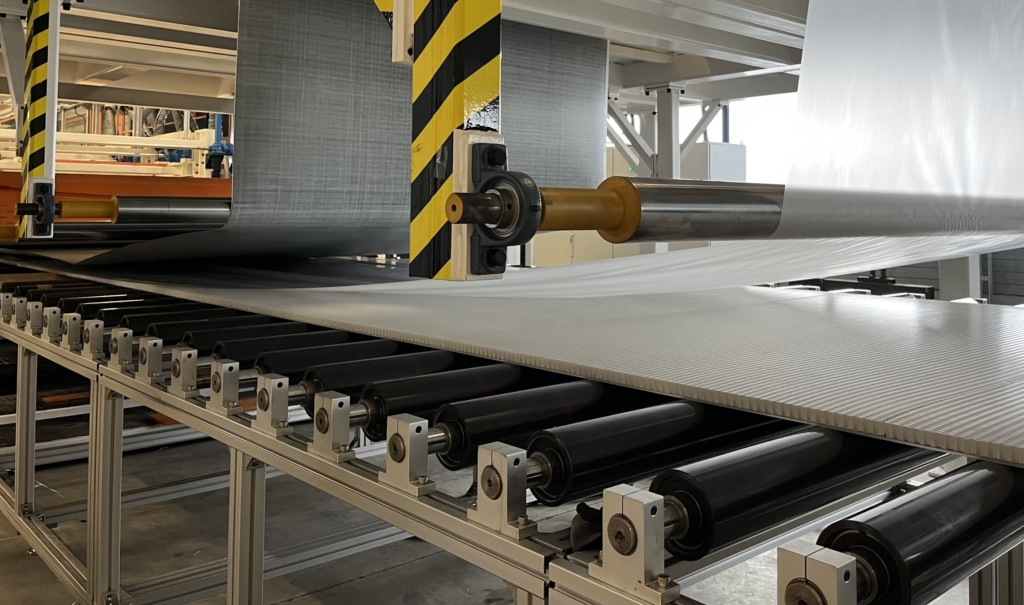
Composite formwork can be used for both walls and floor slabs, but the panel configuration differs per application. Wall formwork requires stiffness in multiple directions and a smooth contact surface, while floor formwork must be able to absorb higher bending and compressive loads. The right panel choice depends on the specific load requirements, the desired reuse, and the dimensions of the formwork system. The questions below look more closely at the technical and practical considerations.
What are the technical differences between wall and floor formwork?
Wall formwork and floor formwork place fundamentally different demands on a panel. With wall formwork, the primary concerns are stiffness in two directions, resistance to lateral concrete pressure, and a smooth contact surface for a clean finish. Floor formwork must absorb vertical loads, including the weight of fresh concrete, reinforcement, and construction traffic.
From a structural perspective, these are the main technical differences:
- Load direction: Wall panels are loaded by horizontal concrete pressure; floor panels carry vertical forces and must limit deflection over larger spans.
- Bending strength: Floor formwork requires higher bending stiffness, especially over larger spans without intermediate support.
- Surface finish: Wall panels need a smooth contact surface for exposed concrete; with floor formwork the underside of the slab is less visible, but flatness remains relevant.
- Weight and handling: Wall panels are often positioned vertically and moved repeatedly, so low weight directly affects labour productivity.
With traditional plywood, wall and floor panels are often made from the same base material, with thickness determining the difference. With composite panels, the combination of core and skin materials offers more freedom to optimise the mechanical properties for each application, without adding unnecessary weight.
What properties must a composite panel have for both applications?
A composite panel suitable for both wall and floor formwork combines high bending stiffness, compressive strength, dimensional stability, and a surface that promotes concrete release. In addition, the panel must withstand moisture, the alkaline conditions caused by cement, and mechanical damage during repeated use.
Mechanical properties
For wall formwork, balanced stiffness in both directions of the panel is important. A cross-reinforced skin construction, in which fibres are oriented in two directions, ensures that the panel performs equally well in every installation direction. For floor formwork, higher bending stiffness in the span direction is required, and core thickness and density play a major role.
Durability and surface
Composite panels must not absorb moisture, swell, or delaminate on contact with fresh concrete or cleaning water. A smooth, closed surface reduces concrete adhesion and extends the service life of the panel. UV resistance is relevant for outdoor storage and long-term use on the construction site. Chemical resistance to cement alkalinity and release agents is likewise a basic requirement for repeated use.
How does composite formwork compare to plywood in repeated use?
Composite formwork structurally outperforms plywood in repeated use. Plywood absorbs moisture, swells, and loses bending stiffness after multiple use cycles. Composite panels are fully waterproof, do not delaminate, and retain their dimensions and mechanical properties even after intensive use in changing weather conditions.
In practice, this means a considerably longer service life. Whereas plywood formwork panels need to be replaced after three to five years, composite panels in comparable applications achieve a service life of twelve years or more. Over a project lifetime of fifteen years, that eliminates two to three replacement cycles. When you add up the panel costs, installation labour, and downtime for each replacement, the composite solution is cheaper per year of use, even with a higher purchase price.
In addition, plywood requires regular maintenance: sanding, impregnating, and checking for damage. Composite panels require no painting, drying time, or structural repairs. For cleaning, rinsing or wiping is sufficient, which further reduces operating costs on construction sites and for rental fleets.
Can composite panels be custom-produced for specific formwork systems?
Yes, composite panels can be custom-produced for specific formwork systems, including tailored dimensions, edge finishing, and surface properties. The production of thermoplastic sandwich panels lends itself well to customisation, both in panel size and in the configuration of core and skin.
Relevant adaptations for formwork applications include:
- Dimensions: Panels can be produced in the exact sizes that fit modular formwork systems, without offcuts or additional processing steps on the construction site.
- Edge finishing: Edge sealing protects the core against moisture ingress and mechanical damage during repeated use and transport.
- Core thickness and density: By adjusting the core thickness and the density of the core material, the bending stiffness can be matched to the specific span and load of the formwork system.
- Surface finish: Depending on the desired concrete finish, the contact surface can be adapted.
For manufacturers of formwork systems, customisation is not an exception but a standard part of product development. A composite panel that fits seamlessly into an existing system reduces adaptation costs and simplifies integration into the production line.
When is composite formwork the better choice over traditional materials?
Composite formwork is the better choice when repeated use, weight reduction, dimensional stability, or a long service life outweigh the initial purchase price. In situations where panels are moved frequently, stored in varying conditions, or deployed in intensive rental fleets, composite delivers a structural advantage.
Specific situations in which composite outperforms traditional materials:
- High frequency of use: In rental fleets and large construction projects with a lot of reuse, the higher purchase costs are quickly amortised through eliminated replacement and maintenance costs.
- Manual handling: Lighter panels reduce the physical strain on workers and increase installation speed, particularly for wall formwork that is positioned vertically.
- Humid or aggressive environments: Composite does not absorb water, does not rot, and is resistant to cement alkalinity and cleaning agents, so performance loss due to environmental influences is minimal.
- Prefab and precast production: In controlled production environments where moulds are used repeatedly, composite offers a stable and durable alternative to wooden moulds that wear out quickly.
Traditional materials such as plywood remain relevant for single-use applications or projects with very low budgets where service life is not a priority. Once reuse and total cost of use over several years are taken into account, the balance almost always shifts in favour of composite.
How we help with composite formwork
We develop and produce thermoplastic sandwich panels that can be used as an alternative to conventional formwork materials. Our panels are manufactured with PP honeycomb or PET foam cores, combined with glass-fibre-reinforced thermoplastic skins, and are available in custom dimensions up to 13,500 mm x 2,900 mm.
What we concretely offer for formwork applications:
- Analysis of your specific load and span requirements, so that the panel configuration matches your formwork system
- Customisation of dimensions, core thickness, core material, and surface finish
- Support with integrating composite panels into existing production processes or system designs
- Technical guidance from prototype to series production, including early identification of design or production risks
We approach every project as a collaboration: we review your design, optimise the panel configuration for your assembly procedure, and help you think through the total cost over the service life. Contact us to discuss which composite solution fits your formwork application, or view our application overviews for more context on what we produce.
Related Articles
- What is the total cost of ownership difference between plywood and sandwich panel floors?
- How do sandwich panel warranties compare to plywood and aluminium?
- How do sandwich panels reduce maintenance costs compared to plywood?
- Why are European manufacturers switching to composite sandwich panels in 2026?
- What is the difference between thermoplastic and thermoset sandwich panels?