

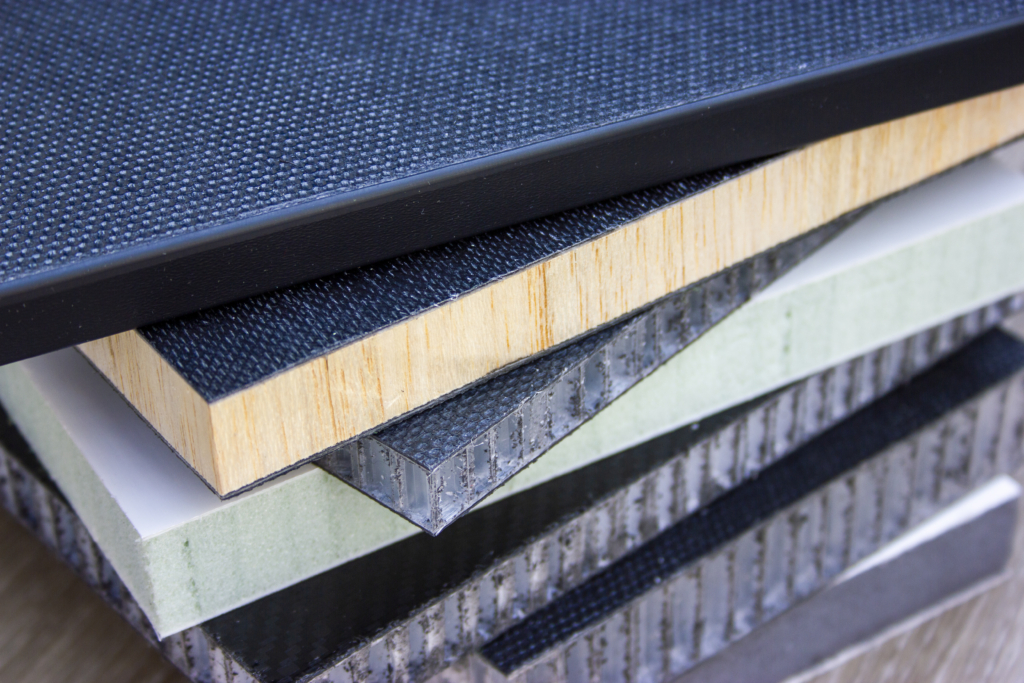
The difference between a woven and non-woven sandwich panel skin comes down to how the reinforcing fibers are arranged. Woven skins interlace fibers in a textile pattern, while non-woven skins stack unidirectional or cross-ply fiber layers without interlacing. That structural distinction directly affects stiffness, strength distribution, surface quality, and how the panel performs under real-world loading conditions.
For manufacturers specifying composite panels for truck bodies, trailers, or scaffolding, the choice of skin architecture is not cosmetic. It shapes the mechanical behavior of the entire sandwich structure. The sections below work through the most common questions engineers and procurement teams ask when comparing these two approaches.
What makes a sandwich panel skin woven or non-woven?
A woven sandwich panel skin is made by interlacing fiber bundles (called tows or rovings) over and under each other in a textile-style pattern, similar to fabric. A non-woven skin lays fibers in flat, parallel layers without interlacing them. The layers are bonded together by a resin matrix rather than by the mechanical interlock of weaving.
In practice, non-woven skins cover a broad family of architectures. The most common types used in structural composite panels are:
- Unidirectional (UD): All fibers run in one direction, maximizing stiffness along that axis
- Cross-ply (CP): Alternating layers oriented at 0° and 90°, distributing strength across two axes
- Multi-ply laminates: Multiple UD or CP layers stacked to build up thickness and load capacity
Woven skins are recognizable by their visible textile pattern on the surface. Non-woven skins typically present a smoother, more uniform face, which is why they are often finished with a PET film or anti-skid coating in commercial panel applications. The absence of fiber crimp in non-woven architectures is a structural advantage: fibers run straight from end to end, which allows them to carry tensile and compressive loads more efficiently than fibers that bend over and under each other in a weave.
How does fiber orientation affect panel strength and stiffness?
Fiber orientation is the single biggest variable controlling the mechanical behavior of a composite skin. Fibers carry load along their length, so the direction in which they run determines where the panel is strong and where it is not. A skin with all fibers in one direction is very stiff along that axis but significantly weaker perpendicular to it.
This is why cross-ply architectures are widely used for wall and cladding panels. By alternating layers at 0° and 90°, a cross-ply skin distributes tensile and bending resistance in both directions. The result is a panel that performs consistently regardless of which way it is installed, which simplifies design and reduces installation errors.
For applications where the dominant load comes from a known direction, a directionally optimized layup can outperform a balanced cross-ply. Scaffolding planks, for example, carry load primarily across their width. A 90-0-90 layup concentrates fiber reinforcement in the transverse direction, maximizing resistance where the load actually acts.
Woven skins also distribute load in two directions, but the fiber crimp introduced by the weave pattern reduces the effective stiffness compared to a non-woven laminate of equivalent fiber content. In structural applications where stiffness-to-weight ratio matters, non-woven architectures generally deliver more performance per gram of material.
Which skin type performs better in transport and vehicle applications?
Non-woven skins, particularly cross-ply and multi-ply glass-fiber laminates, perform better in transport and vehicle applications. They deliver higher stiffness per unit weight, bond more reliably to thermoplastic cores, and support the large-format panel dimensions that truck body builders and trailer manufacturers require.
In commercial vehicle applications, the weight argument is direct. Every kilogram of structural dead weight in a trailer body or cargo box is a kilogram that cannot carry revenue-generating cargo. Lightweight composite panels with non-woven skins replace heavier steel or plywood structures without sacrificing load-bearing performance. In 2026, this weight argument extends beyond payload. For electric trucks and vans, lighter body structures extend battery range per charge. EV fleet buyers now treat structural weight as a range variable, not just a payload variable, and that makes skin architecture a procurement question, not just an engineering one.
Woven skins can perform adequately in lower-demand vehicle applications, but they are less common in heavy transport because the fiber crimp limits stiffness efficiency and the surface texture can complicate bonding and finishing processes. For floor panels in particular, where bending loads are high and surface durability matters, multi-ply non-woven skins with anti-skid finishes are the standard choice across a range of commercial vehicle and scaffolding panel applications.
Does the skin type change how a sandwich panel is processed or bonded?
Yes. The skin architecture affects both how the panel is cut and machined and how it bonds to the core and to adjacent structures. Non-woven skins with thermoplastic matrices are well suited to CNC routing, sawing, and edge bending, which are the standard processing methods for custom-dimensioned panels in vehicle and scaffolding production.
Woven skins, particularly those using thermoset resins, can delaminate at cut edges if the weave is not properly supported during machining. The interlaced fiber structure can also create stress concentrations at the crimp points, which become relevant when panels are drilled or fastened under load.
For bonding, the surface chemistry of the skin matrix matters more than the weave pattern itself. Thermoplastic skins bond well to thermoplastic cores through heat-activated lamination, producing a monolithic panel without adhesive layers. This is relevant for edge sealing and edge bending, where the skin needs to wrap or seal against the core to protect it from moisture and UV exposure. In truck floors and scaffolding boards that are regularly washed down or exposed to weather, that edge integrity directly affects service life.
What fiber and resin combinations are available for each skin type?
Both woven and non-woven skins can use glass fiber or carbon fiber as the reinforcement, combined with either thermoplastic or thermoset resin systems. The combination determines weight, stiffness, cost, and recyclability.
Non-woven skin options
Non-woven skins are available in a wider range of thermoplastic matrix options, including glass-fiber-PP (polypropylene), carbon-PP, and glass-PET. These combinations support continuous production processes and produce panels that are fully thermoplastic and recyclable, which is relevant for European OEMs subject to the EU End-of-Life Vehicles (ELV) Directive. Glass-fiber content in structural non-woven skins typically runs at around 66 to 67 percent by weight, which delivers a strong balance of stiffness and areal weight.
Woven skin options
Woven skins are more commonly found in thermoset systems, such as glass-fiber-epoxy or glass-fiber-polyester, though thermoplastic woven fabrics do exist. Thermoset woven skins are not recyclable in the same way as thermoplastic panels, which creates a compliance consideration for manufacturers reporting under the EU Corporate Sustainability Reporting Directive (CSRD). Carbon fiber woven fabrics are used in high-performance applications where weight is the overriding constraint, but the cost premium is significant and the recyclability question remains.
Should you specify a woven or non-woven skin for your panel application?
For most structural applications in commercial vehicles and scaffolding, a non-woven skin is the better specification. It delivers higher stiffness efficiency, supports thermoplastic processing and recycling, and is compatible with large-format continuous production. Woven skins are worth considering when a specific surface aesthetic is required or when the application involves complex curved geometries where a woven fabric drapes more easily over a mold.
The practical decision comes down to three questions:
- What direction does the dominant load act? If it is biaxial, a cross-ply non-woven skin handles it efficiently. If it is strongly directional, a UD or directionally optimized layup delivers more performance per gram.
- What are the surface requirements? A smooth PET-film finish or an anti-skid surface suits most vehicle and scaffolding applications and is standard on non-woven panel products.
- What are the recyclability and compliance requirements? Thermoplastic non-woven skins support end-of-life recyclability under the ELV Directive. If your customers are subject to CSRD reporting, this is a specification argument, not just a preference.
Specifications vary by customer and application. Always confirm the specific requirements of your project before finalizing a skin architecture, because panel construction, ply count, and core density all interact to determine the final performance profile.
How Compoform Helps You Specify the Right Skin Architecture
We manufacture thermoplastic sandwich panels using non-woven glass-fiber skins in cross-ply and multi-ply configurations, laminated onto PP honeycomb or PP foam cores. Every panel we produce is 100% European-made at our facilities in the Netherlands, with a production capacity of 1.5 million square meters per year and panel dimensions up to 13,500 mm × 2,950 mm.
When you bring us a panel application, we do not simply match you to a standard product. We review your structural requirements, load direction, surface finish needs, and assembly process, then recommend the skin architecture and ply count that fits your specific use case. That includes:
- Cross-ply wall panels with white PET-film finish for cladding and interior applications, where balanced biaxial properties and a clean decorative surface matter
- Multi-ply floor panels with anti-skid surfaces on PP honeycomb cores, designed for high-load truck and trailer floors that are self-supporting without an aluminium subframe, removing a production step and reducing your build cost
- Directionally optimized scaffolding panels engineered to meet EN 12811 load class requirements, including load class 4 on an 11 mm panel with no support underneath
- Custom ply counts and asymmetric constructions where one face needs higher stiffness than the other, for example a 2-ply/4-ply configuration that concentrates reinforcement on the load-bearing side
Over a 15-year vehicle life, switching from plywood to a thermoplastic composite floor eliminates two to three replacement cycles. Once you factor in panel cost, installation labour, and vehicle downtime, the composite is cheaper per year of service, even at a higher unit price.
If you are specifying panels for a truck body, trailer, or scaffolding application and want to work through the skin architecture options with our engineering team, contact us to discuss your project. We will review your design, flag any integration issues, and confirm the panel configuration before production begins.
Related Articles
- How much weight can you save by switching from plywood to sandwich panels?
- How does a PP honeycomb core distribute load across a sandwich panel?
- Can sandwich panels replace steel in structural applications?
- What is the lifespan of a sandwich panel in heavy transport use?
- What are the benefits of sandwich panels over steel and wood?