

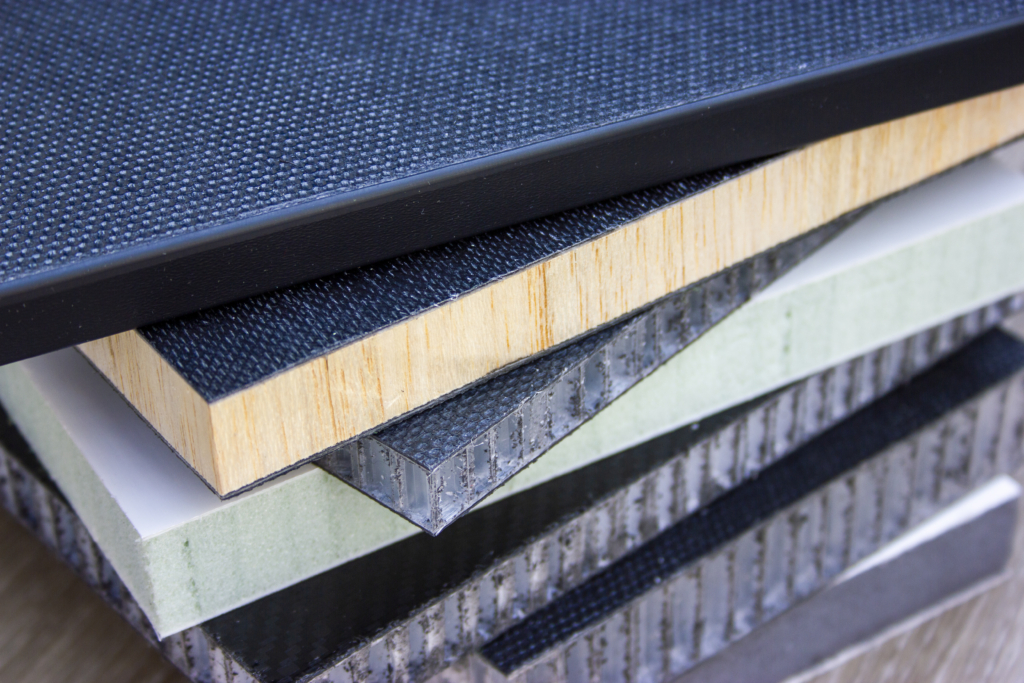
PP honeycomb sandwich panels offer moderate sound transmission loss rather than high acoustic isolation. The cellular PP core absorbs some vibrational energy, and the composite skin-core-skin structure interrupts sound pathways more effectively than a single solid sheet of the same weight. For vehicle body builders and trailer manufacturers, this matters because acoustic comfort is increasingly a specification requirement, not an afterthought.
The sections below address the most common technical questions about acoustic performance, including how PP honeycomb compares to metal panels, what drives performance differences, and how panels can be configured to meet specific noise targets.
How do PP honeycomb sandwich panels affect sound transmission?
PP honeycomb sandwich panels reduce sound transmission by combining mass, damping, and structural decoupling in a single panel. The stiff glass-fiber skins resist vibration, while the cellular polypropylene core interrupts the direct path that sound waves travel through solid materials. The result is a panel that performs better acoustically than its weight alone would predict.
Sound transmission through a building or vehicle panel is governed by three mechanisms: mass, stiffness, and damping. A solid steel sheet relies almost entirely on mass to block sound. A sandwich panel works differently. The two stiff skins act as independent radiating surfaces separated by a low-density core, which means vibration energy must transfer across the core interface twice before it can radiate on the far side. Each interface introduces a loss.
The PP honeycomb core contributes damping through the internal friction of its cellular walls. When sound energy enters the panel, the honeycomb cells deform slightly and convert some of that energy into heat rather than passing it through. This is a modest effect compared to dedicated acoustic materials, but it is meaningful in the mid-frequency range where vehicle interior noise is most noticeable to occupants.
Importantly, the acoustic benefit scales with panel thickness. A thicker core increases the separation between skins, which improves performance at lower frequencies where mass-law panels typically struggle. This is one reason floor panels with 30 mm PP honeycomb cores behave differently acoustically from 15 mm variants, even when the skin specification is identical.
What is the sound absorption coefficient of PP honeycomb panels?
PP honeycomb sandwich panels are not high-absorption materials. Their sound absorption coefficient is generally low, typically in the range of 0.05 to 0.15 across most frequencies, which means they reflect the majority of incident sound rather than absorbing it. They are structural panels first, and their acoustic role is primarily sound transmission loss rather than absorption.
Sound absorption and sound transmission loss are different properties that are often confused. Absorption describes how much sound energy a surface converts to heat when sound strikes it. Transmission loss describes how much sound is blocked from passing through the panel to the other side. PP honeycomb panels perform better on transmission loss than on absorption.
If your application requires genuine sound absorption, such as reducing reverberation inside a cargo box or truck cab, a PP honeycomb panel alone will not achieve that. A composite panel can be paired with an absorptive lining on the interior face, which handles absorption while the structural panel handles transmission loss and load-bearing. This is a common approach in coachbuilding and specialist vehicle construction.
For applications where the panel itself must provide both structural performance and acoustic absorption, the panel configuration, skin weight, and surface treatment all influence the result. Specifying the right combination requires reviewing the actual noise targets for your application rather than relying on generic material data.
How does PP honeycomb compare to aluminum and steel panels for noise reduction?
PP honeycomb sandwich panels generally outperform aluminum and steel panels of equivalent weight for noise reduction. Metal panels have high stiffness and low internal damping, which makes them efficient sound radiators. A PP honeycomb sandwich panel, by contrast, has higher internal damping and a decoupled skin structure that reduces vibrational energy transfer across the panel.
The comparison depends on whether you are comparing panels of equal weight or equal thickness.
Equal weight comparison
At the same areal weight, a PP honeycomb sandwich panel typically achieves better sound transmission loss than a solid aluminum or steel sheet. This is because the sandwich structure distributes mass across two separated skins, which is acoustically more efficient than concentrating the same mass in a single layer. Metal panels at low areal weights also suffer from coincidence dip effects, where sound at certain frequencies passes through with very little attenuation.
Equal thickness comparison
At the same thickness, a PP honeycomb panel is significantly lighter than a steel or aluminum panel. The steel or aluminum panel will have higher mass, which improves low-frequency transmission loss under the mass law. However, the PP honeycomb panel’s damping advantage partially compensates, particularly in the mid-frequency range. For vehicle applications where weight directly affects payload capacity and, in electric vehicles, battery range, the acoustic performance of a lighter composite panel is often the better engineering trade-off.
Metal panels also transmit structure-borne noise efficiently. Vibration from road surfaces, engine mounts, or cargo movement travels through steel and aluminum structures with low attenuation. The composite skin and PP core combination introduces more damping into the structure, which reduces the intensity of structure-borne noise reaching the vehicle interior.
What factors affect the acoustic performance of a honeycomb sandwich panel?
The acoustic performance of a PP honeycomb sandwich panel is shaped by core density, panel thickness, skin weight and layup, and the quality of the bond between skin and core. Changing any one of these variables shifts the panel’s transmission loss profile across the frequency spectrum.
- Core density: Higher-density PP honeycomb cores add mass and stiffness, which improves low-frequency transmission loss. A 140 kg/m3 honeycomb core behaves differently from a 120 kg/m3 core, even at the same thickness.
- Panel thickness: Increasing thickness improves the separation between skins and shifts the panel’s resonance frequencies. Thicker panels generally perform better at lower frequencies.
- Skin weight and layup: Heavier skins add mass, which improves transmission loss under the mass law. A 4-ply glass-fiber skin contributes more acoustic mass than a 2-ply skin. The fiber orientation also affects how stiffness is distributed, which influences where coincidence effects occur.
- Skin-to-core bond integrity: A well-bonded skin transfers vibration energy into the core efficiently, where it is partially dissipated. Delamination or poor adhesion reduces damping and can create resonant cavities that worsen acoustic performance.
- Surface finish: Hard, smooth surfaces reflect sound. Textured or anti-skid surfaces have a marginal effect on absorption at the surface level, but this is a secondary factor compared to the structural variables above.
Panel dimensions also matter. Larger panels have lower resonance frequencies, which can affect how they perform in specific frequency bands relevant to your application. This is why acoustic performance should always be evaluated in the context of the actual panel size and mounting conditions in your vehicle or structure, not from material data alone.
Are PP honeycomb panels suitable for vehicle interior noise control?
PP honeycomb sandwich panels are suitable as the structural layer in a vehicle noise control system, but they are not a complete acoustic solution on their own. For truck bodies, trailers, and cargo boxes, they provide better noise reduction than equivalent steel or aluminum panels at lower weight, which makes them a practical choice when acoustic performance is one of several competing requirements.
In commercial vehicle applications, interior noise comes from multiple sources: road noise transmitted through the floor, wind noise through wall panels, and mechanical noise from the drivetrain. A PP honeycomb floor panel addresses structure-borne road noise more effectively than a steel floor because the composite structure damps vibration rather than transmitting it efficiently. Wall panels with PP honeycomb cores reduce airborne noise transmission from wind and external sources.
Weight reduction in vehicle body structures also has a direct acoustic benefit that is often overlooked. Lighter panels reduce the unsprung or semi-sprung mass that vibrates in response to road inputs, which lowers the amplitude of structure-borne noise at the source. In electric trucks and vans, this matters beyond payload. Lighter body structures extend battery range per charge, and EV fleet buyers in 2026 are increasingly treating weight reduction as a range argument, not just a payload argument. Every kilogram saved in the body structure is a kilogram that either carries cargo or extends the vehicle’s operating range between charges.
For applications with strict interior noise targets, such as refrigerated trailers with crew rest areas or specialist vehicles with onboard equipment, PP honeycomb panels are typically combined with acoustic linings, vibration-damping adhesives, or secondary insulation layers. The composite panel handles the structural load; the acoustic treatment handles the residual noise.
Can PP honeycomb panels be optimized for better acoustic performance?
Yes, PP honeycomb panels can be configured to improve acoustic performance within the constraints of the structural specification. The most effective levers are increasing panel thickness, selecting a higher-density core, specifying heavier skins, and combining the structural panel with a secondary acoustic treatment on the interior face.
Increasing core thickness from 15 mm to 30 mm, for example, improves the separation between skins and shifts resonance behavior. This does add weight, but the weight increase is modest compared to the equivalent improvement in a solid metal panel. PP foam cores, available in density grades from 40 to 140 kg/m3, offer additional flexibility for wall panel applications where the balance between acoustic mass and total panel weight needs to be tuned.
Skin specification also offers room for optimization. A 4-ply glass-fiber skin adds acoustic mass compared to a 2-ply skin, improving transmission loss in the mass-controlled frequency range. The trade-off is a heavier panel, so the acoustic gain must be weighed against the payload or range implications for your specific vehicle.
For applications where the panel must meet a defined sound transmission class or weighted sound reduction index, the panel configuration should be validated against measured data for that specific construction, not estimated from generic material properties. Acoustic performance is sensitive to panel size, edge conditions, and mounting details, all of which vary between applications.
How Compoform Supports Your Acoustic Panel Specification
We work with truck body builders, trailer manufacturers, and specialist vehicle assemblers to configure PP honeycomb panels that meet both structural and acoustic requirements within a single panel solution. Rather than supplying panels to a generic specification, we review your application, your noise targets, and your assembly process before recommending a configuration.
- Panel configuration review: We assess core density, thickness, and skin layup against your structural load requirements and acoustic targets, so you are not over-specifying or under-specifying the panel.
- Custom dimensions: Panels are available in custom dimensions cut to your exact specification, including large-format panels up to 13,500 mm x 2,950 mm, which reduces joints and potential acoustic weak points in the finished structure.
- Compoform-tested performance: Our 30 mm PP honeycomb floor panels are self-supporting without an aluminum subframe, which removes a production step and eliminates a potential vibration transmission path in the floor structure.
- Long service life: Thermoplastic composite panels last significantly longer than plywood in heavy transport applications. Over a 15-year vehicle life, eliminating two or three replacement cycles removes not just material cost but the downtime and labour associated with each refurbishment.
- EU compliance: Our thermoplastic panels are fully recyclable and support compliance with the EU End-of-Life Vehicles Directive, which is a procurement requirement for a growing number of European fleet operators and OEMs.
If you are specifying panels for a vehicle body or trailer where acoustic performance is part of the brief, contact us with your application details. We will review the panel configuration, flag any integration issues before production, and support you through the development process as an engineering partner, not just a panel supplier.
Related Articles
- What is the difference between a woven and non-woven sandwich panel skin?
- What is the role of sandwich panels in dry freight trailer construction?
- How do sandwich panel scaffold boards reduce on-site injuries?
- How to compare material specs before your next build project?
- Are sandwich panels strong enough for structural applications?