

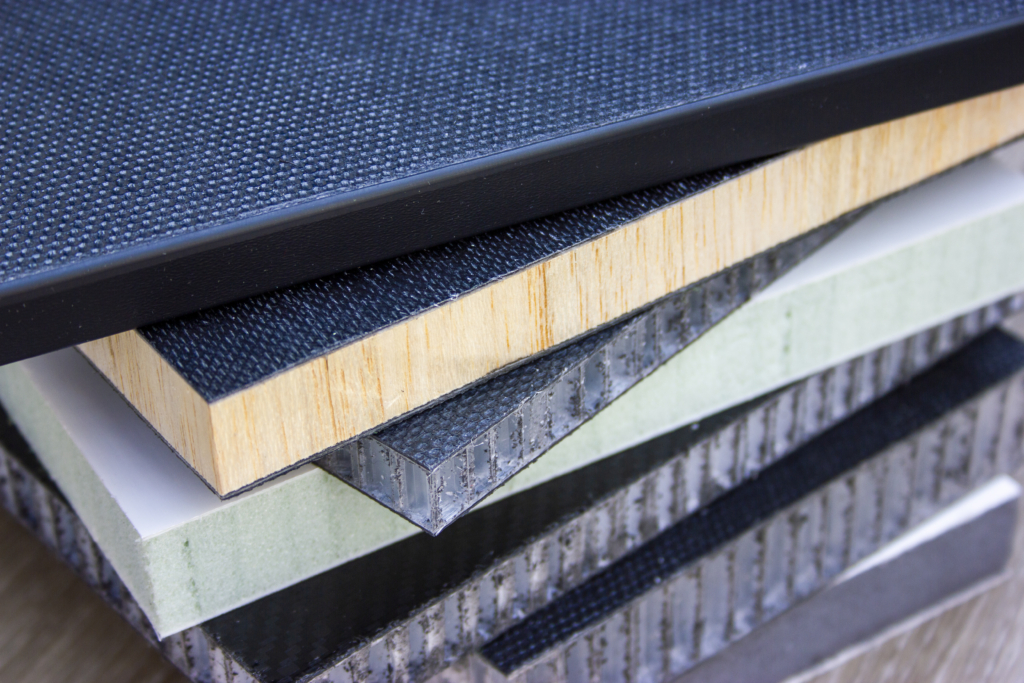
PP honeycomb is used as a core material in sandwich panels because it delivers an exceptional strength-to-weight ratio. The hexagonal cell geometry distributes compressive and shear loads efficiently across the panel, while polypropylene as a base material keeps overall weight low, resists moisture, and remains fully recyclable. The sections below answer the most common questions about how PP honeycomb works, what it offers, and where it performs best.
This article covers the broader sandwich panel market. Our range at Compoform is limited to PP honeycomb and PET foam cores for commercial vehicles and scaffolding.
What makes PP honeycomb different from other core materials?
PP honeycomb is different from other core materials because it combines low density with high structural efficiency and full thermoplastic recyclability. The polypropylene matrix is inherently moisture-resistant and chemically inert, which means it does not absorb water, rot, or degrade when exposed to cleaning agents. Unlike foam cores, the open-cell geometry of honeycomb allows the structure to carry load through geometry rather than material mass alone.
Most alternative core materials involve trade-offs that PP honeycomb avoids. Wood-based cores absorb moisture over time, which leads to delamination and weight gain in service. Foam cores offer good insulation but lower shear strength per unit weight. PP honeycomb sits in a different category: it is a structural core that also happens to be lightweight, chemically stable, and compatible with thermoplastic skins for a fully recyclable panel assembly.
For European OEMs working under the EU End-of-Life Vehicles (ELV) Directive and increasingly under CSRD sustainability reporting obligations, the recyclability of PP honeycomb is not just a preference. It is a compliance argument. A panel built entirely from thermoplastic materials can be reprocessed at end of life without the separation problems that arise with thermoset composites or mixed-material assemblies.
How does the honeycomb geometry affect panel performance?
The hexagonal honeycomb geometry affects panel performance by converting compressive and shear forces into tension and compression within the cell walls, rather than absorbing them through bulk material. This is the same structural principle that makes a bridge truss stiffer than a solid beam of the same weight. The geometry does the structural work, so the core can be made from a lightweight polymer without sacrificing load-bearing capacity.
When a sandwich panel is loaded in bending, the skins carry the tensile and compressive stresses while the core resists shear between them. The honeycomb geometry is particularly effective at this because the cell walls run perpendicular to the panel face, giving the core a high out-of-plane stiffness relative to its mass. Increasing the cell wall height, which corresponds to increasing panel thickness, raises the panel’s bending stiffness significantly without adding proportional weight.
Cell size and wall thickness also influence performance. Smaller cells with thinner walls produce a lighter core with lower absolute load capacity. Larger cells with thicker walls increase density and load capacity. In practice, a PP honeycomb core density of 140 kg/m³ with 8 mm tube diameters, as used in Compoform’s floor panels, delivers a compression strength of 4.50 MPa at the panel level (measured per EN ISO 844), which is sufficient for truck body floor applications without requiring an aluminium subframe beneath the panel.
What are the main properties of PP honeycomb as a core?
The main properties of PP honeycomb as a core material are low density, high shear and compressive strength relative to weight, moisture resistance, chemical resistance, thermal stability across the temperature ranges typical of transport applications, and full thermoplastic recyclability. Together, these properties make it a practical structural core for panels that need to perform reliably over long service lives in demanding environments.
- Low density: PP honeycomb cores are significantly lighter than solid polymer, wood, or metal alternatives. This directly reduces panel weight and, in vehicle applications, increases available payload or extends battery range.
- Moisture resistance: Polypropylene does not absorb water. Panels used in truck bodies, trailers, and scaffolding boards are regularly washed down or exposed to rain, and the core does not degrade under these conditions.
- Chemical resistance: PP is resistant to a wide range of cleaning agents, fuels, and industrial fluids, which matters in logistics and transport environments.
- Thermal stability: PP honeycomb performs across the temperature range typical of European commercial vehicle operation, from winter cold to summer heat, without significant dimensional change.
- Recyclability: Because both the core and the thermoplastic skins are polypropylene-based, the panel can be reprocessed at end of life. This supports compliance with the EU ELV Directive for vehicle manufacturers.
One property worth noting specifically for scaffolding applications: edge sealing and edge bending protect the honeycomb core from UV exposure and moisture ingress at the cut edges. For scaffold boards that are regularly handled, stacked, and exposed to weather, this edge protection is what determines long-term durability rather than the core material alone.
Which industries use PP honeycomb sandwich panels?
PP honeycomb sandwich panels are used across a range of industries, but the strongest adoption in 2026 is in commercial vehicles and scaffolding. Truck body builders, trailer manufacturers, and van body assemblers use PP honeycomb panels for floors, walls, and roofs because the weight saving translates directly into payload capacity and, for electric vehicles, into extended battery range. Scaffolding manufacturers use them for structural decking boards where load class certification and low weight for manual handling are both required. You can explore PP honeycomb panel applications across industries to see how these panels are specified in practice.
Commercial vehicles
In truck bodies and trailers, PP honeycomb panels replace plywood or steel in floor, sidewall, and roof applications. The weight reduction is significant: a composite floor panel can weigh substantially less than an equivalent plywood or steel floor, and every kilogram saved in body structure is a kilogram that can carry revenue-generating cargo. For fleet operators transitioning to electric trucks and vans, this argument extends further. Lighter body structures extend battery range per charge, making weight reduction a range argument as much as a payload argument. In 2026, EV fleet buyers routinely ask about body weight as part of procurement specifications.
A 30 mm PP honeycomb sandwich floor panel is self-supporting, meaning it requires no aluminium subframe underneath. For truck body builders, this removes a production step, reduces component count, and lowers total assembly cost. Over a 15-year vehicle life, a composite floor also eliminates two to three plywood replacement cycles. Once you factor in panel cost, installation labour, and vehicle downtime for each replacement, the composite floor is cheaper per year of service even at a higher unit price.
Scaffolding and access equipment
In scaffolding, the relevant performance benchmark is EN 12811, which defines load classes for temporary work platforms. A 10.5 mm Compoform PP honeycomb panel achieves EN 12811 load class 4 with no support underneath, which demonstrates the structural efficiency of the honeycomb construction at a panel thickness that keeps weight low enough for manual handling on site. Lighter scaffold boards reduce fatigue for workers who carry and position them repeatedly, and they reduce the dead load on the scaffold structure itself.
How does PP honeycomb compare to aluminum honeycomb in sandwich panels?
PP honeycomb and aluminium honeycomb are both structural core materials with similar geometric principles, but they differ in weight, cost, recyclability, and the industries they serve. Aluminium honeycomb offers higher stiffness and strength at equivalent density, which is why it is used in aerospace applications where performance margins are tight and cost is secondary. PP honeycomb is lighter in absolute terms for equivalent panel sizes in many configurations, significantly lower in cost, and fully recyclable as a thermoplastic material.
For commercial vehicle and scaffolding applications, aluminium honeycomb is rarely the right choice. The cost premium is not justified when PP honeycomb meets the structural requirements, and the mixed-material nature of an aluminium core bonded to thermoplastic skins creates end-of-life separation challenges that conflict with EU ELV Directive compliance requirements. PP honeycomb with thermoplastic skins produces a panel that can be reprocessed as a single material stream.
Aluminium honeycomb also requires more careful handling to avoid core crushing during fabrication and installation. PP honeycomb is more tolerant of the handling conditions typical in truck body assembly and scaffolding manufacturing environments. For the industries where PP honeycomb is the right specification, the comparison with aluminium honeycomb is not competitive in practice. They serve different markets with different priorities.
Can PP honeycomb panels replace steel or wood in structural applications?
Yes, PP honeycomb sandwich panels can replace steel or wood in many structural applications, provided the panel specification is matched to the load requirements of the specific application. In truck body floors, trailer sidewalls, and scaffolding boards, PP honeycomb panels already replace plywood and steel at scale. The replacement is not a compromise: the panels meet the same or higher structural performance requirements while delivering significant weight reductions.
The structural case rests on the sandwich panel principle. The stiff, fibre-reinforced thermoplastic skins carry bending loads while the PP honeycomb core resists shear between them. The result is a panel that behaves structurally like a much heavier solid material but at a fraction of the weight. For applications where the load is primarily bending and compression, such as floors and decking, this is a direct functional replacement for plywood or steel plate.
Durability is also a relevant factor in the replacement argument. In heavy transport, thermoplastic composite floors last significantly longer than plywood. Industry experience with composite panels in truck body applications points to service lives of 12 years or more, compared to three to five years for plywood under equivalent conditions. This means two to three fewer replacement cycles over a vehicle’s working life, with corresponding savings in material cost, labour, and downtime.
The replacement does require attention to edge details, fastener types, and connection methods, since composite panels behave differently from wood or steel at joints and fixings. Getting these details right at the design stage is where the difference between a successful replacement and a problematic one is made.
How Compoform Helps with PP Honeycomb Sandwich Panels
We manufacture PP honeycomb sandwich panels for commercial vehicles and scaffolding, and we work with truck body builders, trailer manufacturers, and scaffolding companies to specify the right panel configuration for each application. This is not a catalogue selection process. We review your design, assess the load requirements, and configure the panel to match your assembly process and performance targets.
- Panel configuration: We select core density, skin specification, and panel thickness based on your structural requirements, not a standard product range. A floor panel for a refrigerated trailer has different requirements from a scaffold decking board, and we configure accordingly.
- Custom dimensions: Panels are available in custom dimensions cut to your exact specification, including large-format panels up to 13,500 mm × 2,950 mm. This removes the need for field joining that adds weight and complexity.
- Edge protection: We apply edge sealing and edge bending where the application requires it, protecting the core from moisture ingress and UV degradation in service.
- ELV compliance support: Our thermoplastic panels support your compliance with the EU End-of-Life Vehicles Directive. We can provide material documentation to support your sustainability reporting under CSRD.
- Post-sales support: We stay involved through integration, flag issues before they reach production, and support you through any iteration needed as your design evolves.
If you are evaluating PP honeycomb panels for a truck body floor, trailer sidewall, or scaffolding board application, see how these properties translate in truck body applications and contact our engineering team about your specific panel configuration. We review the design with you before anything goes to production.