

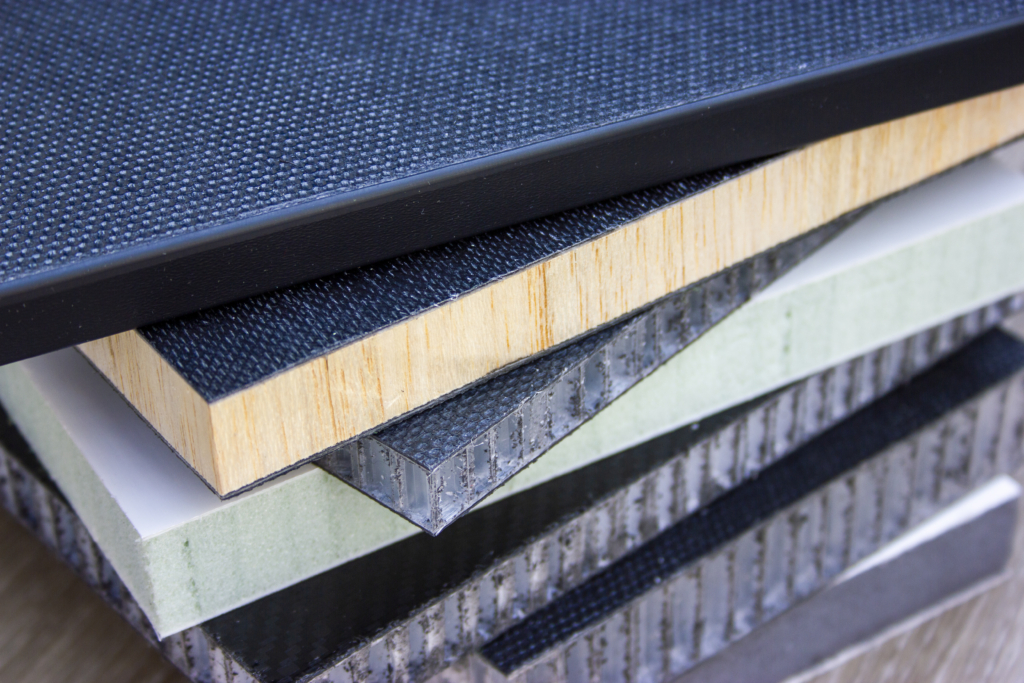
Polypropylene honeycomb is a lightweight thermoplastic core material made from extruded polypropylene tubes fused together in a repeating hexagonal or tubular grid structure. It sits at the centre of a sandwich panel, bonded between two structural skins, and provides compressive strength and rigidity at a fraction of the weight of solid materials. The sections below cover how it is made, how it performs, and where it is used in commercial applications.
How is polypropylene honeycomb manufactured?
Polypropylene honeycomb is manufactured by extruding polypropylene into hollow tubes, then thermally bonding those tubes side by side to form a rigid, open-cell grid. The result is a continuous block of interlocked tubular cells that can be sliced to any required thickness and laminated with structural skins to form a finished sandwich panel.
The production process starts with raw polypropylene resin, which is melted and extruded through a die to produce uniform hollow tubes. These tubes are aligned in parallel rows and fused together under heat and pressure. Because polypropylene is a thermoplastic, the bonding process is clean and does not require adhesives; the material welds to itself when heated, which also makes the core fully recyclable at end of life.
Tube diameter is a controlled variable that directly affects the density and mechanical performance of the finished core. In Compoform’s panel range, for example, PP honeycomb uses an 8 mm tube diameter, available at densities of 120 kg/m³ for scaffolding applications and 140 kg/m³ for flooring panels. Higher density means smaller wall spacing or thicker tube walls, which increases compressive strength but also adds weight. Selecting the right density for the application is part of the engineering process, not a standard off-the-shelf decision.
What are the structural properties of PP honeycomb?
PP honeycomb delivers high compressive strength and stiffness relative to its weight. The tubular cell geometry distributes point loads across a wide area, resisting crushing forces efficiently. When laminated between structural skins, the core also resists shear forces and prevents the skins from buckling under bending loads, which is the fundamental principle behind sandwich panel design.
The specific performance of a PP honeycomb core depends on its density. A 140 kg/m³ core, as used in floor panel applications, delivers meaningfully higher compressive strength and modulus than a 120 kg/m³ core used in lighter-duty scaffolding panels. Neither figure is universal; the finished panel’s bending performance is also shaped by skin thickness, fibre orientation, and overall panel thickness. Thicker panels with the same core density will carry significantly higher loads because the skins are further apart, increasing the panel’s second moment of area.
PP honeycomb also performs well in wet and chemically aggressive environments. Unlike wood or paper-based cores, polypropylene does not absorb moisture, does not rot, and resists most cleaning agents, a relevant property for truck floors and scaffolding boards that are regularly washed down or exposed to weather.
What is polypropylene honeycomb used for?
Polypropylene honeycomb is used as the structural core in sandwich panels for commercial vehicle bodies, trailer floors, and scaffolding boards, wall cladding, and flooring systems. Its combination of low weight, high compressive resistance, and moisture immunity makes it well suited to any application where dead weight must be minimised without sacrificing load-bearing capacity.
In commercial transport, PP honeycomb floor panels replace traditional plywood or steel floors in truck bodies and trailers. The weight saving directly increases legally permitted payload capacity; every kilogram removed from the floor structure is a kilogram that can carry revenue-generating cargo. In 2026, this argument extends beyond payload to battery range: in electric trucks and vans, lighter body structures extend range per charge. Every kilogram of structural dead weight reduces how far the vehicle travels on a single charge, making weight reduction a range argument as much as a payload argument. EV fleet procurement teams now routinely ask about panel weight as part of their vehicle specification process.
In scaffolding, PP honeycomb panels are used as working platforms and boards. The material’s resistance to moisture and chemicals means it does not degrade on construction sites the way timber does, and its consistent mechanical properties make load performance predictable across the working life of the board.
Other applications include wall cladding panels for vehicle interiors, cargo box liners, and modular structures where a lightweight, durable panel is needed at large format dimensions.
How does PP honeycomb compare to aluminium honeycomb?
PP honeycomb and aluminium honeycomb are both used as sandwich panel cores, but they differ significantly in weight, cost, recyclability, and compatibility with thermoplastic manufacturing processes. PP honeycomb is lighter per unit volume, lower in material cost, and fully recyclable within a single-material thermoplastic system. Aluminium honeycomb offers higher stiffness in very thin sections but introduces dissimilar material bonding challenges and end-of-life separation issues.
For European commercial vehicle and scaffolding applications, the practical differences matter most at the system level. A thermoplastic PP honeycomb core bonds directly to thermoplastic skins without adhesive layers, producing a panel that is chemically consistent throughout. This simplifies recycling under the EU End-of-Life Vehicles (ELV) Directive, which requires manufacturers to demonstrate material recoverability. An aluminium core bonded to polymer skins creates a mixed-material structure that is harder to separate and process at end of life, an increasingly relevant compliance consideration for European OEMs subject to CSRD sustainability reporting requirements.
From a handling and fabrication perspective, PP honeycomb panels can be cut, routed, and edge-sealed using standard thermoplastic processing equipment. Aluminium honeycomb requires different tooling and generates metal swarf that must be managed separately. For mid-volume manufacturers producing truck bodies or trailer floors at meaningful scale, the simpler processing of PP honeycomb reduces production complexity and tooling cost.
What skins are laminated onto polypropylene honeycomb cores?
PP honeycomb cores are laminated with glass-fibre-reinforced thermoplastic skins, most commonly using glass-fibre-PP or glass-PET laminates. The skin architecture, the number of plies and the fibre orientation, determines the panel’s tensile strength, bending resistance, and surface finish. Common configurations include 2-ply and 4-ply unidirectional laminates, as well as cross-ply layups where fibres alternate between 0° and 90° to equalise performance in both directions.
Surface finish options on the outer skin face include white PET film for a clean, decorative appearance and black anti-skid finishes for flooring and scaffolding applications where grip is a safety requirement. The PET film surface on wall panels also provides UV resistance, relevant for vehicle exteriors and outdoor scaffolding boards exposed to prolonged sunlight.
Fibre content in the skins runs at approximately 66 to 67% glass fibre by weight, which gives the laminate high tensile stiffness relative to its thickness. The combination of a stiff, lightweight core with high-fibre-content skins is what allows a relatively thin sandwich panel to carry loads that would require a much thicker and heavier solid material to match.
Skin selection is application-specific. A floor panel in a truck body needs a 4-ply skin with an anti-skid surface and high bending resistance in the loaded direction. A wall cladding panel needs a cross-ply skin that performs equally in both orientations and presents a finished surface. Specifying the wrong skin for the application undermines the structural performance of even a well-chosen core.
Is polypropylene honeycomb recyclable?
Yes, polypropylene honeycomb is recyclable. Because both the core and the thermoplastic skins are polypropylene-based, the entire panel can be processed as a single material stream at end of life; no separation of dissimilar materials is required. This makes PP honeycomb sandwich panels compatible with thermoplastic recycling infrastructure and relevant to European OEMs with material recovery obligations.
For manufacturers supplying into the commercial vehicle sector, recyclability is increasingly a compliance requirement rather than a preference. The EU End-of-Life Vehicles Directive sets material recovery targets for vehicles, and OEMs subject to CSRD sustainability reporting need to document the recoverability of materials used in their products. A fully thermoplastic sandwich panel simplifies that documentation compared to mixed-material alternatives.
It is worth noting that recyclability at end of life is distinct from recycled content at point of manufacture. PP honeycomb panels are recyclable, but the proportion of recycled input material in any given panel depends on the specific production process and supplier. If recycled content is a procurement requirement, confirm this directly with the manufacturer rather than assuming it from the material’s recyclability.
How Compoform Supports Your PP Honeycomb Panel Specification
We manufacture PP honeycomb sandwich panels for commercial vehicle bodies, trailer floors, and scaffolding applications from our production facilities in the Netherlands. Every panel we produce is 100% European-made, and our production line handles custom dimensions up to 13,500 mm × 2,950 mm, formats that are not available off-the-shelf from most European suppliers.
When you work with us, the process starts with your application requirements, not a standard product list. We review your load case, assembly process, and surface finish needs, then configure the core density, skin architecture, and panel thickness to match. Practically, this means:
- Core density selection: We specify 120 kg/m³ or 140 kg/m³ PP honeycomb based on your actual load requirements, not a default option.
- Skin configuration: 2-ply or 4-ply glass-fibre skins, cross-ply or unidirectional, with PET film or anti-skid surface finish depending on your application.
- Custom dimensions: Panels cut to your exact specification, reducing fabrication steps in your assembly process.
- Edge protection: Edge sealing and edge bending are available to protect the core from moisture and UV, relevant for truck floors washed down regularly and scaffolding boards used outdoors.
- Structural validation: Our 30 mm PP honeycomb floor panels are self-supporting with no aluminium subframe required, removing a production step and reducing your total cost of ownership.
We also flag integration issues before production starts. If your current design specifies a panel configuration that will underperform in your assembly environment, we tell you before you commit to tooling or a production run, not after. That is the difference between a panel supplier and an application partner. To discuss your specific panel requirements, get in touch with our engineering team.
Related Articles
- What are the fire and smoke requirements for aerospace sandwich panels?
- How thick should sandwich panels be in a motorhome build?
- What weight savings do sandwich panel scaffold boards offer over timber?
- How do sandwich panels perform in refrigerated vehicle bodies?
- Why are sandwich panels better than solid plastic sheets?