

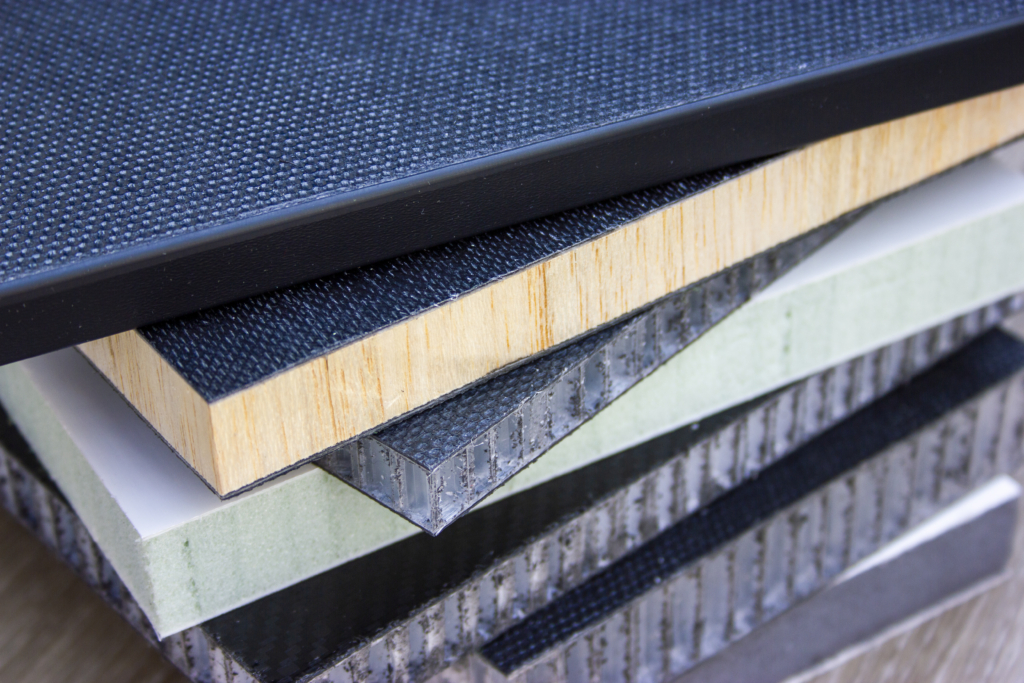
A mono-material sandwich panel is a composite panel where the skins and the core are made from the same polymer family, most commonly polypropylene (PP). Because every layer shares the same base material, the panel can enter a standard thermoplastic recycling stream at end of life without requiring separation of incompatible materials. This matters because European regulations, including the EU End-of-Life Vehicles (ELV) Directive, are tightening recyclability requirements for components used in commercial vehicles, trailers, and transport infrastructure. The questions below unpack how mono-material design works, where it falls short in conventional panels, and what it means for manufacturers choosing composite panels in 2026.
What makes a sandwich panel ‘mono-material’?
A sandwich panel is mono-material when its skins, core, and any bonding layer all belong to the same polymer family, so the panel can be recycled as a single material stream without mechanical or chemical separation. In practice, this most commonly means a polypropylene (PP) skin laminated onto a PP foam or PP honeycomb core, with no thermoset adhesive or incompatible polymer introduced at any interface.
The defining characteristic is chemical compatibility across every layer. A conventional sandwich panel might combine glass-fibre-reinforced epoxy skins with a PU foam core. Even if both layers are technically recyclable in isolation, the thermoset resin cannot be melted and reformed, and the foam cannot be separated cleanly at industrial scale. The result is a panel that goes to landfill or incineration regardless of its individual components.
In a true mono-material panel, the glass-fibre reinforcement within the skins is the one element that requires careful consideration. Glass fibre does not melt with the PP matrix, but because both the fibre and the matrix are inert and non-contaminating, the recycled material can still be processed as a glass-filled PP compound, which has established downstream markets in injection moulding and non-structural applications. The panel remains recyclable as a system, even if the output is a downgraded grade of PP rather than virgin-equivalent material.
Why is material compatibility the core recycling challenge for composite panels?
Material compatibility is the central recycling challenge for composite panels because recycling infrastructure is built around single-material streams. When a panel bonds two or more chemically incompatible materials together, no cost-effective industrial process can separate them cleanly, which means the entire panel is treated as contaminated waste regardless of how recyclable each individual component might be.
The problem is structural. Sandwich panels are engineered to resist delamination under load, which means the bond between skin and core is intentionally permanent. The same property that makes a panel durable in service makes it difficult to disassemble at end of life. For panels that combine a thermoset skin (such as glass-fibre-reinforced polyester) with a thermoplastic core, this is a fundamental incompatibility: thermosets cannot be remelted, so any recycling process that applies heat to recover the thermoplastic core will degrade the thermoset fraction into a contaminant rather than a recoverable material.
Multi-material panels also create regulatory complications. Under the EU ELV Directive, vehicle manufacturers must demonstrate that a defined percentage of vehicle mass is recoverable. When a panel cannot be assigned cleanly to a recoverable material category, it reduces the recoverable fraction of the whole vehicle. For truck body builders and trailer manufacturers operating under CSRD sustainability reporting requirements in 2026, this is no longer a theoretical concern. Procurement teams are actively asking suppliers to document material composition and end-of-life pathways for every major component.
How does a mono-material panel get recycled at end of life?
A mono-material thermoplastic sandwich panel is recycled by shredding the panel into fragments, then processing the resulting material through standard thermoplastic recycling equipment. Because the skin and core share the same polymer base, no separation step is required. The shredded material is melted, compounded, and pelletised into recycled PP, which can then be used in injection moulding, extrusion, or other non-structural applications.
The process follows these broad steps:
- Collection and sorting: End-of-life panels are collected from vehicle dismantlers or construction sites and sorted by material type. Mono-material panels are straightforward to identify and sort because their composition is consistent and documented.
- Size reduction: Panels are shredded or granulated into small fragments. The glass-fibre reinforcement within the skins is broken into short fibres during this stage but remains embedded in the PP matrix.
- Melt processing: The granulated material is fed into an extruder. The PP matrix melts and flows; the glass fibres remain as a filler, producing a glass-filled recycled PP compound.
- Pelletising and reuse: The compound is pelletised and sold into secondary markets. Typical applications include automotive interior components, pallets, and non-structural injection-moulded parts.
The key practical advantage over multi-material panels is the absence of a separation step. Separation is where most composite recycling economics break down. When a panel must be chemically or thermally treated to isolate its components before any recycling can begin, the energy cost and processing complexity typically exceed the value of the recovered material. Mono-material panels bypass this problem entirely.
What’s the difference between mono-material and multi-material sandwich panels?
The difference between mono-material and multi-material sandwich panels comes down to whether the skins, core, and adhesive layers share the same polymer family. Mono-material panels use chemically compatible layers throughout, enabling end-of-life recycling as a single stream. Multi-material panels combine different polymer types or thermoset and thermoplastic layers, which delivers broader design flexibility during production but creates a panel that cannot be recycled without costly separation processes.
Mono-material panels
In a mono-material panel, every structural layer is based on the same polymer. A PP-skin-over-PP-foam or PP-skin-over-PP-honeycomb construction is the most common example in commercial vehicle and scaffolding panel applications. The bond between layers is achieved by thermal fusion or a compatible PP-based adhesive film, so no foreign chemistry is introduced. At end of life, the panel enters a thermoplastic recycling stream without pre-treatment.
The trade-off is that the designer works within a narrower material palette. Not every performance requirement can be met with a single polymer family, particularly where fire resistance, extreme temperature stability, or very high stiffness-to-weight ratios are needed.
Multi-material panels
Multi-material panels combine materials selected for their individual performance characteristics rather than their chemical compatibility. A common configuration pairs a glass-fibre-reinforced thermoset skin with a PU foam or aluminium honeycomb core. This approach can achieve higher stiffness or fire performance than a mono-material thermoplastic panel of equivalent thickness, but the resulting panel is effectively non-recyclable under current industrial conditions.
For European OEMs facing ELV Directive compliance and CSRD reporting obligations, the recyclability gap between these two panel types is becoming a procurement-level decision, not just an environmental preference. Specifying a multi-material panel today means accepting a documented end-of-life liability that will appear in sustainability reporting for the life of the vehicle.
Which industries are driving demand for recyclable composite panels?
Commercial vehicle manufacturing and scaffolding are the two sectors driving the strongest demand for recyclable composite sandwich panels in Europe in 2026. In both sectors, the push comes from a combination of regulatory pressure, fleet operator sustainability commitments, and the practical economics of lightweight structures.
In commercial vehicles, truck body builders and trailer manufacturers face direct pressure from two directions. Fleet operators with CSRD reporting obligations are asking their vehicle suppliers to document the recyclability of major structural components. At the same time, the shift to electric trucks is making weight reduction a range argument as much as a payload argument. Lighter body structures extend battery range in electric trucks and vans. Every kilogram of structural dead weight reduces range per charge, making weight reduction a range argument, not just a payload argument. This is a standard procurement question from EV fleet buyers in 2026. A recyclable thermoplastic panel that is also lighter than the steel or plywood it replaces addresses both concerns simultaneously.
In scaffolding, the driver is different but equally concrete. Scaffolding boards are high-turnover items that reach end of life frequently. A board that can re-enter a recycling stream rather than going to landfill reduces waste disposal costs for scaffolding hire companies and supports compliance with construction sector waste targets under European environmental regulations.
Beyond these two primary sectors, modular construction and logistics infrastructure are beginning to specify recyclable composite panels, though these markets are at an earlier stage of adoption compared to commercial vehicles and scaffolding.
Does mono-material design compromise structural performance?
Mono-material thermoplastic sandwich panels do not inherently compromise structural performance for the applications where they are most commonly specified. For truck body floors, trailer walls, and scaffolding boards, a well-engineered PP-based panel can meet the relevant load requirements without the thermoset skins or dissimilar core materials that create recycling problems.
Performance depends on configuration rather than material family. A PP honeycomb core at 140 kg/m³ with 4-ply glass-fibre-reinforced PP skins delivers substantially higher bending and compressive performance than a lower-density foam core with 2-ply skins, even though both are mono-material PP constructions. The designer’s tools are core density, skin thickness, fibre orientation, and panel thickness, not a switch to a different polymer.
Fibre orientation is particularly relevant. A cross-ply skin architecture, where fibres run at 0° and 90° in alternating layers, equalises mechanical properties in both directions. This makes the panel suitable for installation in either orientation without a preferred load direction, which is useful for wall cladding and scaffolding applications where the load direction is not always predictable. A directionally optimised layup, such as a 90-0-90 arrangement, concentrates strength in the primary load direction, which is the right choice for scaffolding planks where the dominant load runs across the panel width.
Where mono-material thermoplastic panels do have genuine limitations is in applications requiring very high fire resistance ratings or extreme operating temperatures. In those cases, a thermoset or hybrid construction may be the only option that meets the specification. For the majority of commercial vehicle and scaffolding applications, however, mono-material thermoplastic panels meet the structural brief while adding a recyclability advantage that multi-material panels cannot match.
How Compoform Supports Mono-Material Panel Specification
We build our sandwich panel range around PP honeycomb and PET foam cores, both of which support mono-material or near-mono-material constructions depending on the skin specification. For truck body builders, trailer manufacturers, and scaffolding companies working through recyclability requirements for the first time, we work through the panel configuration with you before production begins, not after.
In practice, this means we help you with:
- Material documentation: We provide full material composition data for each panel configuration, so you can complete ELV Directive compliance documentation and CSRD sustainability reporting without chasing information from multiple suppliers.
- Configuration optimisation: We review your load requirements, installation method, and end-of-life obligations together, then recommend the core density, skin architecture, and thickness that meet your structural specification within a recyclable material system.
- Compoform-specific performance: A 30mm PP sandwich panel floor from us is self-supporting with no aluminium subframe required. This removes a production step for truck body builders and reduces the number of dissimilar materials in the finished vehicle, which simplifies end-of-life material accounting.
- Long service life as a sustainability argument: Thermoplastic composite panels last significantly longer than plywood in heavy transport applications. Over a 15-year vehicle life, a composite floor eliminates two to three plywood replacement cycles. Once you factor in panel cost, installation labour, and vehicle downtime, the composite is cheaper per year of service, even at a higher unit price, and generates less total waste over the vehicle’s life.
We approach every project as an application engineering exercise. If your current panel specification creates a recyclability problem you have not yet resolved, bring us the design and we will review it with you, flag the issues, and propose a configuration that works for both your assembly process and your sustainability obligations.
Related Articles
- What is the role of sandwich panels in horse trailer construction?
- What are the logistics and storage requirements for sandwich panels?
- What sandwich panels are used in temperature-controlled cargo bodies?
- How do sandwich panels contribute to lower total cost of ownership?
- What fire ratings do sandwich panels carry?