

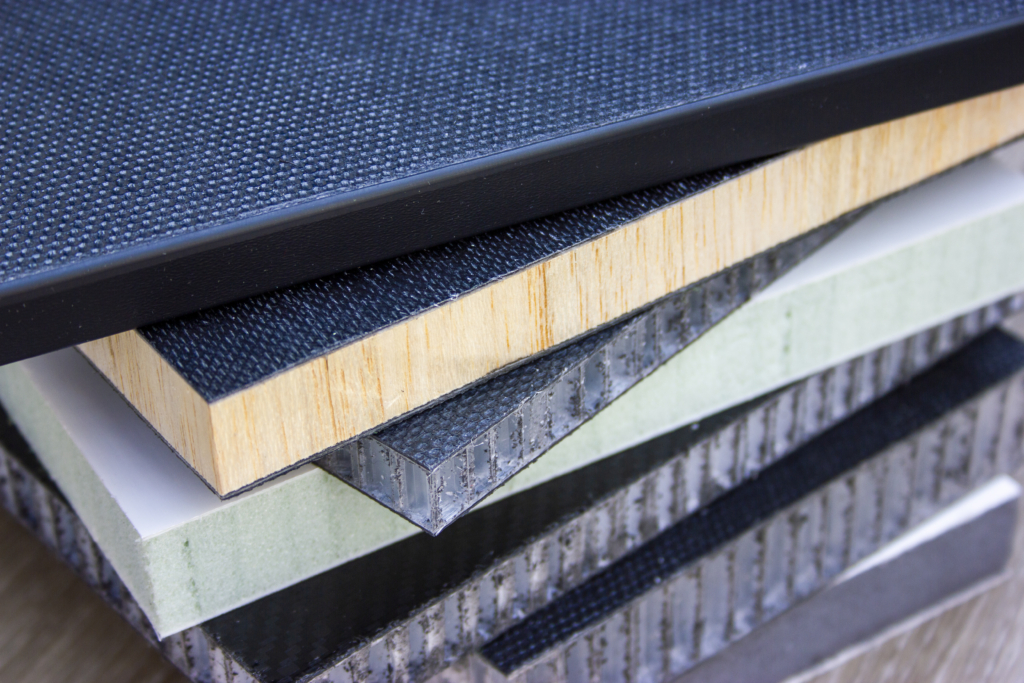
Thermoplastic sandwich panels contribute to a circular economy by using fully recyclable polypropylene and PET materials that can re-enter the production stream at end of life, rather than going to landfill. Their long service life also reduces the frequency of replacement, which cuts the total volume of material consumed over time. The questions below unpack how this works in practice across production, weight reduction, and vehicle manufacturing.
This article covers the broader sandwich panel market. Compoform’s range is limited to PP honeycomb and PET foam cores for commercial vehicles and scaffolding.
What makes a material truly circular in manufacturing?
A material is truly circular in manufacturing when it can be recovered, reprocessed, and reused at the end of its service life without significant loss of material quality, and when its production generates minimal waste from the outset. Circularity is not just about recyclability in theory — it requires that the recovery infrastructure, material chemistry, and product design all align to make reprocessing practical.
In practice, three properties define a circular material:
- Monomaterial or compatible chemistry: Materials made from a single polymer family, or from compatible polymers, are far easier to recover than mixed-material composites. Separation steps add cost and reduce recovery rates.
- Durability that delays replacement: A material that lasts longer consumes fewer resources over time. Replacing a component once every 12 years instead of every three years reduces total material throughput by a factor of four.
- Closed-loop reprocessing potential: The recovered material should be capable of re-entering a production process — ideally the same one — rather than being downcycled into lower-grade applications or sent to energy recovery.
Regulatory pressure is also shaping what “circular” means for European manufacturers. The EU End-of-Life Vehicles (ELV) Directive sets recovery and recyclability targets for vehicles, and the Corporate Sustainability Reporting Directive (CSRD) now requires many OEMs to report on material circularity across their supply chains. For procurement engineers, material choice is increasingly a compliance question, not just a performance one.
How do thermoplastic sandwich panels support material recovery?
Thermoplastic sandwich panels support material recovery because both the skins and the core are made from thermoplastic polymers — primarily polypropylene (PP) or PET — that can be melted and reprocessed without chemical breakdown. Unlike thermoset composites, which cure into a permanently cross-linked structure, thermoplastics retain their reprocessability throughout their service life.
This matters at end of life. A PP honeycomb core panel with glass-fibre-reinforced PP skins is built from a compatible polymer family. When the panel reaches the end of its useful life, the material can be shredded and fed back into a thermoplastic processing stream. The glass fibre content reduces the quality of the recovered polymer to some degree, but the material does not become unrecoverable — it can be used in lower-demand applications or blended with virgin material.
PET foam core panels offer a similar advantage. PET is one of the most widely recycled polymers in Europe, with established collection and reprocessing infrastructure already in place. Using PET as a structural core material means the panel’s recovery pathway aligns with existing recycling systems rather than requiring new infrastructure.
This is a meaningful distinction from thermoset alternatives. Fibre-reinforced polyester panels, for example, cannot be melted and reprocessed — they can only be mechanically ground and used as filler, or sent to energy recovery. For OEMs subject to the ELV Directive recyclability targets, the difference between a thermoplastic and a thermoset panel can directly affect whether a vehicle meets its end-of-life recovery threshold.
Do sandwich panels reduce waste during the production process?
Yes, sandwich panels reduce production waste in two ways: they arrive as large-format, precision-cut sheets that minimise offcut waste during assembly, and their lightweight construction reduces the total mass of material needed to achieve a given structural performance compared to solid metal or wood alternatives.
Large-format panels — produced up to 13,500mm × 2,900mm — allow body builders and trailer manufacturers to cut exactly what they need from a single sheet, reducing the number of joins and the volume of offcuts generated. Fewer joins also mean fewer fasteners, adhesives, and sealing materials, which reduces the complexity of the waste stream at end of life.
The production process for thermoplastic sandwich panels is also inherently lower-waste than wet layup thermoset manufacturing. There are no solvents, no resin mixing waste, and no consumable vacuum bagging materials. The continuous production line format means material is processed in a controlled, repeatable way that limits reject rates and scrap generation.
From a systems perspective, the weight advantage of sandwich panels also reduces waste indirectly. A lighter truck body requires less fuel or battery energy per kilometre, which reduces the resource consumption associated with operating the vehicle over its lifetime — not just manufacturing it.
How does panel weight reduction connect to lifecycle emissions?
Panel weight reduction connects to lifecycle emissions because the majority of a commercial vehicle’s carbon footprint occurs during operation, not manufacturing. A lighter body structure reduces the energy required to move the vehicle over its entire service life, which directly lowers cumulative emissions — whether the vehicle runs on diesel or electricity.
For diesel trucks, the relationship is straightforward: less structural dead weight means lower fuel consumption per kilometre. Over a vehicle life of 15 years and hundreds of thousands of kilometres, even modest weight savings compound into significant fuel and emissions reductions.
For electric trucks and vans, the argument is different but equally important. Battery range in electric vehicles is directly affected by total vehicle mass. Every kilogram of structural dead weight reduces the distance the vehicle can travel on a single charge. For fleet operators transitioning to electric trucks in 2026, weight reduction is a range argument — not just a payload argument. EV procurement teams are now routinely asking suppliers about body weight as part of vehicle specification, because range directly affects route planning, charging infrastructure requirements, and operational cost.
A thermoplastic sandwich panel floor or wall panel is substantially lighter than the steel or plywood it replaces. That weight saving, multiplied across a fleet and across years of operation, represents a material reduction in lifecycle emissions — one that sits outside the manufacturing phase entirely but is enabled by the material choice made at the point of production.
What role do sandwich panels play in sustainable vehicle manufacturing?
Sandwich panels play a direct role in sustainable vehicle manufacturing by reducing structural weight, extending component service life, and using materials that align with European recyclability regulations. For truck body builders and trailer manufacturers, they are one of the most practical tools available for improving the environmental profile of a vehicle without compromising load capacity or structural integrity. You can explore sandwich panel applications across commercial vehicle sectors to see how these benefits are realised in practice.
The service life argument is particularly relevant. Thermoplastic composite panels last significantly longer than plywood in heavy transport applications — industry experience from truck body applications points to 12 or more years of service life, compared to three to five years for plywood floors. Over a 15-year vehicle life, that eliminates two to three plywood replacement cycles. Once you account for panel cost, installation labour, and vehicle downtime during refits, the composite option is cheaper per year of service — even at a higher unit price. Fewer replacements also mean less material consumed and less waste generated over the vehicle’s operational life.
Sandwich panels also support sustainable manufacturing at the assembly stage. Their dimensional stability and consistent mechanical properties reduce rework and adjustment during body building. A self-supporting 30mm PP sandwich panel floor, for example, eliminates the need for an aluminium subframe — removing a production step, reducing part count, and cutting the total material input into the vehicle.
For OEMs subject to CSRD reporting requirements, the ability to specify panels with documented recyclability, known material composition, and traceable European manufacturing adds measurable value to sustainability disclosures.
Are all composite sandwich panels equally sustainable?
No, composite sandwich panels are not equally sustainable. The sustainability profile of a sandwich panel depends heavily on the core material, the skin chemistry, and whether the panel can be recovered and reprocessed at end of life. Thermoplastic panels and thermoset panels represent fundamentally different positions on the circularity spectrum.
The most important distinction is between thermoplastic and thermoset construction. Thermoset panels — those using epoxy, polyester, or vinyl ester resin systems — cure into a permanently cross-linked structure that cannot be melted and reprocessed. At end of life, they can only be mechanically ground or sent to energy recovery. This limits their contribution to a circular economy and can create compliance challenges under the EU ELV Directive for vehicle manufacturers with recyclability targets to meet.
Thermoplastic panels, by contrast, use polymer systems that remain reprocessable throughout their service life. PP honeycomb and PET foam core panels fall into this category. Their recovery pathway is more compatible with existing European recycling infrastructure, and their material composition can be documented and reported against CSRD requirements.
Within the thermoplastic category, sustainability also varies by design. Panels engineered for long service life — with UV-resistant surface finishes, edge sealing against moisture ingress, and skin architectures matched to the load demands of the application — will outlast panels that are underspecified for their environment. A panel that fails prematurely and requires replacement is not a sustainable choice, regardless of its material chemistry. Durability and recyclability together determine the real sustainability outcome.
How Compoform Supports Circular Manufacturing
We build our sandwich panels around PP honeycomb and PET foam cores — both thermoplastic materials that can be recovered and reprocessed at end of life, in line with EU ELV Directive recyclability requirements. Every panel we produce is 100% European-made at our facilities in Beek and Ospel, the Netherlands, with full material traceability for customers who need to report under CSRD.
Here is what that means in practice for truck body builders and trailer manufacturers:
- Self-supporting floor panels: A 30mm PP sandwich panel floor eliminates the need for an aluminium subframe, removing a production step and reducing total vehicle weight — which extends battery range in electric trucks.
- Extended service life: Our thermoplastic panels are engineered for 12 or more years of service in heavy transport applications, eliminating two to three plywood replacement cycles over a vehicle’s life and reducing total material consumption.
- Edge sealing and edge bending: We protect panel cores from UV exposure and moisture ingress — relevant for truck floors washed down regularly and scaffolding boards used in outdoor environments. This directly supports the durability that makes long service life achievable.
- Custom dimensions: Panels are available in custom dimensions cut to your exact specification, up to 13,500mm × 2,900mm, reducing offcut waste during your assembly process.
- Documented material composition: We provide full technical data sheets for each panel configuration, giving your engineering and procurement teams the material information needed for sustainability reporting.
We work with you as an application partner — reviewing your design, optimising the panel configuration for your assembly process, and identifying potential issues before production begins. If you are specifying panels for a truck body floor, trailer sidewall, or scaffolding application and want to understand which configuration fits your load requirements and sustainability targets, speak with our engineering team to start that conversation.