

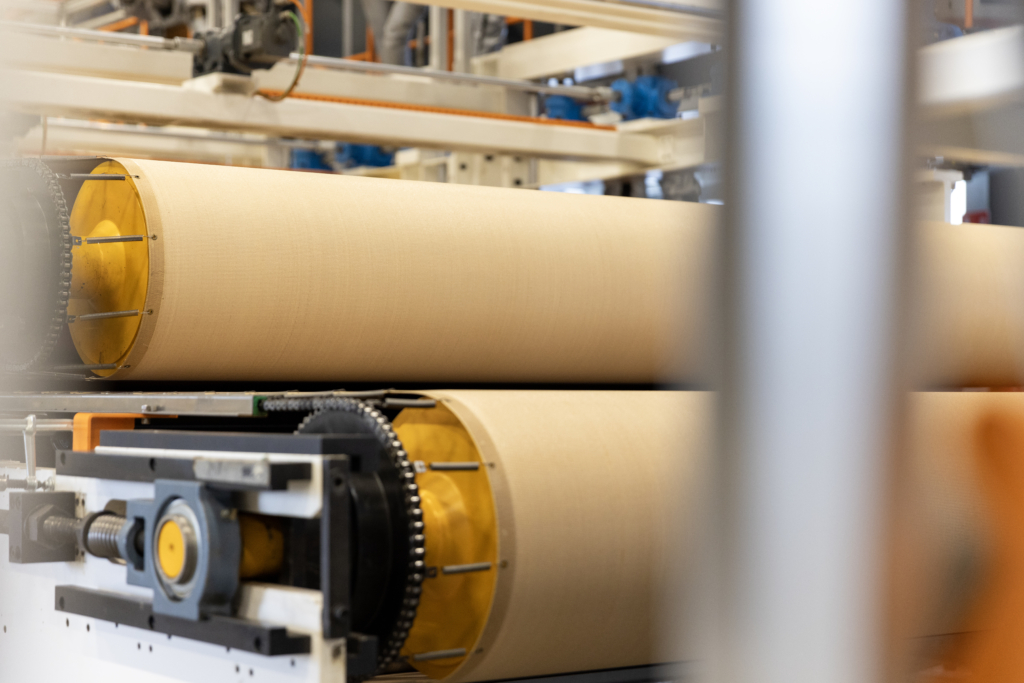
Custom sandwich panels typically take longer to produce than standard sheet materials because they require a dedicated production run configured to your specific dimensions, core density, skin architecture, and surface finish. Standard sheets are pre-produced in fixed configurations and held in stock, so delivery is largely a logistics question. Custom panels involve a manufacturing step first. The sections below work through the practical lead time differences, the variables that drive them, and how to plan your procurement accordingly.
Why do custom sandwich panels take longer to produce than standard sheets?
Custom sandwich panels take longer because each order requires the production line to be set up specifically for that configuration. Core material, skin type, ply count, layer orientation, panel dimensions, and surface finish all need to be confirmed and staged before a single metre of panel can be produced. Standard sheet materials skip this step entirely because the configuration decisions were made once, during product development, and the same setup runs repeatedly at volume.
For thermoplastic sandwich panels produced on a continuous double belt press, the setup process involves selecting and loading the correct core material, positioning the skin laminates in the right orientation, and calibrating press temperature and pressure for the specific panel thickness. If your order calls for a PP-foam core at a particular density grade, combined with a 4-ply glass-fibre skin and a specific surface finish, each of those elements must be sourced, verified, and staged before the run begins. None of that happens with a standard stock sheet pulled from a warehouse shelf.
There is also a minimum run logic at play. Custom configurations are only economical to produce above a certain volume threshold. Below that threshold, the setup cost per panel becomes disproportionate. This means custom orders are often batched, which can add scheduling time depending on where your order falls in the production queue.
What are typical lead times for custom composite sandwich panels?
Lead times for custom thermoplastic sandwich panels typically range from two to six weeks from order confirmation, depending on configuration complexity, order volume, and current production scheduling. Simple configurations with standard core materials and familiar skin architectures sit at the shorter end. Orders involving less common core densities, non-standard dimensions, or new skin combinations take longer because material sourcing and setup verification add time before the production run begins.
Standard sheet materials, by contrast, can often be delivered within a few days to a week when held in stock. The difference is not a manufacturing inefficiency on the custom side. It reflects a fundamentally different production model: stock sheets are made speculatively and stored; custom panels are made to order and delivered directly.
For OEMs running planned production schedules, a four to six week lead time for custom panels is manageable when procurement is integrated into the build plan. The lead time becomes a problem only when custom panels are treated as a last-minute substitution for a stock material. Planning the panel order at the same time as the broader build schedule eliminates most of the friction.
What factors cause lead time variation between panel orders?
Several variables determine where a custom sandwich panel order lands within the typical lead time range. Understanding them helps you forecast more accurately and avoid surprises.
- Core material availability: PP-foam is available in six density grades, from 40 to 140 kg/m³. Commonly used grades are typically in stock. Less frequently specified densities may require a procurement step before production can begin.
- Panel dimensions: Panels up to 13,500 mm x 2,950 mm can be produced, but very large formats require careful scheduling on the production line. Non-standard widths or lengths that differ significantly from common run sizes add setup time.
- Skin architecture: Cross-ply configurations and standard 2-ply or 4-ply architectures are well-established. A new or modified layup sequence requires additional verification before the run is confirmed.
- Surface finish: White PET-film and black anti-skid finishes are standard. Any variation from these requires additional sourcing or process adjustment.
- Order volume: Larger orders justify a dedicated production slot more readily. Smaller volumes may be batched with compatible orders, which can affect scheduling.
- Production queue position: Lead time is also a function of current capacity utilisation. Orders placed during high-demand periods take longer to schedule than those placed during quieter windows.
How do standard sheet materials achieve shorter delivery windows?
Standard sheet materials achieve short delivery windows by separating the manufacturing decision from the customer order. The configuration is fixed, the production run happens in advance at scale, and finished panels are held in inventory. When a customer orders, the only remaining steps are picking, packing, and shipping. There is no manufacturing lead time because the manufacturing already happened.
This model works well for applications where a fixed configuration meets the structural and dimensional requirements. For many wall cladding applications, for example, a standard 17 mm or 20 mm panel with a cross-ply skin and white PET-film surface covers a wide range of use cases without modification. The cross-ply architecture equalises mechanical properties in both directions, so the panel performs consistently regardless of installation orientation, which makes it genuinely versatile as a stock product.
The trade-off is inflexibility. Standard sheets come in fixed thicknesses, fixed core densities, and fixed dimensions. If your application requires a panel that falls outside those parameters, a stock sheet is not actually a faster option. It is an incompatible option, and using it as a workaround introduces structural or dimensional compromises that create downstream problems in assembly or performance.
When does a longer lead time for custom panels make commercial sense?
A longer lead time for custom sandwich panels makes commercial sense whenever the performance, dimensional, or weight requirements of your application cannot be met by a standard configuration. For truck body builders and trailer manufacturers, this is frequently the case. Floor panels need to match the exact internal dimensions of the body, carry defined load ratings, and contribute to payload efficiency. A panel that is 10 mm too thick, or specified at the wrong core density, is not a minor inconvenience. It affects the build, the weight, and the legal payload capacity.
The commercial argument becomes even clearer when you account for the full lifecycle. A 30 mm PP-honeycomb floor panel, for example, is self-supporting and eliminates the need for an aluminium subframe. That removes a production step and reduces material cost for the body builder. Over a 15-year vehicle life, a correctly specified composite floor eliminates two to three plywood replacement cycles. Once you factor in panel cost, installation labour, and vehicle downtime for replacement, the composite is cheaper per year of service even at a higher unit price.
For EV fleet operators and the body builders supplying them, the weight argument adds a second dimension. Lighter body structures extend battery range in electric trucks and vans. Every kilogram of structural dead weight reduces range per charge, making weight reduction a range argument, not just a payload argument. This is a standard procurement question from EV fleet buyers across transport applications in 2026, and it strengthens the case for a correctly specified custom panel over a heavier standard alternative.
How can OEMs reduce lead times when ordering custom sandwich panels?
OEMs can reduce effective lead times for custom sandwich panels by integrating panel procurement into their production planning cycle rather than treating it as a reactive purchase. The single most effective action is locking in the panel specification early, before the build schedule is finalised, so the order can be placed with enough lead time to avoid scheduling pressure.
Several practical steps shorten the time between enquiry and delivery:
- Confirm the specification before enquiring: Knowing the required core type, density, skin architecture, dimensions, and surface finish at the point of enquiry eliminates the back-and-forth that adds days or weeks to the pre-production phase.
- Order in planned batches: Aligning panel orders with your production schedule allows the manufacturer to plan production slots in advance. Ad hoc orders compete for available capacity; planned orders can be scheduled ahead.
- Establish a repeat configuration: Once a panel specification is validated for your application, reordering the same configuration is faster than specifying a new one. The setup knowledge is retained and the material sourcing is predictable.
- Communicate volume forecasts: Sharing a forward-looking volume estimate, even an approximate one, allows the manufacturer to plan material procurement and production scheduling around your needs rather than reacting to individual orders.
- Build a buffer into your schedule: For critical production runs, planning to receive panels one to two weeks before they are needed absorbs minor scheduling variation without disrupting your build programme.
How Compoform Supports Your Panel Procurement Planning
We work with truck body builders, trailer manufacturers, and other European OEMs to make custom panel procurement predictable. That starts before the order is placed. When you bring us a new application, we review your structural requirements, assembly process, and dimensional constraints, then recommend a panel configuration that meets your performance targets without over-engineering the specification. Getting the configuration right the first time removes the iteration cycles that extend lead times.
Here is what that looks like in practice:
- Specification review: We assess your load requirements, installation method, and dimensional needs to confirm the right core material, density, skin architecture, and surface finish before production begins.
- Planned production scheduling: For OEMs with recurring panel needs, we work to align production slots with your build schedule so panels arrive when you need them, not when capacity allows.
- Custom dimensions to exact specification: Panels are available up to 13,500 mm x 2,950 mm x 150 mm, cut to your exact requirements. No trimming on your end, no material waste.
- Ongoing technical support: We stay involved through integration and into production, flagging issues before they become problems and supporting any adjustments your process requires.
If you are planning a new vehicle body programme or reviewing your current panel specification, speak with our engineering team about your requirements early. The earlier we are involved, the more we can do to optimise the configuration and compress the time between enquiry and first delivery.