

Caravan walls and roofs are built using thermoplastic sandwich panels, a layered construction consisting of a lightweight core material bonded between two rigid, fibre-reinforced skins. The most common core materials in modern caravan construction are PP foam (polypropylene foam) and PP honeycomb, paired with glass-fibre-reinforced thermoplastic skins. These panels replace older materials like timber frames and aluminium sheet because they deliver a better balance of weight, insulation, weather resistance, and structural rigidity across the full body of the vehicle.
What materials make up a caravan sandwich panel?
A caravan sandwich panel consists of three main layers: two outer skins made from fibre-reinforced thermoplastic, and a lightweight core material bonded between them. The skins carry the structural loads, while the core provides rigidity, insulation, and separation between the skins to maximise bending stiffness without adding unnecessary weight.
The most widely used skin material in modern caravan panels is glass-fibre-reinforced polypropylene (glass-PP). The glass fibres are typically arranged in a cross-ply configuration, with fibres running at 0° and 90° in alternating layers. This orientation distributes mechanical strength evenly in both directions, which matters for panels that may be installed horizontally or vertically. Surface finishes vary by application: wall panels often carry a white PET film for a clean interior appearance, while floor panels may use an anti-skid surface.
For the core, caravan manufacturers typically choose between:
- PP foam (oriented polypropylene foam): Available in multiple density grades, this core offers good thermal insulation alongside structural performance. Lower-density grades reduce weight; higher-density grades increase stiffness and load capacity.
- PP honeycomb: A tubular honeycomb structure that delivers very high compressive strength relative to its weight. More common in floor panels where point loads are a concern.
The bond between skin and core is formed during a continuous pressing process, producing a panel that behaves as a single structural unit rather than a stack of separate layers.
What’s the difference between thermoplastic and thermoset sandwich panels in caravans?
The key difference is in how the resin matrix is processed and what happens to the panel at end of life. Thermoplastic panels use a polymer matrix (such as polypropylene) that can be remelted and reshaped after manufacture. Thermoset panels use resins (such as polyester or epoxy) that cure irreversibly; once set, they cannot be reprocessed.
For caravan manufacturers, this distinction has practical consequences beyond chemistry. Thermoplastic panels can be cut, routed, and thermoformed using standard equipment without releasing harmful fumes. They are also fully recyclable at end of life, which is increasingly relevant under European sustainability reporting requirements such as the CSRD and the EU ELV Directive. Thermoset panels, by contrast, are difficult to recycle and typically go to landfill or incineration.
From a performance standpoint, thermoplastic sandwich panels offer strong impact resistance. A continuous fibre-reinforced thermoplastic skin absorbs impact energy through fibre deformation rather than brittle fracture, which is an advantage in a vehicle body that experiences road vibration, stone strikes, and handling loads over its service life.
Thermoset panels remain common in lower-cost caravan production where upfront material price is the primary driver. However, as European OEMs face growing pressure on recyclability and total cost of ownership, thermoplastic alternatives are becoming the preferred specification for mid-range and premium caravan builds.
Why do caravan manufacturers choose sandwich panels over wood or metal?
Caravan manufacturers choose sandwich panels over timber frames and aluminium sheet primarily because sandwich panels deliver a better strength-to-weight ratio while also eliminating the moisture and corrosion problems that affect both wood and metal over time.
Timber frames absorb moisture, swell, rot, and lose structural integrity, a well-documented failure mode in older caravans. Aluminium is corrosion-resistant but adds significant dead weight, and its thermal conductivity creates cold bridging through the wall structure. A composite sandwich panel avoids both problems: the thermoplastic skins do not corrode or absorb water, and the foam or honeycomb core provides thermal separation between the interior and exterior faces.
Weight is also a direct commercial argument. Every kilogram saved in the caravan body structure is a kilogram that can be added to payload, equipment, or passenger comfort without exceeding tow vehicle limits. This matters for leisure vehicle buyers who want to carry more without upgrading their tow vehicle. In 2026, the same argument applies to electric tow vehicles: a lighter caravan body extends the range available per charge, which is now a standard question from buyers considering EV towing setups. Lighter body structures reduce the energy cost of moving the vehicle, making weight reduction a range argument as much as a payload argument.
Sandwich panels also reduce assembly complexity. A single panel can serve as both the structural wall and the finished interior surface, removing the need for separate insulation layers, vapour barriers, and interior cladding in some configurations. You can find more detail on how these panels are used across different vehicle types on our caravan and motorhome panel applications page.
Are the same panel types used for caravan walls and roofs?
Walls and roofs use similar sandwich panel construction, but the specific configuration, core density, skin thickness, and panel thickness, differs because the load cases are different. Wall panels primarily resist wind pressure, racking loads, and point loads from fixings. Roof panels must also carry distributed loads from snow accumulation and any roof-mounted equipment, which typically requires a stiffer panel specification.
In practice, caravan walls commonly use PP foam core panels in the 17 mm to 30 mm thickness range with cross-ply glass-fibre skins. The cross-ply architecture is well suited to wall applications because it equalises mechanical properties in both directions, allowing the panel to be installed in either orientation without a preferred load direction.
Roof panels often use a similar foam core construction but may specify a higher core density or a thicker skin to handle the additional bending loads. In some caravan designs, the roof panel also needs to accommodate roof hatches, ventilation cutouts, and solar panel mounting points, all of which are achievable with thermoplastic panels using standard CNC routing.
Floor panels are a distinct category. They typically use a PP honeycomb core rather than foam, because honeycomb delivers substantially higher compressive and bending performance for the point loads generated by furniture legs, occupant movement, and storage weight. The surface finish also differs: floor panels carry an anti-skid surface rather than the smooth PET film used on wall and roof panels.
What panel dimensions and thicknesses are standard in caravan construction?
There is no single universal standard for caravan panel dimensions; specifications vary by manufacturer, vehicle class, and the structural requirements of each panel position. However, wall and roof panels in the 17 mm to 30 mm thickness range are the most common in European caravan production, with floor panels typically running thicker to handle higher compressive loads.
Panel width and length are driven by the caravan body dimensions. Larger panels reduce the number of joints in the body, which simplifies assembly and improves weather sealing. Modern thermoplastic sandwich panel production lines can produce panels up to 13,500 mm in length and 2,900 mm in width, which is sufficient to cover the full sidewall of most caravan and motorhome bodies in a single piece.
Core density is the other key variable. PP foam cores are available across a range of density grades, and the right grade depends on the structural demands of the specific panel position. A lower-density core reduces weight in a roof panel where bending loads are moderate; a higher-density core adds stiffness where the panel must carry heavier loads or resist point load penetration.
How are sandwich panels joined and finished in a caravan body?
Sandwich panels in a caravan body are typically joined using aluminium extrusion profiles, structural adhesives, or a combination of both. The joining method depends on the panel position, the structural loads at the joint, and the manufacturer’s assembly process.
At wall-to-floor and wall-to-roof junctions, aluminium extrusion profiles are the most common solution. The profile captures the panel edges, provides a weather seal, and transfers loads between panels without requiring through-fasteners that would penetrate the core. Structural adhesive bonding is used where a cleaner exterior appearance is required or where the joint geometry makes extrusion profiles impractical.
Edge treatment is important for long-term durability. The cut edges of a sandwich panel expose the core material, which can absorb moisture or degrade under UV exposure if left unsealed. Edge sealing, either with a compatible adhesive, a folded skin, or an edge profile, protects the core and extends the service life of the panel. This is particularly relevant for panels in exposed positions such as the underside of the floor or the lower sections of the sidewall where road spray and wash-down water are regular factors.
Interior surfaces with a white PET film finish are typically bonded or mechanically fixed to the interior framing and require no additional cladding. Exterior surfaces may be painted, wrapped, or left in their natural finish depending on the caravan manufacturer’s design specification.
How Compoform Helps with Sandwich Panels for Caravan Construction
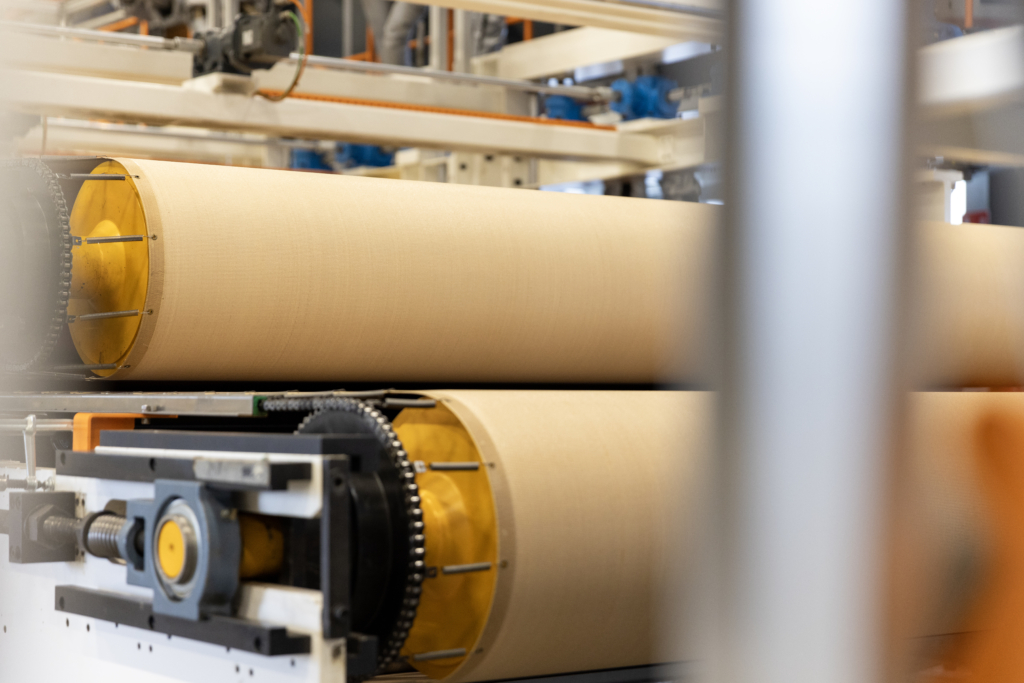
We manufacture fully custom thermoplastic sandwich panels for caravan walls, roofs, and floors, produced on a 72-metre continuous double belt press at our facilities in the Netherlands. Every panel is made to your exact specification, not pulled from a standard catalogue.
When you work with us on a caravan or motorhome project, we review your structural requirements and assembly process before recommending a panel configuration. That means specifying the right core material (PP foam or PP honeycomb), the right density grade, the correct skin architecture, and the appropriate surface finish for each panel position in the body. We flag potential issues, such as edge sealing requirements or joint compatibility, before production starts, not after the first batch arrives.
What we offer for caravan manufacturers specifically:
- Custom panel dimensions up to 13,500 mm × 2,950 mm × 150 mm, including full sidewall lengths that minimise body joints
- Multiple core and skin configurations — PP foam in six density grades, PP honeycomb, glass-fibre cross-ply and multi-ply skins, PET film or anti-skid surface finishes
- 100% European manufacturing with consistent quality and reliable lead times — no dependency on long-haul supply chains
- Engineering support through design review, panel optimisation, and post-delivery technical assistance
We approach each project as a partnership. If you are specifying sandwich panels for a new caravan model or looking to replace timber or aluminium in an existing design, speak with our engineering team about your project and we will work through the configuration with you before committing to production.
Related Articles
- What sandwich panels are used in aircraft interior construction?
- How do sandwich panel bridge decks compare to steel and concrete?
- How do sandwich panel scaffold boards reduce on-site injuries?
- What are the moisture resistance properties of RV sandwich panels?
- What makes thermoplastic sandwich panels easier to recycle?