

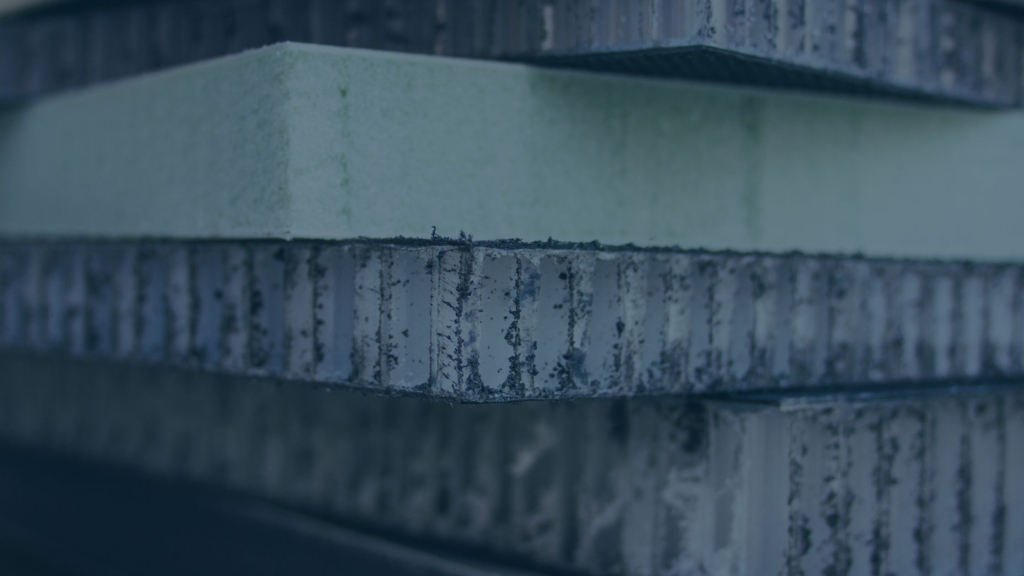
Sandwich panels are bonded and laminated by joining two stiff outer skins to a lightweight core using either thermal fusion or structural adhesive. The method used depends on the skin and core materials: thermoplastic panels are typically bonded through heat and pressure in a continuous lamination process, while thermoset-based systems rely on adhesive bonding. The sections below unpack each stage of that process and the factors that determine which approach is right for a given panel configuration.
What bonding methods are used in sandwich panel production?
The two principal bonding methods in sandwich panel production are thermal bonding and adhesive bonding. Thermal bonding fuses thermoplastic skins directly to a compatible thermoplastic core using heat and pressure, creating a molecular-level bond without any adhesive layer. Adhesive bonding uses structural glues or films to join skins and core materials that cannot be thermally fused.
The choice between these methods is not arbitrary. It follows directly from the material chemistry of the skins and core. When both are thermoplastic and chemically compatible, thermal bonding produces a clean, consistent bond line with no added weight or curing time. When the materials are dissimilar, or when one component is thermoset, adhesive bonding bridges the compatibility gap.
A third approach, used in some specialist applications, is mechanical fastening at the panel edges or through-thickness. This is rarely used as the primary bonding method for the face-to-core joint, but it plays a role in edge detailing and in securing panels to subframes during installation.
How does the lamination process work for composite sandwich panels?
Composite sandwich panel lamination works by feeding the core material and skin layers together through a controlled heat and pressure zone, where they are fused or bonded into a single integrated structure. In a continuous production line, the process runs as a single pass: skins are unwound from rolls, pre-heated, pressed against the core, and cooled under controlled pressure to lock in the bond.
The sequence typically follows these stages:
- Material preparation: Skin laminates are pre-consolidated from glass-fibre reinforced thermoplastic tapes or woven fabrics. The core material is cut or formed to the required thickness and density.
- Pre-heating: Both skins and the core surface are brought to the bonding temperature. For thermoplastic systems, this softens the matrix at the interface without degrading the bulk material.
- Pressing: The stack passes through a press or double-belt laminator that applies uniform pressure across the full panel width. This consolidates the bond line and removes air pockets.
- Cooling under pressure: The panel is cooled while still under pressure. This step is important for thermoplastic systems because the bond solidifies as the matrix re-crystallises. Releasing pressure too early can cause warping or weak adhesion.
- Trimming and finishing: The continuous sheet is cut to length, edges are sealed or bent, and surface finishes such as PET film or anti-skid coatings are applied where specified.
Continuous lamination lines allow very large panel formats. Production equipment capable of producing panels up to 13,500 mm in length and 2,950 mm in width runs as a semi-automatic process, making consistent bond quality achievable across the full panel area rather than just at the edges or contact points.
What is the difference between adhesive bonding and thermal bonding in sandwich panels?
The core difference is how the bond forms. Thermal bonding melts the thermoplastic matrix at the skin-to-core interface and fuses the materials together as they cool, creating a bond that is part of the material itself. Adhesive bonding introduces a separate bonding agent between the skin and core, relying on the adhesive’s mechanical and chemical grip rather than material fusion.
Thermal bonding
Thermal bonding requires that both the skin and core share compatible thermoplastic chemistry, typically polypropylene-based systems. The bond line contains no foreign material, which means there is no adhesive layer to degrade, absorb moisture, or creep under sustained load. The result is a bond that performs consistently across the full service life of the panel. Thermal bonding also suits high-volume continuous production because there is no adhesive mixing, pot life management, or curing wait time involved.
Adhesive bonding
Adhesive bonding is more flexible in terms of material combinations. It allows thermoset skins to be joined to thermoplastic cores, or metal face sheets to composite cores, where thermal fusion is not possible. The trade-off is that bond quality depends on surface preparation, adhesive selection, and curing conditions. Poorly prepared surfaces, incorrect adhesive viscosity, or inadequate cure time can all produce weak or inconsistent bond lines. In demanding environments, such as truck floors washed down regularly or scaffolding boards exposed to standing water, adhesive bond lines require careful specification to resist moisture ingress over time.
What core and skin materials affect bonding compatibility?
Bonding compatibility is determined by the chemical family of the skin and core materials. Thermoplastic skins bond thermally to thermoplastic cores when they share a compatible matrix, most commonly polypropylene. Dissimilar material families require adhesive bonding, and some combinations require surface treatment before any bond will hold reliably.
The most relevant material pairings in commercial panel production are:
- Glass-fibre reinforced PP skin + PP honeycomb core: Fully thermally compatible. The PP matrix in the skin fuses directly to the PP honeycomb walls under heat and pressure. This is the configuration used in high-load floor panel and scaffolding board applications where bond integrity under repeated impact and flexural loading matters.
- Glass-fibre reinforced PP skin + PP foam core: Also thermally compatible. Oriented PP foam cores at densities ranging from 40 to 140 kg/m³ can be laminated directly to glass-PP skins. Higher-density foam cores provide greater resistance to skin-core shear under bending loads.
- Glass-fibre reinforced PET skin + PP core: PET and PP are not thermally compatible at the same processing temperature. Bonding these combinations requires either a tie layer or a compatible adhesive film.
- Steel or aluminium face sheets + thermoplastic core: Metal skins cannot be thermally fused to polymer cores. Structural adhesive bonding is the standard approach, with surface pre-treatment of the metal to improve adhesion.
Skin architecture also plays a role. Cross-ply laminates, where fibres alternate at 0° and 90°, distribute load more evenly across the bond line than unidirectional laminates, which carry load primarily in one direction. For wall cladding panels where biaxial stiffness matters, cross-ply skins are the standard choice. For floor panels where the dominant load is in one axis, multi-ply unidirectional skins with 66 to 67% glass fibre content by weight deliver higher in-plane tensile performance per unit thickness.
Why do sandwich panels delaminate and how can it be prevented?
Sandwich panel delamination occurs when the bond between the skin and core fails, allowing the two to separate. The most common causes are inadequate bonding during manufacture, moisture ingress at exposed edges, and shear stress at the skin-to-core interface that exceeds the bond’s capacity under repeated loading.
In service, delamination typically starts at the panel edges rather than in the field. Exposed core material at cut edges absorbs moisture, which weakens the bond line progressively. In transport applications, truck floors and trailer walls are regularly washed down, and any unsealed edge becomes a point of entry. Over time, freeze-thaw cycling in northern European climates accelerates this process by expanding trapped moisture and mechanically stressing the bond.
Prevention depends on three factors:
- Bond quality at manufacture: Consistent temperature and pressure across the full panel area during lamination prevents weak zones. Continuous double-belt laminators are more reliable in this respect than batch pressing, because pressure is applied uniformly rather than at discrete points.
- Edge sealing: Sealing or bending the panel edges after cutting closes off the core from moisture exposure. For scaffolding boards and truck floors that face regular washing, edge protection is not optional. It directly determines how long the panel performs before delamination initiates at the perimeter.
- Correct panel specification for the load: Delamination under load occurs when the skin-to-core shear stress exceeds the bond’s capacity. Selecting a core density appropriate for the applied bending load, and ensuring the skin thickness is matched to the span, keeps shear stress within the bond’s working range across the full service life.
How does panel size and thickness influence the lamination approach?
Panel size and thickness both affect how heat and pressure are distributed during lamination, which in turn determines the bonding method and equipment required. Larger panels demand equipment with wider pressing zones and longer heating sections to maintain uniform conditions across the full area. Thicker panels require longer dwell times in the heat zone to bring the core-skin interface to bonding temperature without overheating the outer surfaces.
For thin panels in the 10 to 15 mm range, continuous lamination lines handle the process efficiently. The relatively short heat path through the panel thickness means the interface reaches bonding temperature quickly and the panel cools rapidly under pressure. Thicker panels, from 20 mm upward, require more controlled heating profiles to avoid a temperature gradient that leaves the interface under-bonded while the skin surface is already at processing temperature.
Very large panel formats introduce a different challenge: flatness. A panel 13,500 mm long and nearly 3,000 mm wide has significant potential for warping if cooling is uneven across its area. Controlled cooling under pressure, with consistent contact across the full panel width, is what keeps large-format panels flat and dimensionally stable after lamination. This is why continuous belt systems are better suited to large-format production than static batch presses, which struggle to maintain even contact pressure across wide panels.
Thickness also determines whether the panel is self-supporting in its application. A 30 mm PP sandwich panel floor panel, for example, is stiff enough to span between chassis rails without an aluminium subframe beneath it. This removes a production step for truck body builders and reduces the overall structural weight of the vehicle, which matters both for payload capacity and, in electric trucks and vans, for battery range. Every kilogram of structural dead weight reduces range per charge, making weight reduction a range argument as much as a payload argument. This is a standard procurement question from EV fleet buyers in 2026.
How Compoform Approaches Sandwich Panel Bonding and Lamination
We manufacture thermoplastic sandwich panels using a 72-metre semi-automatic continuous lamination line at our facilities in Beek and Ospel, the Netherlands. Our panels use PP honeycomb or oriented PP foam cores thermally bonded to glass-fibre reinforced thermoplastic skins, producing a fully integrated structure with no adhesive layer at the skin-to-core interface.
What this means in practice for truck body builders, trailer manufacturers, and scaffolding companies:
- Custom dimensions up to 13,500 mm × 2,950 mm cut to your exact specification, with no minimum order on custom sizes that forces you to accept standard formats that don’t suit your assembly process.
- Edge sealing and edge bending applied after cutting to protect the core from moisture ingress, relevant for any panel that will be washed down regularly or exposed to standing water in service.
- Panel configurations matched to your load case, whether that is a 10.5 mm scaffolding board achieving EN 12811 load class 4 with no support underneath, or a 30 mm floor panel that eliminates the aluminium subframe from your truck body build.
- Thermoplastic panels that last 3 to 4 times longer than plywood in heavy transport applications, based on Compoform’s own service experience. Over a 15-year vehicle life, that eliminates two to three replacement cycles. When you account for panel cost, installation labour, and vehicle downtime, the composite floor is cheaper per year of service even at a higher unit price.
We review your design before production starts, optimise the panel configuration for your assembly process, and flag potential issues before they become production problems. If you are specifying panels for a truck body, trailer, or scaffolding application and want to work through the bonding and lamination requirements for your specific configuration, speak with our engineering team to start that conversation.
Related Articles
- What is the difference between a woven and non-woven sandwich panel skin?
- What is a mono-material sandwich panel and why does it matter for recycling?
- What are the acoustic properties of PP honeycomb sandwich panels?
- What materials are used as face sheets on sandwich panels?
- How do sandwich panels reduce payload dead weight?