

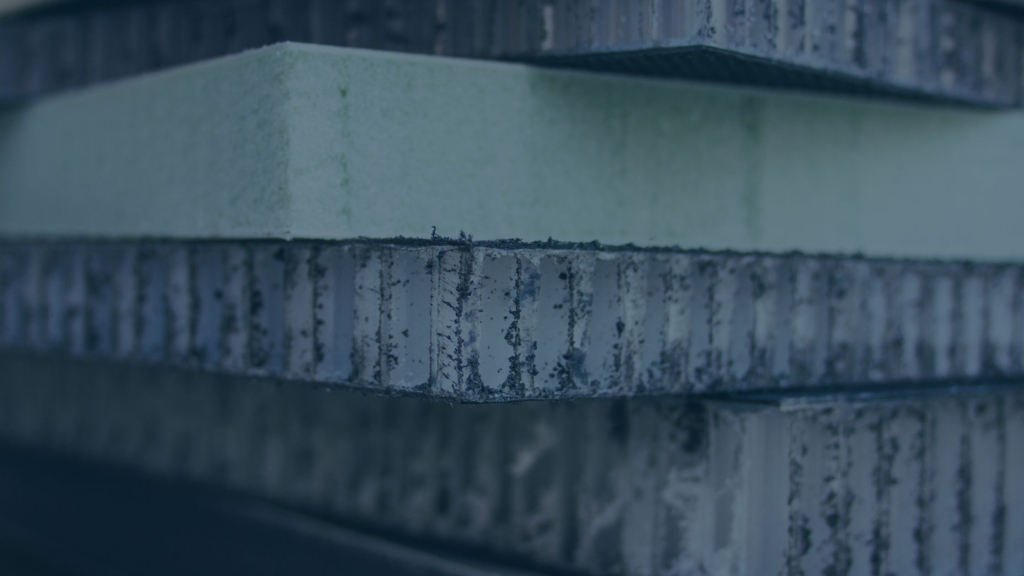
Thermoplastic sandwich panels handle moisture and humidity well. Unlike wood or untreated metal, panels built with polypropylene cores and glass-fibre-reinforced thermoplastic skins do not absorb water, rot, or corrode when exposed to wet conditions. Water absorption across tested configurations stays below 1.50% per ISO 62, making these panels a reliable choice for applications where regular washdowns, rain exposure, or high ambient humidity are part of daily operation. The questions below unpack the specific mechanisms, material comparisons, and design practices that determine how well a sandwich panel performs in wet environments.
What makes sandwich panels vulnerable to moisture damage?
Sandwich panels become vulnerable to moisture when their core material absorbs water, when their skins delaminate under freeze-thaw cycling, or when exposed edges allow water to migrate into the panel interior. The outer skins typically provide the first line of defence, but edge joints, fastener holes, and cut surfaces are the points where moisture most commonly enters.
The core is where moisture damage does the most structural harm. Organic cores such as balsa or paper honeycomb swell, soften, and lose compressive strength when saturated. Even some closed-cell foam cores can absorb moisture over time if the skin-to-core bond degrades. Once water enters a panel, freeze-thaw cycles accelerate the damage by expanding trapped moisture and widening any existing microcracks in the laminate.
Fastener holes and cut edges are the second major vulnerability. A panel with excellent skin impermeability can still fail at the edges if those surfaces are left unsealed after fabrication. This is particularly relevant for floor panels in truck bodies and trailer decks, which are washed down regularly and exposed to standing water, road spray, and cleaning chemicals. Sealing cut edges and using appropriate fastener types eliminates most of the practical risk in these environments.
How do thermoplastic composite panels compare to wood and metal in wet conditions?
Thermoplastic composite sandwich panels outperform both wood and untreated steel in wet conditions. Wood absorbs moisture, swells, and eventually rots, while steel corrodes unless continuously maintained. Thermoplastic skins and polypropylene cores are chemically inert to water and do not support biological growth, making them structurally stable across a wide range of humidity levels.
Wood versus thermoplastic composites
Plywood and timber-based panels are widely used in truck body floors and trailer walls because they are inexpensive and easy to work with. However, in transport applications, plywood floors typically require replacement every three to five years due to moisture-driven delamination, rot, and surface degradation. A thermoplastic composite floor panel in the same application lasts twelve or more years based on in-service experience, eliminating two to three replacement cycles over a vehicle’s working life. When you factor in panel cost, installation labour, and vehicle downtime for each replacement, the composite is cheaper per year of service even at a higher unit price.
Steel and aluminium versus thermoplastic composites
Steel panels corrode when protective coatings are scratched or worn, and aluminium, while more corrosion-resistant, still oxidises and requires surface treatment in aggressive environments. Both metals conduct heat readily, which creates condensation problems in refrigerated or temperature-controlled vehicle bodies. Thermoplastic composites are non-conductive, corrosion-proof, and dimensionally stable across the operating temperature range of minus 40 to plus 80 degrees Celsius. They also add significantly less dead weight, which translates directly into payload capacity or, for electric trucks and vans, extended battery range per charge.
What core materials offer the best moisture resistance in sandwich panels?
Polypropylene-based cores, both PP foam and PP honeycomb, offer strong moisture resistance because polypropylene is hydrophobic by nature. It does not absorb water, does not swell, and does not degrade chemically when exposed to humidity or liquid water. This makes PP cores well suited to applications where moisture exposure is a regular operating condition rather than an occasional risk.
Oriented PP foam cores are available in a range of densities. Lower-density grades work well in wall cladding panels where compressive loads are modest and moisture resistance is the primary concern. Higher-density grades and PP honeycomb cores are used in floor panels where both load performance and moisture resistance are needed simultaneously. The PP honeycomb structure, with its tubular geometry, provides high compressive strength while keeping the core mass low and maintaining the same hydrophobic properties as solid PP foam.
The skin-to-core bond is equally important. A core that resists moisture absorption provides little protection if the laminate bond degrades and allows water to track between the skin and core. Glass-fibre-reinforced thermoplastic skins bonded to PP cores in a continuous lamination process create a monolithic structure with no adhesive layer that can fail under prolonged wet exposure. This is a meaningful advantage over panels assembled with adhesive films, where bond line integrity depends on the adhesive’s long-term resistance to moisture and temperature cycling.
How does humidity affect the structural integrity of sandwich panels over time?
For thermoplastic sandwich panels with PP or PET foam cores and glass-fibre-reinforced skins, prolonged humidity exposure causes minimal structural degradation. Testing per ISO 62 shows water absorption below 1.50% across panel configurations, and mechanical properties remain stable after extended conditioning in humid environments. The risk is not zero, but it is substantially lower than for panels built with organic cores or thermoset resin systems.
Durability testing on Compoform panels includes 2,000 hours of heat ageing at 80 degrees Celsius, UV ageing per ISO 4892-2, and 500 hours of alkaline ageing in milk of lime at 50 degrees Celsius. Floor panels with PP honeycomb cores recorded zero measurable mechanical degradation after heat ageing and only marginal change after UV and alkaline exposure. These results reflect real-world conditions in commercial vehicle applications, where panels face a combination of heat, UV, cleaning chemicals, and moisture over a service life measured in years, not months.
The practical implication for procurement engineers is that humidity alone is not a disqualifying condition for thermoplastic composite panels. The more important variables are edge sealing quality, fastener selection, and whether the panel has been cut or drilled after delivery without appropriate sealing of the exposed core. A panel that leaves the production line with sealed edges and arrives on a vehicle body with properly sealed fastener penetrations will maintain its structural properties across its full service life.
What design and sealing practices prevent moisture ingress in panel assemblies?
The most effective practices for preventing moisture ingress in sandwich panel assemblies are edge sealing, controlled fastener selection, and designing joints so water drains away rather than pools against panel edges. These measures address the specific points where moisture enters panels in service, regardless of how moisture-resistant the core and skin materials are.
- Edge sealing: Any cut edge exposes the core cross-section. In PP foam and PP honeycomb panels, the core itself does not absorb water, but an unsealed edge allows water to track along the skin-to-core interface over time. Edge banding or edge folding the thermoplastic skin over the cut face eliminates this path entirely and is standard practice for scaffolding boards and truck floor panels that face regular washdowns.
- Fastener selection and sealing: Through-bolts and self-tapping screws create penetrations through both skins. Using sealed fasteners or applying sealant at each penetration point prevents water from entering the core through the fastener hole. Blind rivets with sealed mandrels are preferred in many vehicle body applications for this reason.
- Joint design: Panel-to-panel joints and panel-to-frame connections should be designed so that water drains away from the joint rather than collecting against it. Overlapping joints, rebated edges, and sloped surfaces all reduce the time that water sits in contact with any potential ingress point.
- Surface finish selection: PET-film surface finishes provide a smooth, sealed outer surface with controlled gloss and colour properties. The film acts as an additional moisture barrier over the glass-fibre laminate and is particularly useful in wall cladding applications where the panel surface is exposed to condensation or cleaning.
For scaffolding boards, which sit outdoors and accumulate standing water in wet weather, the combination of a PP honeycomb or PP foam core with sealed edges and an anti-skid surface finish addresses both the moisture and the slip-resistance requirements in a single panel specification. The anti-skid surface is inherent to the panel construction rather than a coating applied after the fact, which means it does not wear away or delaminate under repeated wet-weather use.
How Compoform Approaches Moisture Resistance in Panel Design
We engineer moisture resistance into our panels at the material and process level, not as an afterthought. Every panel we produce uses PP honeycomb or PP foam cores, both of which are hydrophobic and chemically stable in wet conditions. Our glass-fibre-reinforced thermoplastic skins are laminated to the core in a continuous process that creates a monolithic structure without adhesive bond lines that can fail under sustained moisture exposure.
For applications where moisture exposure is a primary concern, we offer:
- Edge sealing and edge bending as standard options for scaffolding boards and truck floor panels that face regular washdowns or outdoor exposure
- PET-film surface finishes on wall panels, providing a sealed decorative surface with over 22,000 hours of UV resistance per our own testing
- Anti-skid surface finishes on floor panels, integrated into the laminate rather than applied as a separate coating
- Custom panel dimensions up to 13,500 mm by 2,950 mm, cut to your exact specification so you minimise the number of joints and exposed edges in your assembly
We also review your assembly design before production. If your joint details or fastener layout create moisture ingress risks, we flag them and work with you to resolve them before panels are cut and shipped. That review is part of how we work, not an optional add-on.
If you are specifying panels for a truck body, trailer, or scaffolding application where moisture performance is a requirement, speak with our engineering team about panel configuration for your conditions. We will review your design, confirm the appropriate core density and skin architecture, and make sure the edge treatment and surface finish match what your application actually demands.
Related Articles
- How much does aluminium really cost over its lifetime?
- Why is PP honeycomb used as a core material in sandwich panels?
- How does a PP honeycomb core distribute load across a sandwich panel?
- What is polypropylene honeycomb and how is it made?
- What are the advantages of sandwich panels in temporary infrastructure?