

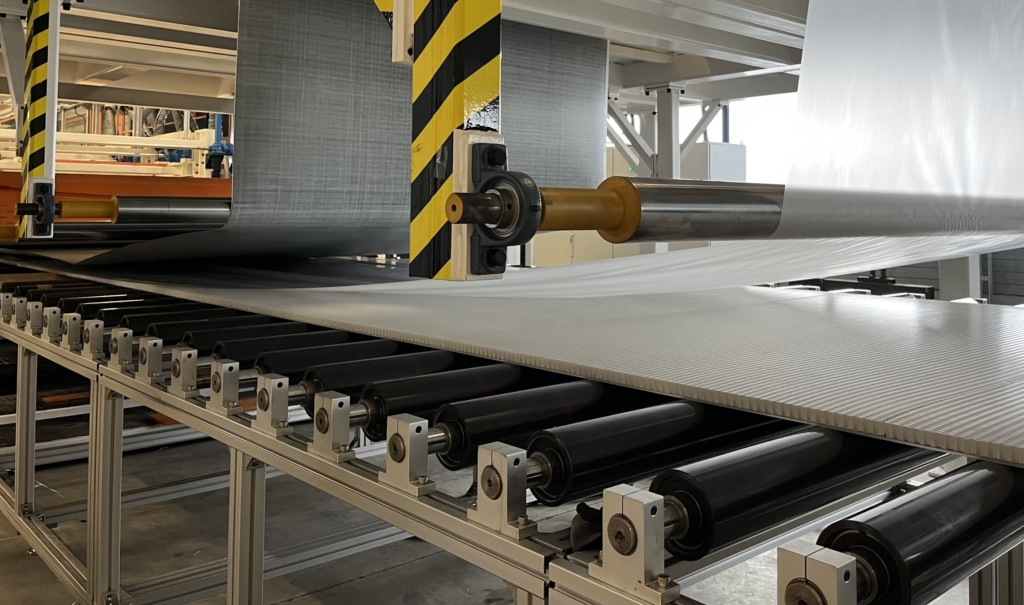
Composite formwork is suitable for a wide range of concrete structures, including walls, floors, columns, foundations and precast concrete products. The panels perform best in applications where reuse, dimensional stability and low maintenance costs matter. The questions below go deeper into specific applications, reuse potential and technical selection criteria.
What advantages do composite panels offer over plywood formwork?
Compared with plywood, composite formwork panels offer a longer service life, greater dimensional stability and lower total cost of ownership. Whereas plywood needs replacing after three to five years due to moisture absorption, delamination and wear, composite panels remain dimensionally stable under changing weather conditions, freeze-thaw cycles and contact with fresh concrete and release agents.
Plywood absorbs moisture, which leads to swelling, shrinking and ultimately structural weakening. Composite panels with a thermoplastic core are completely waterproof and rot-proof. This means they do not need to dry between use cycles and require no repainting or structural repairs. A simple rinse with water is sufficient.
Weight is another relevant difference. Composite sandwich panels are considerably lighter than comparable plywood sheets of the same thickness. This speeds up assembly and dismantling on site, reduces the physical strain on workers and lowers transport costs per shipment because more panels fit on each load.
From a cost perspective, the comparison can be made concrete: over a service life of fifteen years, a composite formwork panel eliminates two to three replacement cycles compared with plywood. Add up the costs of panels, installation labour and downtime, and the composite is cheaper per year of use, even if the purchase price is higher.
Which concrete structures is composite formwork best suited for?
Composite formwork performs best in applications where repeated use, a smooth concrete surface and dimensional stability are required. This makes it particularly suitable for wall formwork, column formwork, foundation slabs and precast concrete production in controlled environments.
For wall formwork, dimensional stability over the full panel length is important. Composite panels deflect less than plywood under concrete pressure, resulting in straight walls with a consistent surface quality. This is relevant for architectural concrete, where the finished surface remains visible.
For column formwork and round shapes, composite panels can be bent to certain radii, depending on the panel construction and thickness. This makes them usable in situations where plywood breaks too easily or offers too little resilience with repeated use in round moulds.
For foundation slabs and floor formwork, weight plays a practical role. Lighter panels are quicker to place and move, which increases labour productivity on projects with large surface areas. Water resistance is especially relevant here, because foundation formwork regularly comes into contact with groundwater and mud.
Can composite formwork be used for precast concrete production?
Yes, composite formwork is well suited to precast concrete production. In a factory setting, formwork moulds are used intensively and repeatedly, which makes direct use of the strengths of composite panels: high dimensional stability, resistance to chemical cleaning agents and a long service life without structural degradation.
In precast production, concrete elements such as walls, floor slabs, stairs and facade elements are cast in moulds. The quality of the end product depends heavily on the accuracy and surface quality of the mould. Composite panels retain their dimensions even after hundreds of use cycles, which supports consistent concrete quality without the mould having to be corrected or replaced in the interim.
Another advantage in precast environments is chemical resistance. Release agents, cleaning products and fresh concrete do not attack thermoplastic composite panels. This extends the life of the mould and lowers maintenance costs in the production environment.
Composite panels can also be produced to size for specific mould geometries. Panels are available in large dimensions, which limits the number of seams in a mould and reduces the risk of concrete leakage. This is a practical advantage when producing large precast elements.
How many times can a composite formwork panel be reused?
The number of reuse cycles of a composite formwork panel depends on the panel composition, the application and the conditions on site, but composite panels consistently and considerably outperform plywood over multiple use cycles. Whereas plywood visibly degrades after a few dozen cycles, composite panels retain their structural and dimensional properties for much longer.
In practice, plywood formwork typically achieves ten to twenty use cycles before the surface is too damaged for quality concrete work. Composite panels are designed for a much longer service life. In controlled environments such as precast factories, where panels are handled and cleaned carefully, the number of cycles can be considerably higher.
The key to a long service life is the water resistance of the composite construction. Plywood degrades primarily through moisture absorption at the edges and surface. Composite panels with a closed thermoplastic skin and sealed edges do not absorb moisture, so the core stays intact. Edge sealing is an important detail here: well-sealed edges protect the core against moisture and mechanical damage during repeated use.
Which technical specifications matter when choosing composite formwork?
When selecting composite formwork panels, flexural strength, stiffness, surface quality, thickness and edge finishing are the most relevant technical parameters. The right combination depends on the specific application, the concrete pressure to which the panel is exposed and the desired concrete surface.
Flexural strength and stiffness determine how the panel behaves under concrete pressure. A panel with too little stiffness deflects and causes dimensional deviations in the concrete surface. The required stiffness depends on the pour height, the pour rate and the support spacing. Flexural strength is tested in accordance with ISO 14125, the relevant European standard for composite panels.
Surface quality is relevant when the concrete surface remains visible or has to meet specific requirements. A PET film surface gives a smooth, consistent concrete finish. An anti-slip surface is less suitable for formwork applications where a smooth concrete skin is required, but can be useful in other construction applications.
Panel thickness and core material together determine the weight and load-bearing capacity. A thicker core increases stiffness without increasing weight proportionally, which is an advantage for large formwork areas. Core density also affects compressive strength, which is relevant for applications with high point loads such as screw fixings or clamps.
Edge finishing is an underestimated but practically relevant detail. Open edges expose the core to moisture and mechanical damage. Well-sealed edges considerably extend the life of the panel, especially in outdoor applications or for panels that are regularly cleaned with pressurised water.
Maximum panel dimensions are relevant for applications with large formwork areas. Larger panels mean fewer seams, which reduces the risk of concrete leakage and speeds up assembly.
How does Compoform help with composite formwork solutions?
We develop and produce thermoplastic sandwich panels for companies looking for alternatives to plywood and other conventional formwork materials. Our panels are produced in the Netherlands and are available in sizes up to 13,500 mm by 2,900 mm, which enables large formwork areas with minimal seams.
What we offer for formwork applications:
- Custom panel configurations tailored to your specific formwork geometry, concrete pressure and reuse objectives
- A choice of core materials (PP honeycomb or PET foam) and skin architectures, depending on the required stiffness and surface quality
- Edge finishing and edge sealing that extend the life of the panel under intensive use and regular cleaning
- Technical support in reviewing your design, optimising the panel configuration for your production process and flagging points of attention before production starts
- Prototypes and samples for technical evaluation before you move to series production
We work as an application partner, not as a supplier that ships panels to specification. This means we review your design, align the panel configuration with your assembly process and work with you to determine which solution best fits your application and usage objectives.
Would you like to know whether composite panels are suitable for your formwork application? Contact us to discuss your project.