

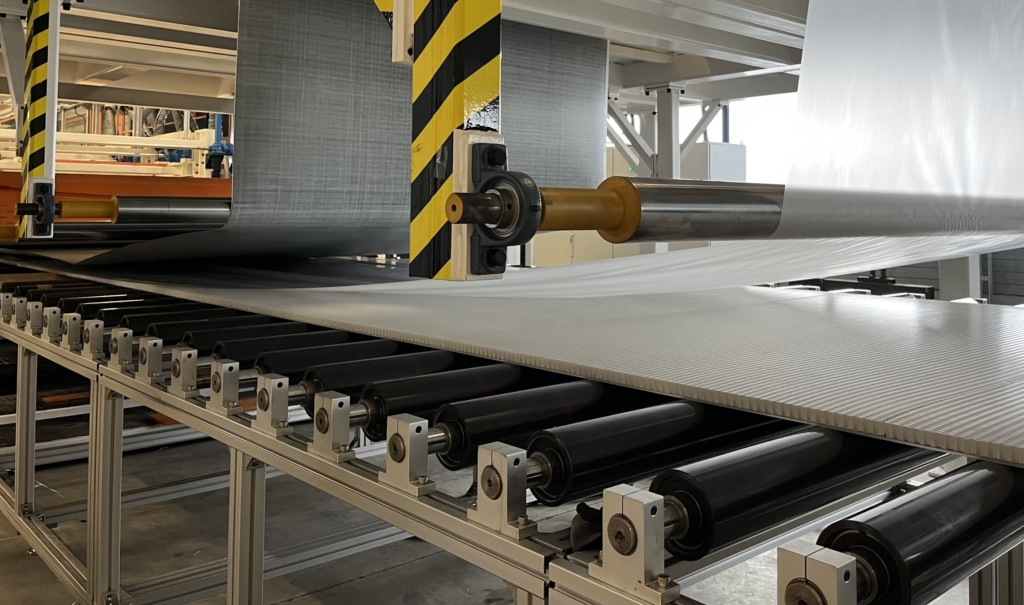
Composite formwork is a system of formwork panels made from fibre-reinforced plastic layers surrounding a lightweight core, instead of traditional timber or plywood. This sandwich construction combines high strength with low weight, which makes the panels reusable many times over and able to withstand the harsh conditions of a construction site. The questions below take a closer look at materials, applications, reuse and the practical benefits of composite formwork panels.
What materials are used in composite formwork?
Composite formwork panels typically consist of a lightweight core of PP foam or PP honeycomb, surrounded by glass-fibre-reinforced thermoplastic skin layers. The skin layers contain a high glass fibre content that gives the panels the required flexural and compressive strength. The result is a sandwich panel that is considerably lighter than plywood, yet at least as strong structurally.
The choice of core material largely determines the mechanical properties of the finished panel. Oriented PP foam is available in various densities and offers a good balance between stiffness and weight. PP honeycomb delivers higher stiffness per kilogram and is particularly well suited to applications with high point loads. Both core types are fully waterproof and do not rot, which is a major advantage in the damp environment of concrete formwork.
The outer skin layers are produced in different build-ups, such as cross-ply laminates or multiple unidirectional layers, depending on the load requirements of the application. Surface finishes range from smooth PET film to anti-slip textures, depending on the functional requirements of the formwork system.
How does composite formwork differ from traditional plywood?
The biggest differences between composite formwork and traditional plywood lie in durability, weight and reusability. Plywood absorbs moisture, swells and quickly loses its flatness and strength after repeated use. Composite formwork panels are completely waterproof, dimensionally stable and retain their properties even after many use cycles.
In practice, this means plywood formwork panels have to be replaced after a limited number of pours, whereas composite panels are designed for long-term reuse. In harsh industrial conditions, thermoplastic sandwich panels demonstrably last three to four times longer than comparable plywood. Over the lifetime of a project or a fleet of formwork material, that eliminates several replacement cycles, including the associated labour and material costs.
The difference in weight is also considerable. Composite panels can be up to 65% lighter than equivalent plywood panels, depending on thickness and configuration. This makes a direct difference when moving panels by hand on site, as well as in transport and storage. Plywood also requires maintenance, such as treating edges and surfaces, whereas composite panels need no painting, drying or structural repair.
Which applications are suitable for composite formwork panels?
Composite formwork panels are suitable for any application where repeated use, easy handling and resistance to moisture and chemicals matter. Specific applications include wall and floor formwork for in-situ concrete, modular formwork systems, precast concrete moulds and production equipment for precast concrete manufacturers.
For manufacturers of modular formwork systems, composite panels offer an attractive advantage: the panels can be produced to size in large dimensions, up to 13,500 mm long and 2,900 mm wide, so they fit almost any system design. Custom thicknesses, edge finishes and surface structures are possible, so the panel integrates seamlessly into an existing formwork system.
Precast concrete producers benefit from the dimensional stability of composite panels. Because the panels do not expand or shrink with changes in moisture, the dimensions of the concrete products remain consistent from pour to pour. This is a direct quality advantage over timber moulds, which deform over time.
How often can composite formwork be reused?
Composite formwork panels are designed for intensive reuse over a long service life. Whereas plywood formwork panels visibly deteriorate after a few dozen pours, composite panels retain their structural properties and surface quality for considerably longer, provided they are used and cleaned correctly.
The exact number of reuse cycles depends on the panel configuration, the formwork pressure applied, the release agents used, and the way the panels are stored and transported. Thermoplastic sandwich panels are fully waterproof and resistant to delamination, chemicals and UV radiation, which eliminates the main causes of premature wear in plywood.
For formwork rental companies and contractors who use panels intensively, the longer service life delivers a direct, measurable cost saving. Suppose a composite panel lasts three to four times longer than plywood: over a period of fifteen years, that means two to three fewer replacement cycles, each with its associated panel, labour and downtime costs. Even with a higher purchase price per panel, the total cost per year of use is lower.
What are the benefits of lightweight formwork panels on site?
Lightweight formwork panels speed up the assembly and dismantling of formwork systems, reduce the physical strain on workers and lower transport costs per shipment. On a busy construction site, where time and safety directly affect project costs, these are tangible operational benefits.
A panel that is up to 65% lighter than plywood can be moved by one person without aids. This not only speeds up the work but also reduces the risk of injury from overexertion. Less weight per panel also means more panels can be carried per truck, which lowers logistics costs per project.
On the construction site itself, the lower weight also benefits the supporting structure of the formwork system. A lighter formwork floor or wall places fewer demands on the underlying support structure, which allows for slimmer or simpler support constructions. This can reduce the total material costs of a formwork setup.
When is composite formwork the right choice for a project?
Composite formwork is the right choice when repeated use, low maintenance costs and consistent material performance outweigh the lower purchase price of plywood. This is particularly the case for projects with a high turnover of formwork material, for precast concrete production and for applications in aggressive environments.
Specific situations in which composite formwork is clearly preferable:
- Formwork rental: Rental companies that use panels intensively and want to minimise replacement costs benefit directly from the longer service life.
- Precast concrete production: Producers who need consistent dimensional accuracy over many pours benefit from dimensionally stable panels that do not deform due to moisture.
- Harsh or chemically loaded environments: At locations where formwork panels are exposed to aggressive release agents, extreme weather conditions or frequent cleaning, composite offers a clear advantage.
- Projects with high labour-cost sensitivity: When the speed of assembly and dismantling directly affects project planning, the lower weight of composite panels delivers a measurable time saving.
Plywood remains a realistic choice for single-use applications or projects with a very limited budget and low reuse requirements. But as soon as the total cost is calculated over multiple use cycles, including replacement, labour and logistics, the balance quickly shifts in favour of composite.
How we help with composite formwork panels
We develop and produce thermoplastic sandwich panels for formwork system manufacturers and precast concrete producers looking for a reliable alternative to plywood and other conventional formwork materials. Our approach is that of an application partner: we review your design, optimise the panel configuration for your production process and flag potential bottlenecks before production starts.
What we can do for you:
- Produce custom-sized panels, up to 13,500 mm × 2,900 mm, matched to your formwork system
- Tailor the core material and skin build-up to your specific load and durability requirements
- Provide edge finishes, surface structures and private labelling for OEM programmes
- Offer technical support in evaluating composite as an alternative to your current panel material
- Supply samples and prototypes so you can assess performance before making a production decision
Would you like to know whether composite formwork panels suit your application? Contact us to discuss your project. Together we will look at the technical requirements, the expected number of use cycles and the most suitable panel configuration for your situation.
Related Articles
- What payload gains are realistic when switching to sandwich panels?
- What is a mono-material sandwich panel and why does it matter for recycling?
- Can sandwich panels be used for both walls and floors in a campervan?
- How are sandwich panels fixed in commercial vehicle floors?
- Why are European manufacturers switching to composite sandwich panels in 2026?