

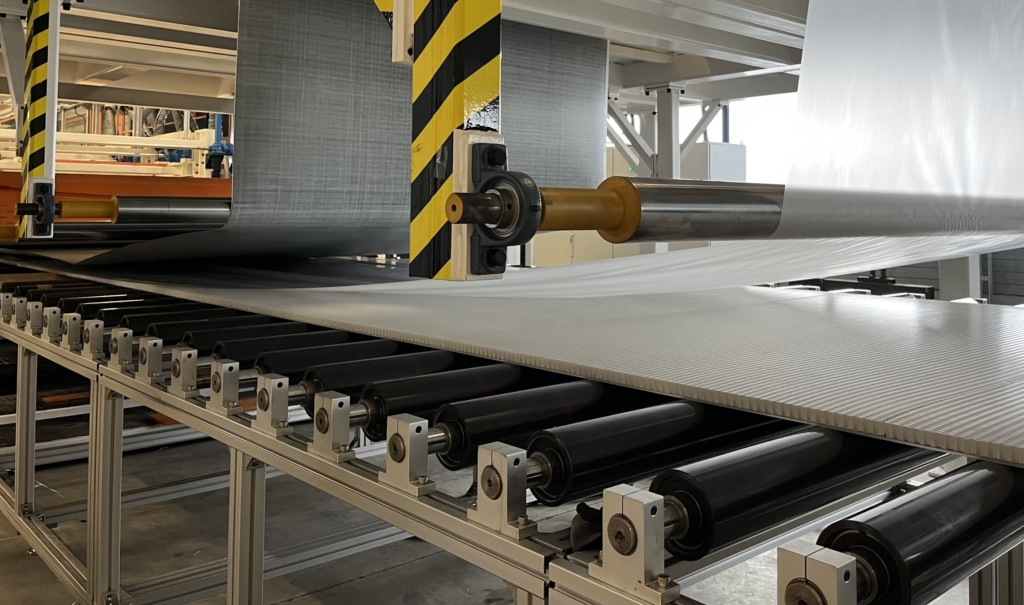
Composite formwork panels are manufactured from a combination of fibre-reinforced thermoplastic skins and a lightweight core, usually made of polypropylene (PP) honeycomb or PET foam. The exact choice of materials determines the panel’s weight, strength, service life and recyclability. The questions below take a closer look at the materials, the performance and the reasons why more and more manufacturers are switching from plywood to composite.
Which core materials determine the strength of composite formwork panels?
The strength of a composite formwork panel is determined by two components: the skins and the core. The skins, usually made of glass fibre-reinforced polypropylene (PP) or glass fibre PET, provide the bending and tensile strength. The core, usually PP honeycomb or PET foam, provides stiffness, compressive strength and the panel’s lightweight character.
In a sandwich panel, skin and core work together as an integrated structure. The skins absorb the bending stresses, while the core keeps the two skins apart and thereby increases the section modulus without increasing weight proportionally. This principle makes it possible to achieve high stiffness with relatively little material.
Fibre orientation in the skins plays a major role here. A 90-0-90 triaxial layup, in which fibres are arranged in multiple directions, ensures a balanced load distribution in both the longitudinal and transverse directions of the panel. This is relevant for formwork applications in which the panel is loaded in multiple directions by concrete pressure.
What is the difference between thermoplastic and thermoset composites in formwork?
Thermoplastic composites, such as glass fibre PP, can be reheated and reshaped after production, are more recyclable and have higher impact strength. Thermoset composites, such as glass fibre epoxy or glass fibre polyester, cannot be reshaped once cured, generally offer higher stiffness at lower weight, but are harder to recycle and less suitable for circular applications.
For formwork panels that are used repeatedly and eventually have to be disposed of, thermoplastic composites offer a clear advantage. They are fully recyclable, which is relevant in the context of the European CSRD regulations and the requirements that more and more contracting authorities place on sustainable material use. Thermosets do deliver excellent mechanical performance, but end-of-life waste processing is more complex and more costly.
From a production perspective, thermoplastic panels are also easier to weld, bend and machine with standard CNC equipment, without the special extraction or protective measures that are sometimes required for thermosets.
How does fibre reinforcement affect the performance of formwork panels?
Fibre reinforcement significantly increases the tensile strength and stiffness of the skins compared to unreinforced thermoplastic. The fibres absorb the mechanical load that the matrix material alone could not carry. The amount of fibre, the fibre type and the orientation together determine the extent to which the panel resists bending, tension and impact.
Glass fibre is the most widely used reinforcement in formwork panels because of its combination of strength, weight and cost. Carbon fibre offers higher stiffness at even lower weight, but is more expensive and is generally used in applications where weight reduction is the decisive factor.
The orientation of the fibres is at least as important as the type. Unidirectional fibres offer maximum strength in one direction, while a multiaxial layup, such as a 90-0-90 layup, distributes the load in multiple directions. For formwork panels that absorb concrete pressure from different angles, a balanced fibre orientation is a deliberate design choice, not an afterthought.
Why do manufacturers choose composite over plywood for formwork?
Manufacturers choose composite formwork panels because they last considerably longer than plywood, require less maintenance and deliver a lower total cost of ownership (TCO) over their service life. Plywood degrades through moisture absorption, splinters after repeated use and has an average service life of three to five years in intensive formwork applications. Composite panels achieve a service life of twelve years or more in comparable conditions.
Over a fifteen-year period of use, that means in practical terms two to three fewer replacement cycles. When you add up the cost of the panels themselves, the labour hours for replacement and the downtime of the construction site, the composite panel is cheaper per year of use, even though the purchase price is higher.
Composite also offers advantages in terms of weight. Lighter panels reduce the physical strain on workers, increase handling speed on site and lower transport costs per shipment. For formwork system manufacturers who want to differentiate their product on quality and service life, composite is a logical material choice.
Which material properties are most critical for reusable formwork panels?
For reusable formwork panels, the most critical material properties are: compressive strength, impact strength, moisture resistance, dimensional stability and surface quality. Together, these properties determine how many use cycles a panel can handle without loss of performance or dimensional accuracy.
- Compressive strength: the panel must withstand the hydrostatic pressure of fresh concrete without deforming. The core contributes strongly to this.
- Impact strength: on construction sites, panels are regularly knocked, dropped or mechanically loaded. High impact strength prevents damage during normal use.
- Moisture resistance: unlike plywood, thermoplastic composites do not absorb moisture. This prevents swelling, delamination and weight gain after repeated contact with concrete and water.
- Dimensional stability: the panel must retain its original dimensions after every use cycle, so that the concrete surface remains consistent in quality.
- Surface quality: a smooth, closed skin ensures a good concrete finish and easy cleaning between cycles.
Edge finishing also deserves attention. Well-sealed edges protect the core against moisture ingress and mechanical damage, which directly affects the panel’s service life. In practice, this is a detail that makes the difference between a panel that lasts ten years and one that needs replacing after two seasons.
Can composite formwork panels be custom-made for specific applications?
Composite formwork panels can be fully custom-made for specific applications. Dimensions, thickness, skin build-up, fibre orientation, core material and surface finish can all be adapted to the requirements of the application. This makes composite particularly suitable for manufacturers developing a formwork system with specific load requirements, weight targets or dimensions.
Customisation starts with the technical specifications of the application: what loads must the panel absorb, how often will it be reused, what dimensions are needed and what surface quality is required? Based on that input, the panel build-up can be optimised, from the choice of core material to the fibre orientation in the skins.
Panels are available in custom dimensions, cut to size or milled with CNC equipment. Operations such as milling connection grooves, fitting edge profiles or integrating fixing points are possible without compromising the structural integrity of the panel.
How do we help with composite formwork panels?
We develop and produce thermoplastic sandwich panels for formwork system manufacturers and precast concrete producers who are looking for an alternative to plywood and other conventional formwork materials. Our approach is that of an application partner: we review your design, optimise the panel build-up for your production process and flag potential bottlenecks before production starts.
What we offer in practice:
- Custom panel build-up tailored to the specific load requirements and dimensions of your formwork system
- Technical support in evaluating composite as an alternative to plywood, including a comparison of TCO over the service life
- Prototypes and test panels for validation before you move to series production
- Production in the Netherlands with ISO-certified quality control on every production batch
- Flexible dimensions up to 13,500 mm × 2,950 mm, machined to size for direct integration into your system
Would you like to know whether composite formwork panels are suitable for your application? Get in touch for a technical conversation. Together we will look at your specifications and give honest advice on what composite can mean for your project, with no obligation.