

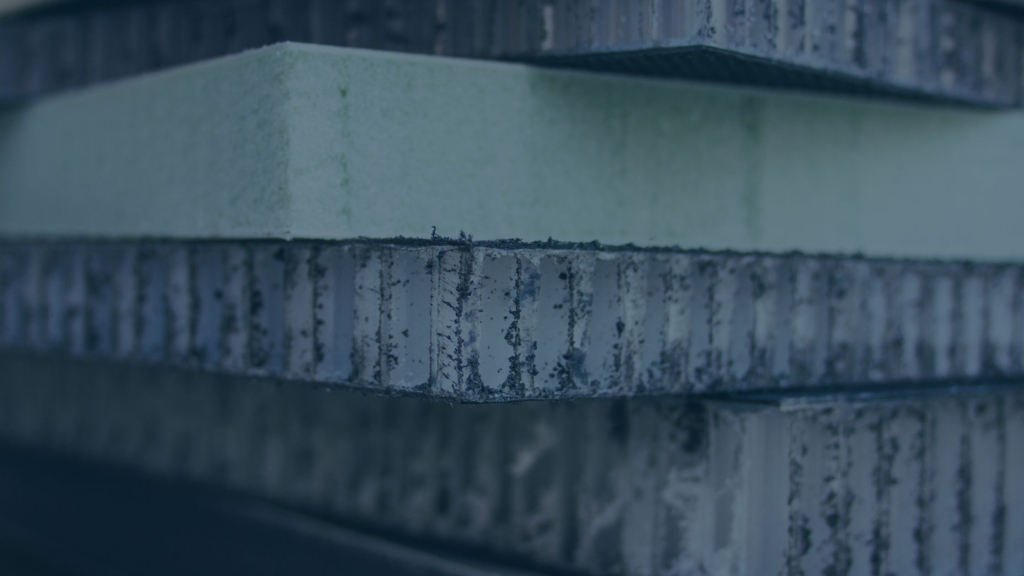
A sandwich panel works by bonding two thin, stiff outer skins to a lightweight core material in between. The skins carry tensile and compressive loads, while the core keeps them separated and transfers shear forces between them. Together, the three layers behave like a structural beam, delivering high stiffness and strength at a fraction of the weight of solid metal or wood.
This structural logic is what makes sandwich panels so effective in demanding applications like truck bodies, trailer walls, and scaffolding boards, where every kilogram of dead weight has a direct cost. The sections below answer the most common technical questions about how sandwich panels are built and why they perform the way they do.
What are the layers inside a sandwich panel?
A sandwich panel has three layers: two outer skins and a core bonded between them. The skins are thin, dense, and mechanically strong. The core is thick, lightweight, and relatively low in density. The bond between skin and core is what makes the panel behave as a single structural unit rather than three separate materials.
Each layer has a specific role:
- Top and bottom skins resist tension and compression. When a panel bends under load, one skin is pulled in tension and the other is compressed. The skins carry these forces because they are positioned at the outer surfaces, where bending stresses are highest.
- The core keeps the skins separated and transfers shear forces between them. The greater the distance between the skins, the higher the panel’s resistance to bending, which is why a thicker core dramatically increases stiffness without adding proportional weight.
- The bond layer between skin and core is not always visible, but it is structurally important. If the bond fails, the panel loses its composite action and the skins and core behave independently, which collapses the structural performance.
In thermoplastic sandwich panels, the skins and core are typically fused together through heat and pressure rather than adhesive bonding, which produces a more durable and chemically consistent joint.
How does a sandwich panel achieve structural strength?
A sandwich panel achieves structural strength through the separation of its two stiff skins by a lightweight core. This geometry mimics the cross-section of an I-beam: material is concentrated where bending stresses are highest (the outer faces), and the middle section is kept as light as possible while still transferring shear. The result is a structure with a very high stiffness-to-weight ratio.
The underlying mechanics follow beam theory. When a load is applied across a panel, it creates a bending moment. The top skin goes into compression and the bottom skin goes into tension. The core resists the shear forces that develop between the two skins and prevents them from sliding relative to each other. As long as the core maintains this shear connection, the panel behaves as one integrated structure.
Increasing core thickness has a disproportionate effect on stiffness. Doubling the core thickness roughly quadruples the panel’s resistance to bending deflection, while adding relatively little to the total weight. This is why sandwich panels can be engineered to meet specific load requirements by adjusting core thickness and density rather than adding more skin material.
Skin architecture also plays a role. In glass-fibre reinforced thermoplastic skins, fibres can be oriented in a cross-ply arrangement, alternating layers at 0° and 90°, which distributes mechanical properties evenly in both directions. This makes the panel perform consistently regardless of which direction the load is applied, which matters for wall panels that may be installed in either orientation.
What materials are used for sandwich panel skins and cores?
Sandwich panel skins are typically made from fibre-reinforced polymer composites, metals, or engineered polymer films. Cores are made from low-density materials that provide shear resistance without adding significant weight, common options include polymer foams and honeycomb structures. The specific combination determines the panel’s weight, stiffness, surface quality, and suitability for a given application.
Skin materials
Glass-fibre reinforced thermoplastic (GFRTP) skins are widely used in commercial vehicle and scaffolding applications. They combine high tensile strength with low weight and can be produced with surface finishes, such as white PET film for interior wall panels or black anti-skid textures for floor panels, integrated directly into the laminate. Skin architecture varies: a cross-ply laminate balances properties in both directions, while unidirectional plies can be stacked to maximise strength along a specific load axis.
Carbon-fibre skins offer higher stiffness per unit weight but at greater cost, making them more relevant for specialist applications. Steel and aluminium skins are used where surface hardness or electrical conductivity matters, though they add weight and are not recyclable in the same way as thermoplastic composites.
Core materials
Polymer foam cores, such as oriented polypropylene (PP) foam, are available in a range of densities, typically from 40 to 140 kg/m³. Lower-density foams reduce weight; higher-density foams improve compressive strength and shear stiffness. The ability to select core density independently of skin specification gives designers significant flexibility in tuning panel performance.
PP honeycomb cores use a tubular cell structure to achieve very high compressive strength relative to their weight. The geometry of the honeycomb distributes point loads across a larger area, which is why honeycomb-core panels are preferred for flooring applications where concentrated loads from pallets or equipment are common.
Why are sandwich panels lighter than solid metal or wood?
Sandwich panels are lighter than solid metal or wood because most of the panel’s volume is occupied by a low-density core rather than solid material. The structural work is done by the thin skins at the outer surfaces, where it is mechanically most effective. Filling the interior with dense material adds weight without adding proportional stiffness, sandwich construction avoids that inefficiency entirely.
To put this in practical terms: a solid steel plate thick enough to match the bending stiffness of a 30 mm sandwich panel would be many times heavier. The sandwich panel achieves the same resistance to deflection by placing its load-bearing material at the outer faces and using a lightweight core to maintain the separation between them.
For truck body builders and trailer manufacturers, this weight difference translates directly into payload capacity. Every kilogram saved in the body structure is a kilogram that can carry revenue-generating cargo. In 2026, this argument extends beyond payload to battery range: lighter body structures extend the range of electric trucks and vans on a single charge. Fleet operators procuring electric vehicles now treat structural weight as a range variable, not just a payload variable, and that makes the weight advantage of sandwich panels a procurement consideration at the fleet level, not just the engineering level.
Compared to plywood, thermoplastic sandwich panels also resist moisture absorption, which means they do not gain weight in service the way timber-based panels do. A plywood floor that has absorbed moisture over several years of use can be significantly heavier than its nominal specification, a problem that does not affect thermoplastic composite panels.
Where are sandwich panels used in industry?
Sandwich panels are used wherever structures need to be stiff, strong, and light at the same time. The most active sandwich panel application areas in Europe in 2026 are commercial vehicle bodies, trailers, and scaffolding, sectors where weight, durability, and dimensional consistency directly affect operating economics.
In truck body and trailer construction, sandwich panels replace plywood or steel in floors, walls, and roofs. A composite floor panel in a refrigerated trailer or dry freight body reduces tare weight, which increases legal payload capacity. In electric truck applications, the same weight reduction extends battery range per charge, a factor that fleet operators now specify directly when sourcing body components.
In scaffolding, composite panels replace timber planks. A well-engineered thermoplastic sandwich panel can achieve EN 12811 load class 4 performance, the standard for heavy-duty scaffold platforms, at a fraction of the weight of timber, and without the moisture absorption, rot, or splintering that limits timber’s service life on construction sites.
Beyond these primary markets, sandwich panels appear in:
- Caravan and motorhome walls and roofs, where weight limits are strict and thermal insulation matters
- Cargo boxes and refrigerated van bodies
- Façade cladding panels, where weather resistance and dimensional stability are priorities
- Horse vans and specialist vehicle bodywork
The common thread across all these applications is the same structural logic: a lightweight panel that performs like a much heavier solid material, and that holds its properties over years of service in demanding conditions.
How Compoform Helps You Specify the Right Sandwich Panel
We manufacture thermoplastic sandwich panels using PP honeycomb and PP foam cores, with glass-fibre reinforced thermoplastic skins in cross-ply and multi-ply configurations. Every panel we produce is 100% European-made at our facilities in the Netherlands, with a production line capable of panels up to 13,500 mm × 2,950 mm, dimensions that are not available off the shelf from most European suppliers.
Here is what working with us looks like in practice:
- Panel configuration review: We review your load requirements, installation method, and assembly process before recommending a core type and density, skin architecture, and thickness. A 30 mm PP foam-core wall panel and a 30 mm PP honeycomb floor panel are very different products, we help you select the right one for your application.
- Custom dimensions: Panels are available cut to your exact specification, eliminating on-site cutting steps and reducing material waste in your production line.
- Surface finish selection: White PET film surfaces for interior wall panels, black anti-skid finishes for floors and scaffold boards, surface properties are specified as part of the panel, not added afterwards.
- Lifespan and TCO argument: Thermoplastic composite panels last significantly longer than plywood in heavy transport applications. Over a 15-year vehicle life, eliminating two or three plywood replacement cycles, including panel cost, installation labour, and vehicle downtime, makes the composite the lower-cost option per year of service, even at a higher unit price.
- Ongoing support: We stay involved after the first delivery. If your assembly process changes, if you encounter a fit issue, or if you want to optimise the panel specification for a new vehicle variant, we work through that with you.
If you are building truck bodies, trailers, or scaffolding systems and want to understand which panel configuration fits your specific load and assembly requirements, speak with our engineering team, we will review your design and give you a concrete recommendation before you commit to a specification.